Stock Analysis · Highwoods Properties Inc (HIW)
Overview
Highwoods Properties is a real estate investment trust, or REIT, focused mainly on owning, developing, leasing, and managing office buildings. Its portfolio is concentrated in business districts and mixed-use areas across fast-growing Sun Belt markets such as Atlanta, Charlotte, Dallas, Nashville, Orlando, Raleigh, Richmond, and Tampa. In simple terms, the company makes money by owning office properties and collecting rent from tenants, while also developing new buildings and occasionally selling assets.
The business is still primarily a traditional office landlord, but with a specific focus on newer, better-located properties in markets that have had stronger population and job growth than many older U.S. office regions. That matters because office real estate has become a market where quality and location increasingly separate stronger portfolios from weaker ones.
Based on recent company reporting, Highwoods’ revenue mix is dominated by rental and related property income, with smaller contributions from other real estate activities.
- Rental and other property revenue: approximately 95% to 98% of total revenue. This includes base office rent, reimbursements from tenants for operating costs, parking, and other property-related income.
- Fee and other income: approximately 1% to 3%. This can include management or other ancillary real estate income when applicable.
- Gains and other non-recurring items: usually a small and less predictable share, depending on asset sales or special transactions.
The broader earnings profile shows a business with fairly stable revenue over the last several years, but with pressure from interest expense and softer profitability compared with earlier periods. Operating income recovered in 2025 after a weaker 2024, while revenue remained in a relatively narrow band. That suggests the main debate around Highwoods is not whether it can generate rent, but how well it can protect occupancy, margins, and balance-sheet flexibility in a difficult office market.
Key Figures
| Metric | Value | Sector ⓘ |
|---|---|---|
| Date | Oct 17, 2026 | |
| Context | ||
| Sector | Real Estate | |
| Industry | REIT - Office | |
| Market Cap ⓘ | $3.28B | |
| Beta ⓘ | 1.08 | |
Value (Cheapness) | ||
| P/E Ratio ⓘ | 20.14 | 17.38 |
| P/B Ratio ⓘ | 1.37 | 0.85 |
| FCF Yield ⓘ | 11.43% | 7.38% |
| Dividend Yield ⓘ | 7.02% | 4.85% |
| EBIT / EV ⓘ | 3.74% | 3.78% |
| PEG ⓘ | 7.77 | |
Growth (Business expansion) | ||
| Revenue Growth ⓘ | 7.50% | 5.30% |
| RPS Growth (5Y CAGR) ⓘ | 0.41% | 6.02% |
| EPS Growth (5Y CAGR) ⓘ | -7.15% | -11.37% |
| BVPS Growth (5Y CAGR) ⓘ | -3.19% | 0.45% |
| Margin Growth (5Y Trend) ⓘ | -14.19% | -0.22% |
| FCF Growth (5Y CAGR) ⓘ | -20.38% | 5.40% |
| DPS Growth (5Y CAGR) ⓘ | 0.65% | 5.02% |
Quality (Business durability) | ||
| ROIC (Latest) ⓘ | N/A | 5.69% |
| ROE (Latest) ⓘ | 7.12% | 7.56% |
| ROA (Latest) ⓘ | 2.67% | 2.85% |
| ROIC (5Y Median) ⓘ | 3.49% | 4.22% |
| ROE (5Y Median) ⓘ | 6.17% | 6.03% |
| ROA (5Y Median) ⓘ | 2.59% | 2.44% |
| Net Debt / EBIT (Latest) ⓘ | 13.27 | 7.59 |
| Net Debt / EBIT (5Y Median) ⓘ | 11.46 | 8.40 |
| Net Debt / EBITDA (Latest) ⓘ | 6.03 | 5.27 |
| Net Debt / Assets ⓘ | 52.08% | 37.76% |
| EBITDA / Interest ⓘ | 3.46 | 4.10 |
| Operating Margin (Latest) ⓘ | 30.39% | 35.29% |
| Operating Margin (5Y Median) ⓘ | 34.54% | 37.31% |
| Debt to Equity (Latest) ⓘ | 147.01% | 88.87% |
| Profit Margin (Latest) ⓘ | 20.11% | 19.61% |
| Free Cash Flow (Latest) ⓘ | $374.97M | |
Momentum (Price trend) | ||
| 3Y Return ⓘ | +83.85% | +30.75% |
| 12M Return (excl. last month) ⓘ | +2.94% | +4.36% |
| 6M Return ⓘ | +30.61% | -2.52% |
| Price vs. 200-Day MA ⓘ | +9.52% | -2.34% |
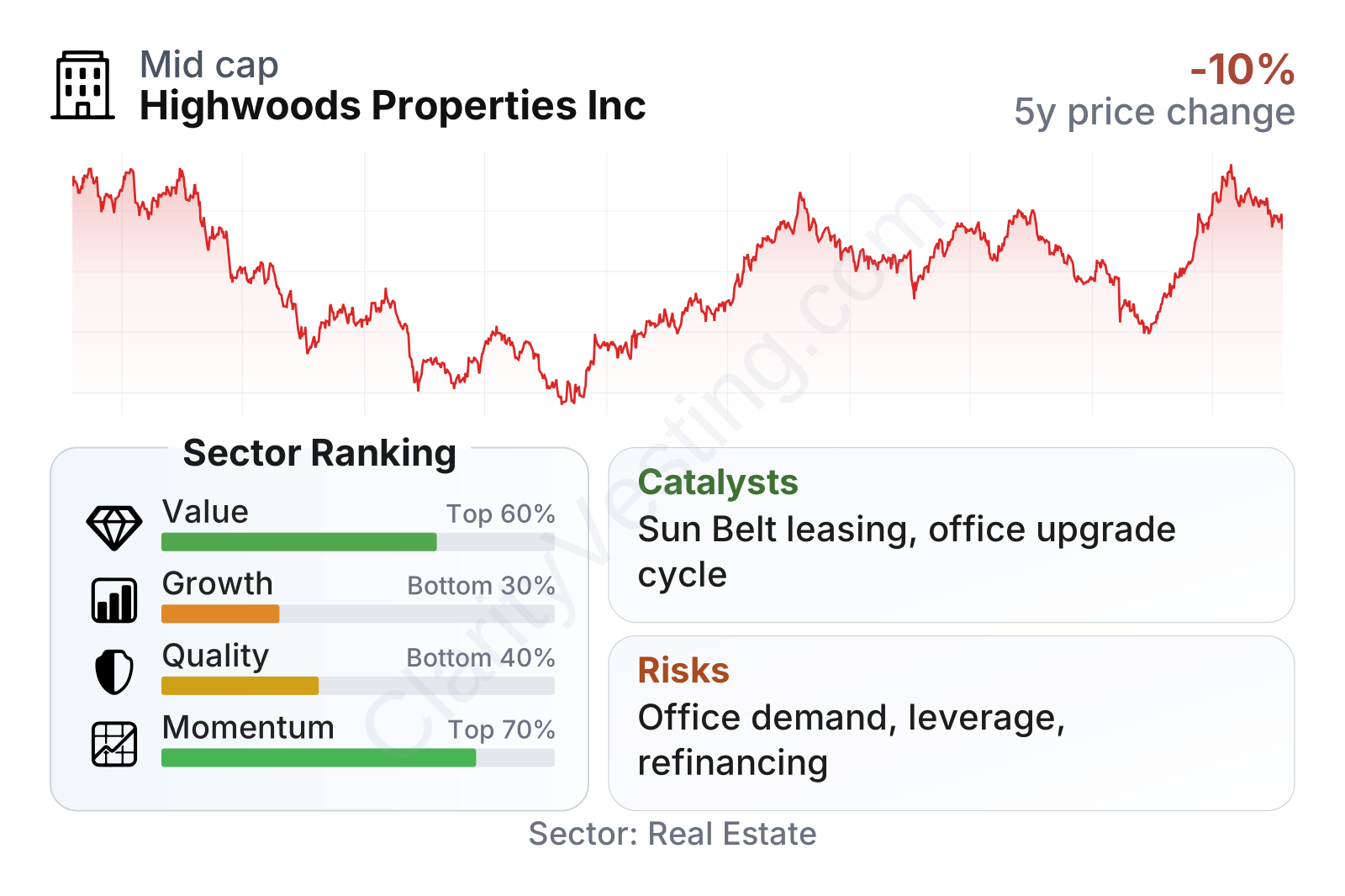
Highwoods is a mid-sized office REIT with a stock that has been volatile over the last several years, reflecting changing views on office demand, interest rates, and property values. On the factor table, valuation looks mixed rather than clearly cheap: the dividend yield and free cash flow yield stand out positively, but the price-to-book ratio is above the sector median and the earnings multiple is only slightly above it. Growth is the weakest area, with long-term revenue per share, book value per share, and free cash flow trends trailing much of the real estate sector. Quality is also somewhat restrained by leverage that runs above sector norms, although profitability itself is not dramatically out of line. Momentum has improved, helped by a strong rebound in the share price over the last six months and over the three-year period from the depressed levels reached earlier in the cycle.
Growth
Highwoods operates in one of the most challenged parts of commercial real estate: office. That means the sector itself is not broadly attractive in the way data centers, industrial warehouses, or cell towers have been. However, Highwoods is positioned in a more resilient niche within office real estate. Its strategy centers on higher-quality properties in Sun Belt cities that continue to benefit from population growth, corporate relocations, and business investment. That does not remove the office sector’s structural challenges, but it does give the company a clearer path than landlords tied to slower-growth downtown markets.
A key part of the company’s strategy is portfolio upgrading. Management has been emphasizing what it calls better business district properties, selective development, and recycling capital out of older assets. For a long-term view, that approach is logical: if office demand remains uneven, tenants are more likely to favor modern buildings with stronger amenities and locations, while older commodity office space can struggle for years.
The revenue-per-share trend shows why this remains a measured, not explosive, growth case. Revenue per share rose in 2022, then gradually eased over the following years. Over a five-year view, the growth rate is close to flat. In other words, Highwoods has shown resilience, but not the kind of compounding top-line expansion that usually drives premium valuations.
The dividend record is steadier than the growth record. Dividend per share has stayed close to the same level for several years, with only very modest cumulative growth. That stability can be useful in understanding the company’s financial posture: it suggests the business has retained enough recurring cash generation to support shareholder distributions, but it has not yet translated into a rising payout pattern that would signal broad-based operating momentum.
One of the most relevant potential catalysts is a more stable office leasing environment. If return-to-office patterns continue to normalize and companies keep favoring high-quality buildings in Sun Belt markets, Highwoods could benefit through better occupancy, improved pricing on renewals, and stronger development economics. Another possible tailwind is interest rates: if financing conditions become less restrictive over time, property values and REIT valuations could receive support, especially for companies whose shares have been sensitive to debt costs and real estate cap rates.
Recent company updates have also highlighted leasing activity, development deliveries, and asset recycling as important markers to watch. For Highwoods, significant opportunity does not depend on entering a new industry; it depends on proving that premium office properties in the right cities can still produce steady cash flows and selective growth despite a weaker overall office backdrop.
Risks
This article is for informational purposes only and does not constitute financial advice. Some content is AI-generated. See Disclaimer


