Stock Analysis · Huntington Ingalls Industries Inc (HII)
Overview
Huntington Ingalls Industries is one of the most important military shipbuilders in the United States. The company designs, builds, overhauls, and maintains nuclear-powered aircraft carriers and submarines, amphibious assault ships, destroyers, and other naval vessels. It also provides fleet support, mission technologies, logistics, intelligence, and unmanned systems work for U.S. government customers. In practical terms, HII is deeply tied to U.S. national security spending, with the U.S. Navy as its most important customer.
Its business is organized into three main segments, and the latest annual mix shows a company still dominated by naval shipbuilding.
- Ingalls Shipbuilding: about 33% of 2025 revenue. This unit builds amphibious assault ships, destroyers, Coast Guard cutters, and provides related services.
- Newport News Shipbuilding: about 32% of 2025 revenue. This is the only U.S. shipyard that builds nuclear-powered aircraft carriers and one of the very few that build nuclear submarines. It also performs aircraft carrier refueling and overhaul work.
- Mission Technologies: about 35% of 2025 revenue. This segment includes C5ISR, cyber, AI and data work, training, live and virtual simulation, unmanned systems, and other defense support services.
That mix matters because it shows HII is no longer just a traditional shipbuilder. Mission Technologies has become a meaningful second engine, while the two shipbuilding divisions still anchor the company with long-duration, hard-to-replicate programs.
Revenue has risen from roughly $9.5 billion in 2021 to about $12.5 billion in 2025, but profitability has been less smooth. Gross profit and operating income improved through 2023, weakened in 2024, and then partly recovered in 2025. This pattern suggests that HII’s main challenge is not demand, but execution and margin control on large, complex programs.
Key Figures
| Metric | Value | Sector ⓘ |
|---|---|---|
| Date | Oct 17, 2026 | |
| Context | ||
| Sector | Industrials | |
| Industry | Aerospace & Defense | |
| Market Cap ⓘ | $10.16B | |
| Beta ⓘ | 0.21 | |
Value (Cheapness) | ||
| P/E Ratio ⓘ | 15.37 | 22.10 |
| P/B Ratio ⓘ | 1.97 | 1.97 |
| FCF Yield ⓘ | -0.39% | 6.38% |
| Dividend Yield ⓘ | 2.08% | 1.94% |
| EBIT / EV ⓘ | 6.95% | 4.79% |
| PEG ⓘ | 0.83 | |
Growth (Business expansion) | ||
| Revenue Growth ⓘ | 10.90% | 9.30% |
| RPS Growth (5Y CAGR) ⓘ | 7.67% | 7.81% |
| EPS Growth (5Y CAGR) ⓘ | -11.71% | -13.06% |
| BVPS Growth (5Y CAGR) ⓘ | 16.67% | 6.14% |
| Margin Growth (5Y Trend) ⓘ | -0.40% | 0.88% |
| FCF Growth (5Y CAGR) ⓘ | 16.64% | 11.01% |
| DPS Growth (5Y CAGR) ⓘ | 4.10% | 9.48% |
Quality (Business durability) | ||
| ROIC (Latest) ⓘ | 9.42% | 10.84% |
| ROA (Latest) ⓘ | 5.29% | 5.41% |
| ROIC (5Y Median) ⓘ | 10.58% | 9.38% |
| ROA (5Y Median) ⓘ | 5.39% | 4.95% |
| Net Debt / EBIT (Latest) ⓘ | 3.10 | 2.08 |
| Net Debt / EBIT (5Y Median) ⓘ | 3.27 | 2.27 |
| Net Debt / EBITDA (Latest) ⓘ | 2.62 | 1.39 |
| Net Debt / Assets ⓘ | 23.05% | 19.28% |
| EBITDA / Interest ⓘ | 11.37 | 9.58 |
| Operating Margin (Latest) ⓘ | 7.14% | 10.50% |
| Operating Margin (5Y Median) ⓘ | 7.47% | 10.29% |
| Debt to Equity (Latest) ⓘ | 55.25% | 65.48% |
| Profit Margin (Latest) ⓘ | 5.01% | 6.67% |
| Free Cash Flow (Latest) ⓘ | -$40.00M | |
Momentum (Price trend) | ||
| 3Y Return ⓘ | +25.16% | +61.68% |
| 12M Return (excl. last month) ⓘ | +3.62% | +12.58% |
| 6M Return ⓘ | -32.95% | 0.00% |
| Price vs. 200-Day MA ⓘ | -21.86% | +0.02% |
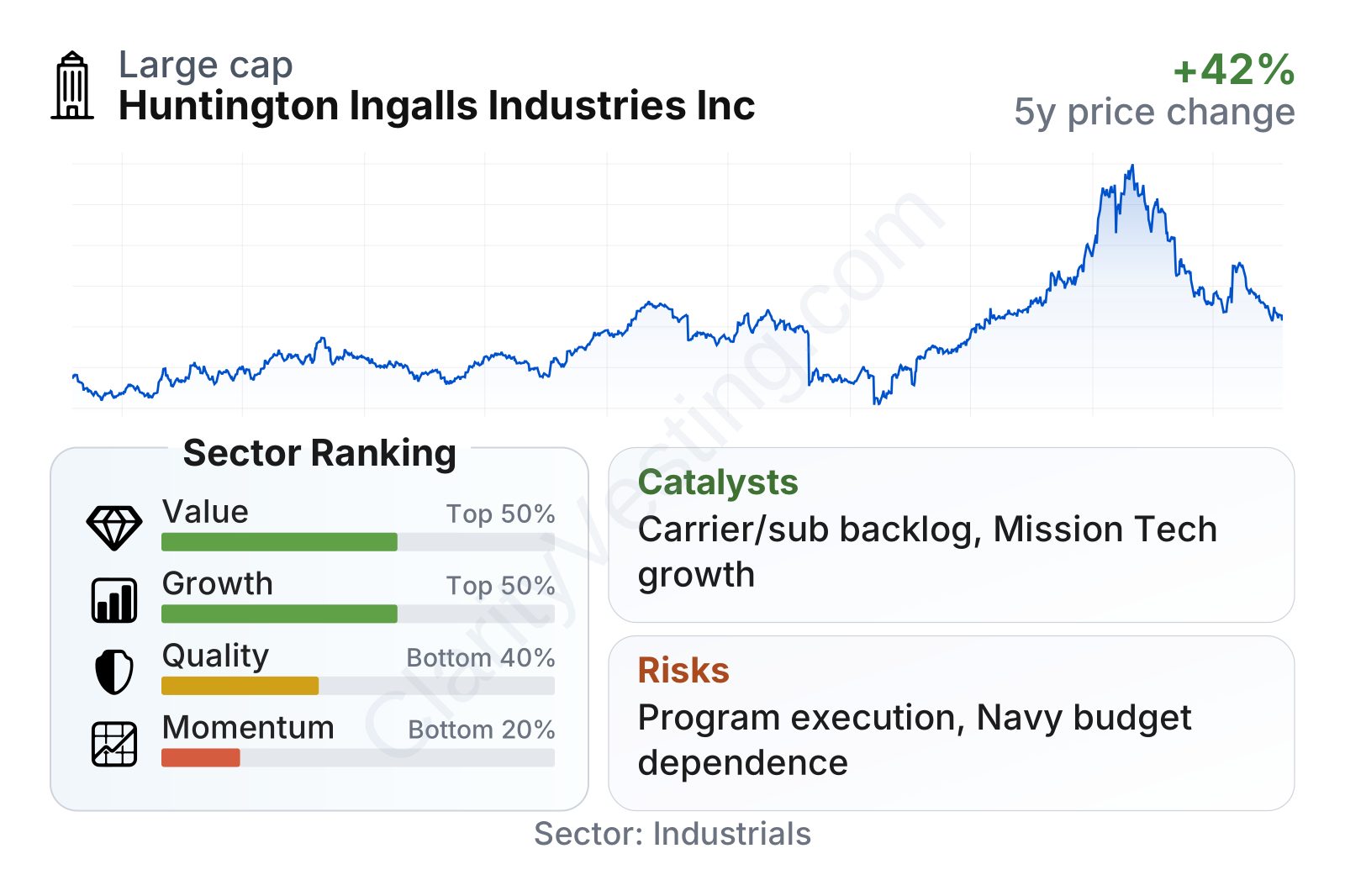
HII is a large defense contractor with a relatively low stock volatility profile, shown by a beta well below 1. On valuation, the shares trade at a price-to-earnings ratio below the sector median, while price-to-book is also slightly below the sector norm. Growth indicators are mixed but generally respectable: recent revenue growth is ahead of the sector median, and free cash flow has expanded well over a five-year period, even if earnings growth has been uneven. The weaker area is business quality, where margins and returns on capital trail much of the sector, mainly because shipbuilding is capital-intensive and contract execution can create profit swings.
Growth
HII operates in a sector with durable long-term demand drivers. The United States continues to prioritize naval readiness, submarine production, aircraft carrier support, missile defense integration, cyber capabilities, and unmanned systems. These are not short-cycle markets. They are usually backed by multi-year budgets, long procurement timelines, and strategic national priorities. That creates a more visible demand base than many industrial markets.
For HII specifically, the strategic logic is clear. The company is protecting its core position in naval shipbuilding while expanding into higher-technology defense services through Mission Technologies. That is sensible because shipbuilding provides long-term backlog and barriers to entry, while technology and support work can diversify revenue and potentially improve resilience across defense spending cycles.
Recent sales momentum has improved again after a softer period in 2024. Year-over-year revenue growth moved back into a solid double-digit range by the latest period. Over the last several years, growth has not been perfectly linear, but the broader direction has been upward, helped by shipbuilding program activity and continued expansion in defense technology services.
Cash generation has been much more volatile than revenue, which is common in large defense manufacturing programs. Even so, the latest trailing free cash flow shows a strong rebound from the low point seen in 2025. That improvement matters because cash flow is what ultimately supports debt reduction, dividends, and internal investment. For a company like HII, a recovery in cash conversion is one of the clearest signs that operations are stabilizing.
There are also real catalysts supporting future activity. HII remains central to the U.S. aircraft carrier industrial base and is one of the few builders involved in nuclear submarine work. The AUKUS framework, broader submarine capacity concerns, and continued emphasis on Indo-Pacific deterrence all reinforce the importance of this industrial niche. On top of that, Mission Technologies has been pushing into autonomous systems, artificial intelligence-enabled defense applications, and military training modernization, all areas that fit current Pentagon priorities.
Recent company updates have also pointed to contract wins and partnerships in unmanned maritime systems, fleet sustainment, and technology services. These do not change the company overnight, but they support the view that HII is positioning itself beyond pure hull construction and toward a broader defense solutions profile.
Risks
This article is for informational purposes only and does not constitute financial advice. Some content is AI-generated. See Disclaimer


