Stock Analysis · Hamilton Insurance Group Ltd (HG)
Overview
Hamilton Insurance Group Ltd is a Bermuda-based specialty insurance and reinsurance company. In simple terms, it helps other businesses, insurers, and institutions protect themselves against large or complex risks. Its activities are organized across underwriting operations and investment income from the capital it holds against future claims.
The company writes business through two main underwriting platforms: insurance and reinsurance. Insurance generally covers commercial clients directly or through brokers in specialty lines, while reinsurance insures other insurance companies. Hamilton also earns investment income by investing the float created from premiums collected before claims are paid.
Based on recent annual reporting, Hamilton’s revenue mix is driven primarily by net premiums earned, with a smaller but meaningful contribution from investment income and a more variable contribution from realized and unrealized gains or other underwriting-related items. A practical way to think about the business is:
- Net premiums earned: roughly 70% to 85% of total revenue in recent years. This is the core business and reflects premiums recognized over the policy period.
- Net investment income: roughly 8% to 15%. This comes from bonds, short-term investments, and other assets held on the balance sheet.
- Other items, including gains and fee-related or mark-to-market effects: typically 5% to 15%, but this can move sharply from year to year.
Within underwriting, Hamilton has emphasized specialty and property-focused areas where pricing can be attractive after periods of industry losses. The business has become meaningfully larger and more profitable since 2023, with revenue, operating income, and net income all improving strongly through 2025. That matters in insurance because scale can improve diversification, broker relationships, and expense efficiency.
The business mix has become more favorable over the last few years. Revenue expanded strongly after a weak 2022, while operating income and net income recovered sharply and then moved well above prior peaks. That pattern suggests the recent period has combined better pricing, profitable underwriting, and stronger investment income.
Key Figures
| Metric | Value | Sector ⓘ |
|---|---|---|
| Date | Oct 24, 2026 | |
| Context | ||
| Sector | Financial Services | |
| Industry | Insurance - Reinsurance | |
| Market Cap ⓘ | $3.60B | |
| Beta ⓘ | 0.47 | |
Value (Cheapness) | ||
| P/E Ratio ⓘ | 6.38 | 12.46 |
| P/B Ratio ⓘ | 1.36 | 1.25 |
| FCF Yield ⓘ | 22.64% | 9.82% |
| Dividend Yield ⓘ | N/A | 2.94% |
| EBIT / EV ⓘ | 31.69% | 8.11% |
| PEG ⓘ | N/A | |
Growth (Business expansion) | ||
| Revenue Growth ⓘ | 13.00% | 9.10% |
| RPS Growth (5Y CAGR) ⓘ | 20.02% | 12.31% |
| EPS Growth (5Y CAGR) ⓘ | 29.87% | -6.97% |
| BVPS Growth (5Y CAGR) ⓘ | 12.39% | 5.02% |
| Margin Growth (5Y Trend) ⓘ | 10.07% | -4.00% |
| FCF Growth (5Y CAGR) ⓘ | 38.86% | 4.71% |
| DPS Growth (5Y CAGR) ⓘ | N/A | 8.92% |
Quality (Business durability) | ||
| ROIC (Latest) ⓘ | 30.29% | 9.18% |
| ROE (Latest) ⓘ | 21.86% | 13.93% |
| ROA (Latest) ⓘ | 6.01% | 1.57% |
| ROIC (5Y Median) ⓘ | 27.18% | 7.80% |
| ROE (5Y Median) ⓘ | 16.12% | 12.15% |
| ROA (5Y Median) ⓘ | 4.84% | 1.28% |
| Net Debt / EBIT (Latest) ⓘ | -0.66 | 1.02 |
| Net Debt / EBIT (5Y Median) ⓘ | -1.82 | 0.72 |
| Net Debt / EBITDA (Latest) ⓘ | -0.64 | 0.88 |
| Operating Margin (Latest) ⓘ | 28.95% | 22.30% |
| Operating Margin (5Y Median) ⓘ | 20.74% | 24.50% |
| Debt to Equity (Latest) ⓘ | 5.25% | 59.34% |
| Profit Margin (Latest) ⓘ | 19.58% | 26.42% |
| Free Cash Flow (Latest) ⓘ | $815.18M | |
Momentum (Price trend) | ||
| 3Y Return ⓘ | N/A | +95.73% |
| 12M Return (excl. last month) ⓘ | +48.03% | +17.30% |
| 6M Return ⓘ | +14.25% | +6.07% |
| Price vs. 200-Day MA ⓘ | +17.05% | +5.36% |
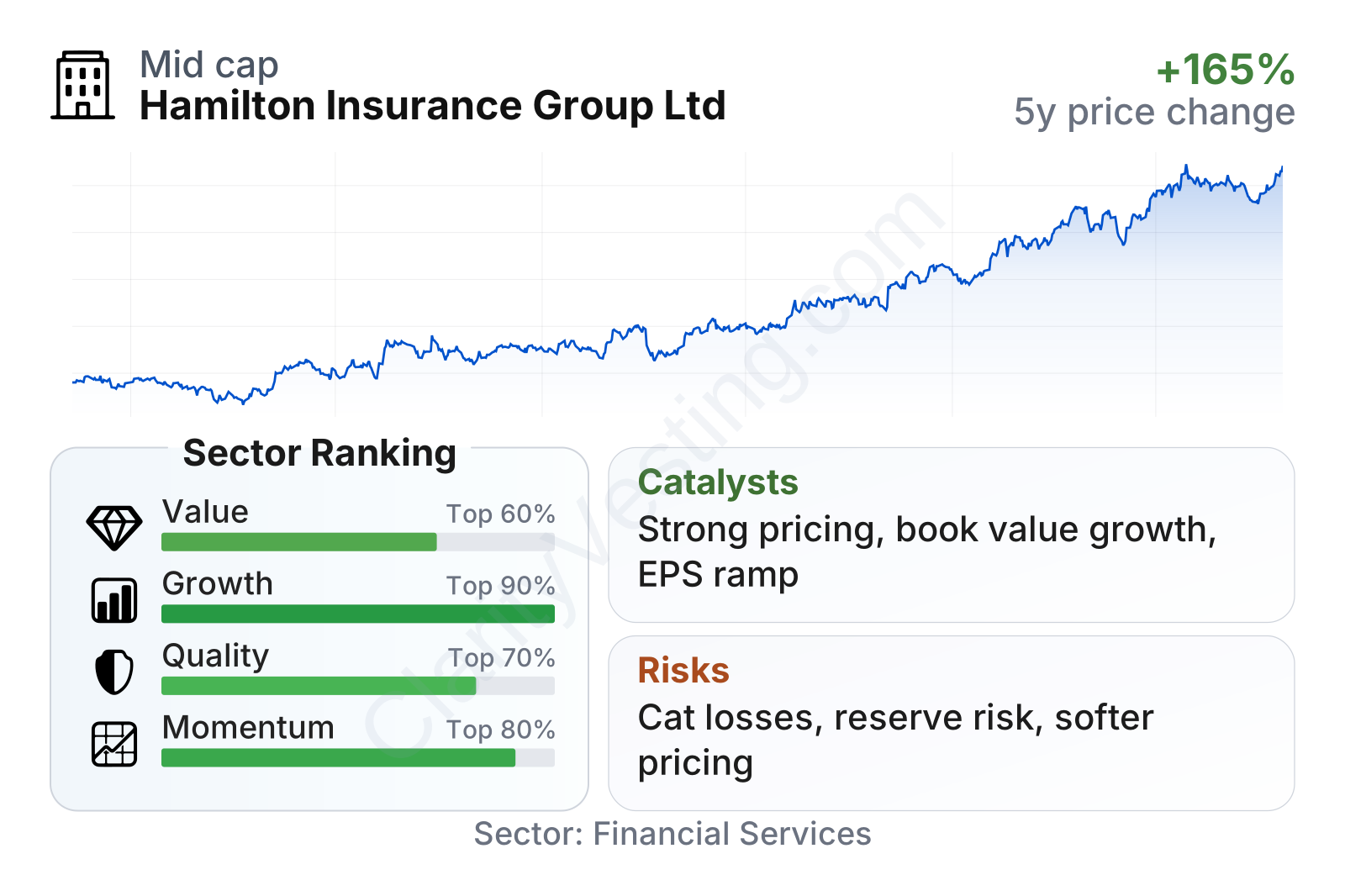
Hamilton stands out more for growth and balance-sheet strength than for income distribution. The company ranks near the top of the sector on growth measures, with revenue, earnings per share, book value per share, and free cash flow all rising faster than industry medians over multi-year periods. Profitability is also solid, with returns on equity and assets above typical sector levels. Leverage looks conservative, with very low debt relative to equity and net cash metrics that compare favorably with peers. On valuation measures, earnings-based multiples remain low versus the sector, although the stock no longer looks as discounted on book value as it did closer to its listing.
Hamilton is still a mid-sized insurer by market value, which can create room for expansion but also means results can be more affected by individual large-loss events than at the biggest global players. The stock’s beta is low, suggesting trading has been less volatile than the broader market.
Growth
The company operates in a sector that has favorable long-term demand drivers. Specialty insurance and reinsurance benefit from rising insured values, more complex corporate risks, cyber exposure, climate-related catastrophe risk, and the ongoing need for insurers to transfer part of their own risk. These trends tend to support premium growth over time, especially when the industry maintains pricing discipline.
Hamilton’s strategy appears aligned with those conditions. The company has focused on specialty underwriting rather than competing broadly across every line of insurance. That is usually important because specialist insurers can be more selective, price risk more carefully, and build relationships in narrower markets where expertise matters more than sheer size.
Another growth support is investment income. Insurers earn not only from underwriting but also from investing premium float. In a higher-yield environment, that can lift earnings even if premium growth moderates. For Hamilton, recent results show both underwriting and investment contributions improving, which creates a more balanced earnings profile.
Earnings per share have increased very quickly since 2023, moving from modest levels to a much stronger run rate by 2025 and remaining elevated in 2026. That kind of progression usually signals a combination of premium growth, healthy pricing, and improved underwriting margins.
Book value per share, a key measure for insurers, has also risen steadily after the 2022 setback. Growth in book value matters because it reflects the company’s ability to compound shareholder capital over time. Hamilton’s multi-year book value growth rate is well above the sector median, which supports the view that recent earnings have not been purely cosmetic.
A recent opportunity worth noting is the broader industry environment rather than a single headline event. Reinsurance pricing remained attractive across several categories after years of catastrophe losses and tighter industry capacity. For a company like Hamilton, that can create room to write business at stronger expected returns than in softer market periods. Public company communications in 2026 also indicate continued emphasis on underwriting discipline and capital allocation rather than chasing volume, which is usually the healthier path in this industry.
Risks
This article is for informational purposes only and does not constitute financial advice. Some content is AI-generated. See Disclaimer


