Stock Analysis · Hess Midstream Partners LP (HESM)
Overview
Hess Midstream Partners LP is an energy infrastructure company focused on the gathering, processing, storage, and transportation of oil, natural gas, and produced water. Its assets are concentrated in the Bakken shale region in North Dakota, where it provides midstream services that support drilling and production activity. In simple terms, it operates the pipes, plants, terminals, and water systems that help move hydrocarbons from the wellhead to market.
A key point for long-term readers is that Hess Midstream is not mainly an oil producer. It earns most of its money by charging for services tied to volumes moving through its system, and a large portion of those arrangements are backed by long-term commercial agreements. That tends to make the business model steadier than that of exploration and production companies, even though it still depends on activity levels in the Bakken and on the health of its largest customer relationships.
Based on recent company reporting, revenue is mainly generated from fee-based midstream services. The business is typically described through three operating areas, with gathering generally the largest contributor.
- Gas gathering, compression, processing, and transportation: approximately 40% to 45% of revenue. This includes collecting natural gas from wells, compressing it, processing it, and moving residue gas and natural gas liquids through connected systems.
- Crude oil gathering, terminaling, storage, and transportation: approximately 30% to 35% of revenue. This covers moving crude oil from production sites into gathering systems, storage, and terminal facilities.
- Produced water gathering and disposal: approximately 20% to 25% of revenue. This includes handling wastewater produced during oil and gas extraction, an important service in the Bakken because water volumes rise as fields mature.
The business mix has an attractive shape for infrastructure economics: relatively low direct operating costs compared with revenue, high operating margins, and recurring cash generation. Over the last several years, revenue and operating income have generally moved upward, while net income has expanded faster, showing improving earnings conversion even as interest expense remains meaningful.
The financial flow highlights a business with very strong gross and operating profitability. Revenue has risen steadily over recent years, and net income has improved materially faster than costs, although interest expense still absorbs a noticeable share of operating profit because the company uses significant leverage.
Key Figures
| Metric | Value | Sector ⓘ |
|---|---|---|
| Date | Oct 17, 2026 | |
| Context | ||
| Sector | Energy | |
| Industry | Oil & Gas Midstream | |
| Market Cap ⓘ | $6.43B | |
| Beta ⓘ | 0.56 | |
Value (Cheapness) | ||
| P/E Ratio ⓘ | 10.76 | 15.44 |
| P/B Ratio ⓘ | 6.14 | 1.73 |
| FCF Yield ⓘ | 10.79% | 8.20% |
| Dividend Yield ⓘ | 9.54% | 3.59% |
| EBIT / EV ⓘ | 11.64% | 7.46% |
| PEG ⓘ | 1.57 | |
Growth (Business expansion) | ||
| Revenue Growth ⓘ | -3.70% | 26.90% |
| RPS Growth (5Y CAGR) ⓘ | -27.23% | 6.90% |
| EPS Growth (5Y CAGR) ⓘ | -8.68% | -15.73% |
| BVPS Growth (5Y CAGR) ⓘ | -8.05% | 6.07% |
| Margin Growth (5Y Trend) ⓘ | 2.03% | 0.58% |
| FCF Growth (5Y CAGR) ⓘ | 3.59% | 1.86% |
| DPS Growth (5Y CAGR) ⓘ | 10.30% | 16.79% |
Quality (Business durability) | ||
| ROIC (Latest) ⓘ | 19.88% | 11.40% |
| ROA (Latest) ⓘ | 8.63% | 6.06% |
| ROIC (5Y Median) ⓘ | 23.23% | 10.30% |
| ROA (5Y Median) ⓘ | 3.22% | 5.42% |
| Net Debt / EBIT (Latest) ⓘ | 3.65 | 1.64 |
| Net Debt / EBIT (5Y Median) ⓘ | 3.68 | 1.83 |
| Net Debt / EBITDA (Latest) ⓘ | 2.99 | 1.08 |
| Net Debt / Assets ⓘ | 86.34% | 17.29% |
| EBITDA / Interest ⓘ | 5.50 | 9.64 |
| Operating Margin (Latest) ⓘ | 62.56% | 16.27% |
| Operating Margin (5Y Median) ⓘ | 62.54% | 20.39% |
| Debt to Equity (Latest) ⓘ | 715.12% | 54.76% |
| Profit Margin (Latest) ⓘ | 23.23% | 8.82% |
| Free Cash Flow (Latest) ⓘ | $694.40M | |
Momentum (Price trend) | ||
| 3Y Return ⓘ | +28.05% | +67.38% |
| 12M Return (excl. last month) ⓘ | +10.47% | +49.19% |
| 6M Return ⓘ | -15.01% | +7.07% |
| Price vs. 200-Day MA ⓘ | -17.54% | +9.56% |
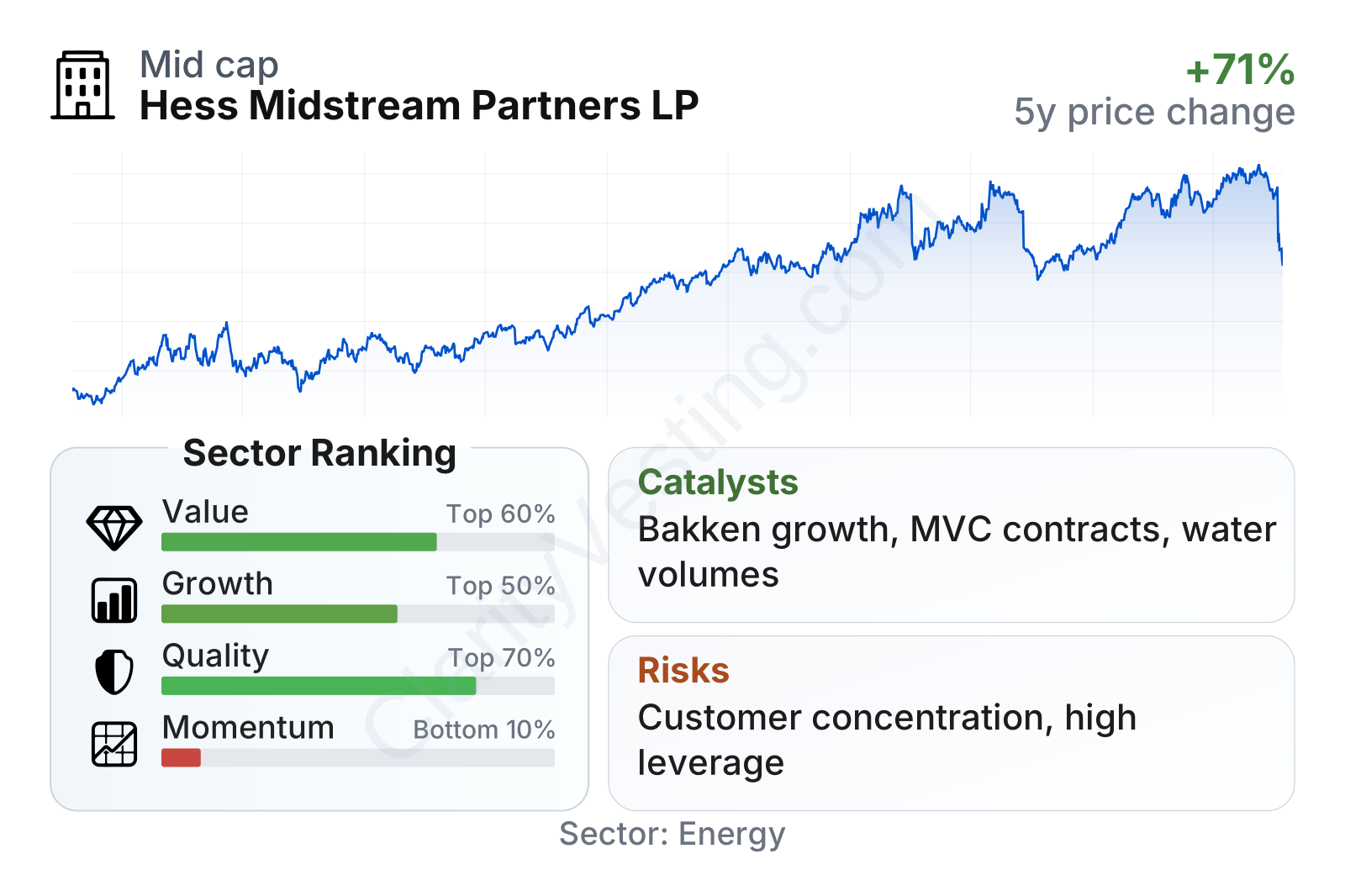
Hess Midstream sits in the mid-cap range and has shown relatively low share-price volatility, with a beta close to 0.5. On valuation measures, it screens as mixed: earnings multiples are slightly below the sector median, free cash flow yield is a little above it, and the trailing distribution yield is clearly higher than the sector norm. Profitability stands out more than growth. Returns on invested capital and operating margins are well above many peers, while revenue growth has recently softened and longer-term per-share growth measures are less impressive. The main balance-sheet tradeoff is leverage, which is much higher than the sector median.
Growth
For long-term context, midstream remains an important part of the energy value chain. Even in a world that is gradually diversifying energy sources, oil and gas infrastructure still matters because hydrocarbons continue to supply a large share of transportation, industrial, heating, and power demand. Within that framework, Hess Midstream’s focus on the Bakken gives it a clear operating niche: it grows when drilling activity, well connections, throughput, and water handling demand expand in its dedicated service area.
The strategy is fairly straightforward and easy to follow. Hess Midstream invests in infrastructure that is closely tied to upstream development in one basin where it already has an established footprint. That can support efficient capital spending because the company is often expanding connected assets rather than building entirely new regional systems from scratch. The model can become stronger as production grows and as more volumes move through existing pipes and plants, since infrastructure businesses often benefit from operating leverage.
Revenue growth has been positive most of the time over the past several years, but the pace has cooled recently. That does not necessarily mean the business model is weakening. In a midstream company, slower top-line growth can coexist with strong cash generation if utilization remains healthy and costs stay controlled. The latest year-over-year reading is softer than the sector median, so the near-term picture looks more like steady maturation than rapid expansion.
Free cash flow has been consistently solid, staying in a fairly tight range and recently running around the mid-$600 million level on a trailing basis. That matters because long-term infrastructure businesses are often judged less by headline revenue growth and more by how much cash remains after capital spending. Stable free cash flow supports distributions, debt service, and selective expansion projects.
One of the clearest growth supports is the company’s commercial structure. Hess Midstream has long-term contracts with minimum volume commitments and dedicated acreage arrangements tied mainly to Hess and also third-party customers. This lowers some of the uncertainty that pure commodity-linked businesses face. Another favorable point is produced water handling. As wells age, water volumes typically increase, and that can create demand for gathering and disposal services even when oil production growth is moderate.
Recent company communications have also emphasized continued Bakken development activity, capacity optimization, and disciplined capital allocation. Those are not explosive catalysts, but they fit the profile of a business aiming for durable cash generation rather than highly volatile growth.
Risks
This article is for informational purposes only and does not constitute financial advice. Some content is AI-generated. See Disclaimer


