Stock Analysis · Henkel AG & Co. KGaA (HENOF)
Overview
Henkel AG & Co. KGaA is a German consumer and industrial products company best known for laundry detergents, home cleaning products, hair care brands, and industrial adhesives. Its business is split between products sold to consumers and materials sold to manufacturers. That mix matters because it gives Henkel exposure to everyday household demand as well as to industrial production trends in markets such as packaging, electronics, automotive, and construction.
Based on the company’s latest annual reporting structure, revenue comes mainly from two divisions:
- Adhesive Technologies: about 52% of sales. This unit includes industrial adhesives, sealants, and functional coatings used in packaging, consumer goods, electronics, automotive, and other manufacturing applications.
- Consumer Brands: about 48% of sales. This division includes laundry and home care products and hair products sold through retail and professional channels under brands such as Persil, Schwarzkopf, and Loctite-branded consumer adhesives.
Geographically, Henkel is broadly diversified across Europe, North America, Asia-Pacific, Latin America, India, the Middle East, and Africa, which reduces reliance on any single country. Recent years also show a clear improvement in profitability: revenue has been broadly stable around the low-20-billion-euro range, while gross profit, operating income, and net income have recovered meaningfully after the 2022 cost pressure period. That suggests the company has recently been better at converting sales into profit even without strong top-line expansion.
Key Figures
| Metric | Value | Sector ⓘ |
|---|---|---|
| Date | Oct 17, 2026 | |
| Context | ||
| Sector | Consumer Defensive | |
| Industry | Household & Personal Products | |
| Market Cap ⓘ | $34.01B | |
| Beta ⓘ | 0.58 | |
Value (Cheapness) | ||
| P/E Ratio ⓘ | 15.36 | 17.88 |
| P/B Ratio ⓘ | 1.63 | 1.29 |
| FCF Yield ⓘ | 12.04% | 12.39% |
| Dividend Yield ⓘ | 2.46% | 2.85% |
| EBIT / EV ⓘ | N/A | 6.43% |
| PEG ⓘ | 2.87 | |
Growth (Business expansion) | ||
| Revenue Growth ⓘ | -0.50% | 4.10% |
| RPS Growth (5Y CAGR) ⓘ | 1.70% | 6.18% |
| EPS Growth (5Y CAGR) ⓘ | -37.25% | -13.59% |
| BVPS Growth (5Y CAGR) ⓘ | 2.05% | 3.20% |
| Margin Growth (5Y Trend) ⓘ | 1.75% | -0.15% |
| FCF Growth (5Y CAGR) ⓘ | 5.11% | 4.10% |
| DPS Growth (5Y CAGR) ⓘ | 2.78% | 6.79% |
Quality (Business durability) | ||
| ROIC (Latest) ⓘ | 17.78% | 12.34% |
| ROA (Latest) ⓘ | 11.15% | 6.30% |
| ROIC (5Y Median) ⓘ | 9.06% | 10.49% |
| ROA (5Y Median) ⓘ | 5.19% | 5.44% |
| Net Debt / EBIT (Latest) ⓘ | 0.36 | 1.96 |
| Net Debt / EBIT (5Y Median) ⓘ | 0.50 | 2.35 |
| Net Debt / EBITDA (Latest) ⓘ | 0.28 | 1.38 |
| Net Debt / Assets ⓘ | 5.77% | 21.51% |
| EBITDA / Interest ⓘ | 21.42 | 9.46 |
| Operating Margin (Latest) ⓘ | 14.06% | 8.87% |
| Operating Margin (5Y Median) ⓘ | 12.87% | 9.53% |
| Debt to Equity (Latest) ⓘ | 29.04% | 72.35% |
| Profit Margin (Latest) ⓘ | 9.36% | 5.40% |
| Free Cash Flow (Latest) ⓘ | $4.10B | |
Momentum (Price trend) | ||
| 3Y Return ⓘ | +36.20% | +20.92% |
| 12M Return (excl. last month) ⓘ | -1.19% | +2.13% |
| 6M Return ⓘ | +20.71% | +1.26% |
| Price vs. 200-Day MA ⓘ | +4.80% | +1.39% |
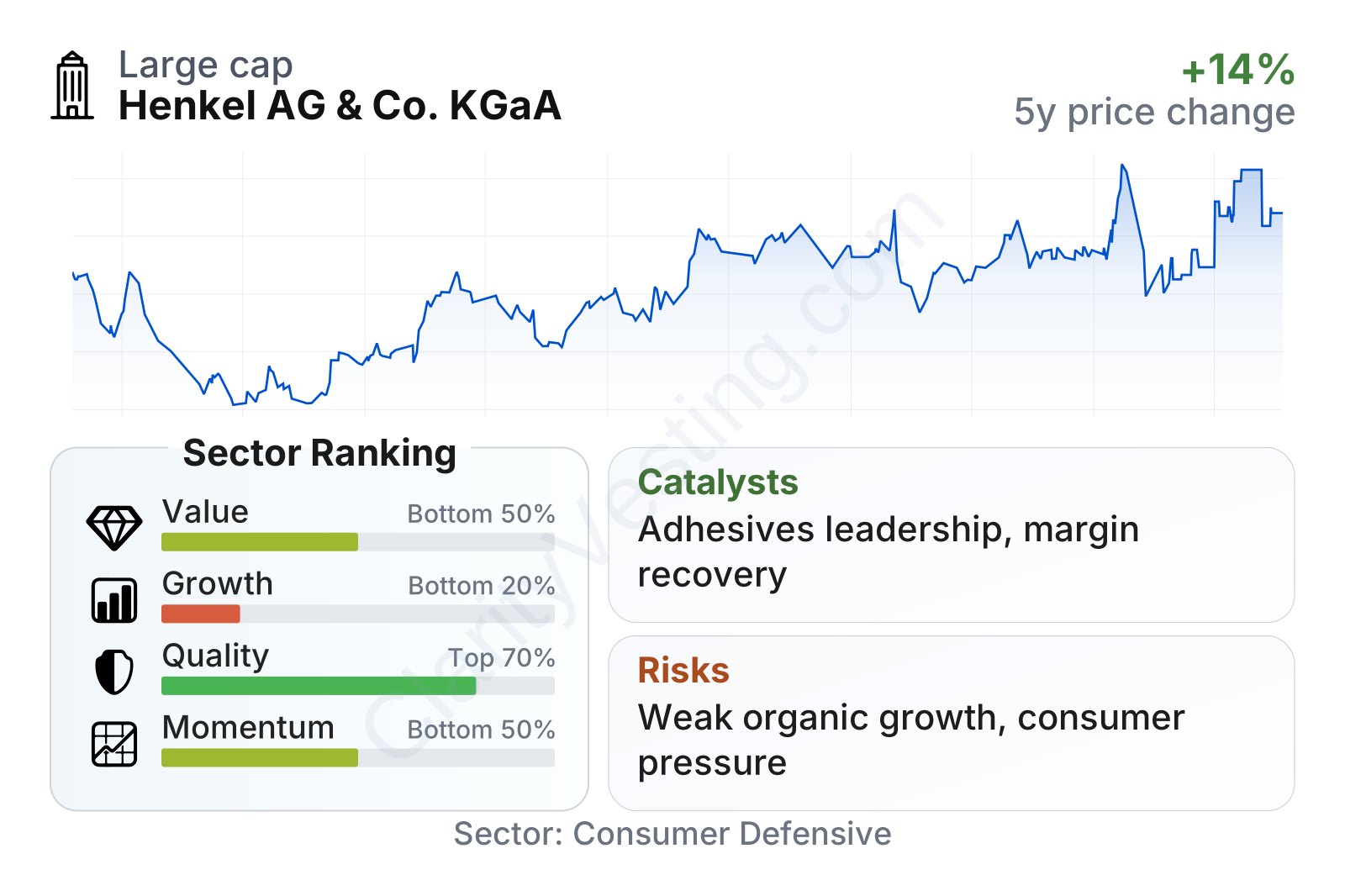
Henkel is a large, defensive business with relatively low share-price volatility, as shown by its beta well below 1. The overall picture from the metrics is mixed but understandable: growth ranks weakly versus the broader household and personal products group, while quality is stronger. Profitability, returns on capital, and balance-sheet strength all stand out positively, but revenue growth and long-term earnings growth have lagged the sector. Recent market performance has been better than the sector median over 6 months, 12 months, and 3 years, suggesting the market has responded favorably to the margin recovery and restructuring progress.
Growth
Henkel operates in markets that are mature overall, but not stagnant. Household cleaning, laundry, beauty care, and industrial adhesives tend to grow steadily over long periods because they are tied to recurring consumption and manufacturing activity. The more attractive part of the portfolio for future expansion is Adhesive Technologies, where demand is supported by long-term themes such as lightweight vehicles, electronics miniaturization, advanced packaging, and energy-efficiency solutions. These are not explosive growth categories, but they can support durable demand if Henkel keeps its technology relevant.
The company’s strategy has become more focused over the last few years. Management merged several consumer activities into one Consumer Brands division to simplify the portfolio, remove duplication, and improve margins. At the same time, Henkel has continued to emphasize premium innovation, pricing discipline, and selective portfolio pruning. That approach makes strategic sense for a company operating in categories where brand strength and operating efficiency matter more than rapid expansion.
Recent revenue growth has been modest and weaker than the sector median, so the main growth case is not about fast sales acceleration today. It is more about whether Henkel can turn a stable revenue base into better earnings and cash flow through mix improvement, cost control, and stronger execution. That is already visible in the company’s margin trend, which has improved over the last five years even though sales growth has been limited.
Cash generation is one of the stronger elements in Henkel’s profile. Free cash flow has held up well and the latest annualized level is substantial for a company of this size. That gives management flexibility to fund dividends, maintain research and brand investment, and pursue bolt-on acquisitions or portfolio adjustments without putting major strain on the balance sheet.
A meaningful recent catalyst has been the continued execution of the Consumer Brands integration and margin expansion program, alongside resilient performance in Adhesive Technologies. Henkel has also highlighted innovation pipelines and category prioritization in adhesives, laundry, and hair care, which could support a better sales mix even if volume growth remains moderate. In a slower consumer environment, that kind of self-help can matter more than macro tailwinds.
Risks
This article is for informational purposes only and does not constitute financial advice. Some content is AI-generated. See Disclaimer


