Stock Analysis · Heico Corporation (HEI)
Overview
Heico Corporation is a specialized aerospace and electronics company serving commercial aviation, defense, space, medical, industrial, and other high-reliability markets. Its business model is relatively easy to understand: it sells replacement aircraft parts, repairs and overhauls components, distributes avionics and other aerospace products, and owns a broad collection of niche electronics businesses that make mission-critical components and subsystems.
The company operates through two main segments. Based on recent annual results, revenue is split approximately as follows:
- Flight Support Group: about 68% of revenue. This is the larger business. It includes FAA-approved aircraft replacement parts, repair and overhaul services, parts distribution, specialty products for commercial and military aircraft, and other aviation aftermarket offerings.
- Electronic Technologies Group: about 32% of revenue. This segment includes specialized electronic components, subsystems, data and power products, electro-optical and infrared products, microwave devices, and other engineered products used in defense, space, aviation, industrial, and medical applications.
That mix matters because it gives Heico exposure to two attractive areas at once: recurring aerospace aftermarket demand and higher-margin niche electronics used in applications where reliability is critical. Over the last several years, the business has also become much larger through acquisitions while maintaining strong profitability, with revenue rising from under $2 billion in 2021 to roughly $4.5 billion in 2025 and net income also moving sharply higher.
Recent business context: in 2025 and into 2026, Heico continued to expand through acquisitions and reported strong growth in both net sales and operating income in its most recent quarterly filings. Management has remained focused on buying specialized businesses, keeping entrepreneurial operating structures, and using Heico’s customer relationships and manufacturing scale to broaden those businesses over time.
The long-term pattern here is clear: sales have scaled rapidly, operating profit has expanded faster than costs, and net income has improved meaningfully despite a higher interest burden than a few years ago. That combination suggests that acquisitions have added not only size, but also earnings power.
Key Figures
| Metric | Value | Sector ⓘ |
|---|---|---|
| Date | Oct 24, 2026 | |
| Context | ||
| Sector | Industrials | |
| Industry | Aerospace & Defense | |
| Market Cap ⓘ | $42.66B | |
| Beta ⓘ | 1.09 | |
Value (Cheapness) | ||
| P/E Ratio ⓘ | 50.87 | 22.29 |
| P/B Ratio ⓘ | 8.65 | 1.98 |
| FCF Yield ⓘ | 2.42% | 6.26% |
| Dividend Yield ⓘ | 0.08% | 1.92% |
| EBIT / EV ⓘ | 3.20% | 4.83% |
| PEG ⓘ | 2.13 | |
Growth (Business expansion) | ||
| Revenue Growth ⓘ | 23.10% | 9.30% |
| RPS Growth (5Y CAGR) ⓘ | 23.87% | 7.76% |
| EPS Growth (5Y CAGR) ⓘ | 17.59% | -13.17% |
| BVPS Growth (5Y CAGR) ⓘ | 16.76% | 6.13% |
| Margin Growth (5Y Trend) ⓘ | 2.46% | 0.74% |
| FCF Growth (5Y CAGR) ⓘ | 20.55% | 10.79% |
| DPS Growth (5Y CAGR) ⓘ | 8.01% | 9.41% |
Quality (Business durability) | ||
| ROIC (Latest) ⓘ | 14.41% | 10.75% |
| ROA (Latest) ⓘ | 9.20% | 5.41% |
| ROIC (5Y Median) ⓘ | 12.40% | 9.37% |
| ROA (5Y Median) ⓘ | 8.58% | 4.95% |
| Net Debt / EBIT (Latest) ⓘ | 1.84 | 2.04 |
| Net Debt / EBIT (5Y Median) ⓘ | 1.93 | 2.27 |
| Net Debt / EBITDA (Latest) ⓘ | 1.57 | 1.39 |
| Net Debt / Assets ⓘ | 23.15% | 19.27% |
| EBITDA / Interest ⓘ | 11.08 | 9.58 |
| Operating Margin (Latest) ⓘ | 24.13% | 10.49% |
| Operating Margin (5Y Median) ⓘ | 21.44% | 10.30% |
| Debt to Equity (Latest) ⓘ | 51.36% | 64.82% |
| Profit Margin (Latest) ⓘ | 16.38% | 6.67% |
| Free Cash Flow (Latest) ⓘ | $1.03B | |
Momentum (Price trend) | ||
| 3Y Return ⓘ | +89.01% | +67.77% |
| 12M Return (excl. last month) ⓘ | -4.86% | +12.05% |
| 6M Return ⓘ | +8.11% | 0.00% |
| Price vs. 200-Day MA ⓘ | -6.92% | +0.67% |
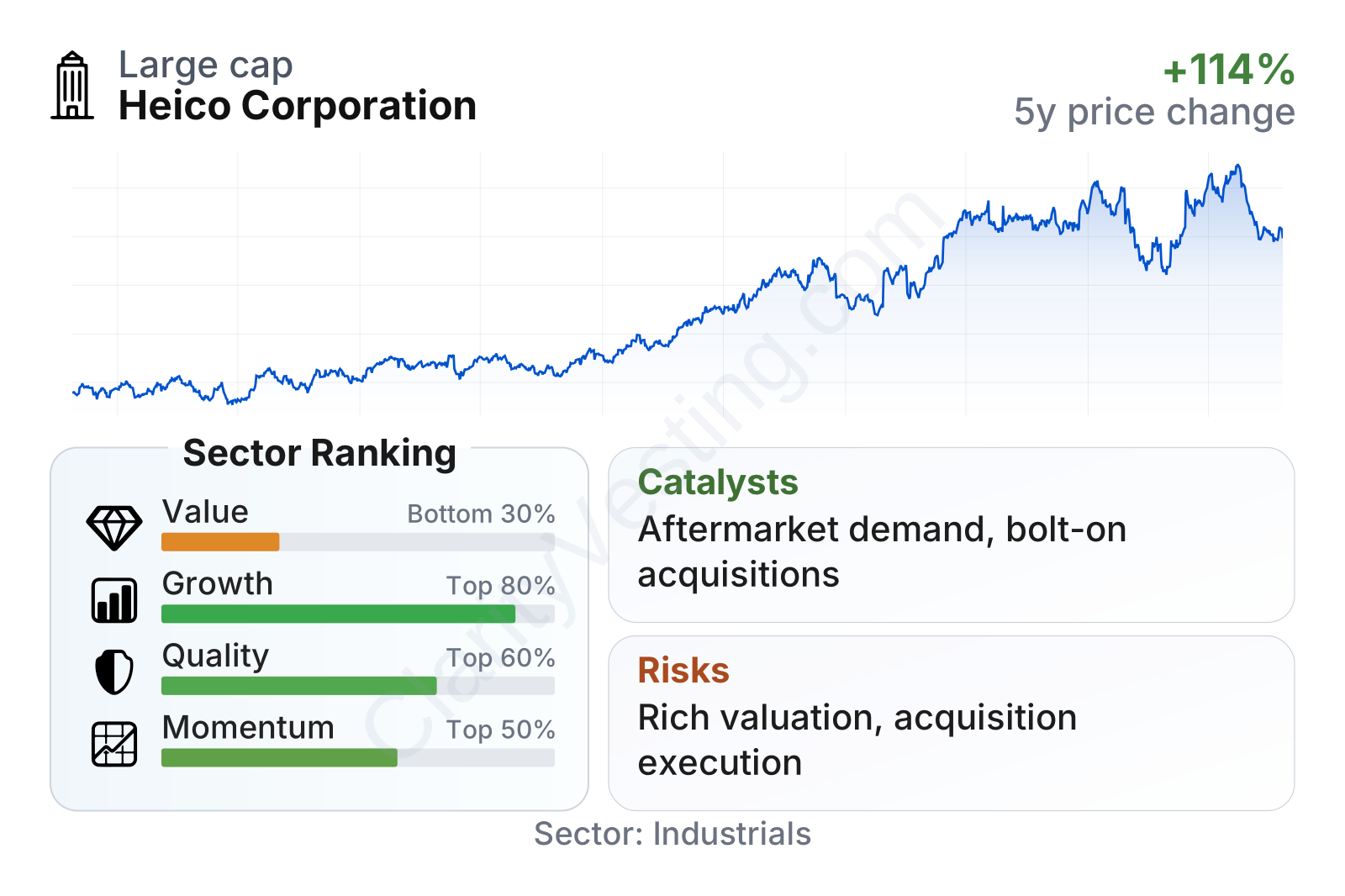
Heico combines strong business quality with strong growth, while the main tradeoff is valuation. Profitability sits well above the sector median, returns on capital are healthy, leverage is manageable, and free cash flow generation has crossed the $1 billion range. At the same time, the stock trades at a clear premium to most industrial and aerospace peers, which means the market is already recognizing a large part of that strength.
The share price trend over the last five years also shows that the market has consistently rewarded execution. Even with periodic pullbacks, the longer-term direction has been decisively upward, reflecting expanding earnings, successful dealmaking, and a business mix that has benefited from the recovery in commercial aviation and resilient defense-related demand.
Growth
Heico operates in a sector with favorable long-term foundations. Commercial aerospace continues to benefit from aircraft utilization, aging fleets, maintenance demand, and constraints in new aircraft production, all of which support the aftermarket. Defense and space electronics also remain important spending priorities in the United States and allied countries, especially in areas involving sensing, communication, power management, and mission-critical hardware.
The company’s strategy is one of the more coherent in the sector. Rather than trying to dominate one massive platform program, Heico focuses on hundreds of smaller niche positions where certification, engineering know-how, customer trust, and long product life cycles matter. This approach tends to reduce dependence on any single product while creating room for steady bolt-on acquisitions. The model has worked for decades and still appears scalable.
Revenue growth has remained well above the broader sector median, even after exceptionally strong periods have normalized. The recent pace shows that Heico is still growing at a double-digit rate from an already much larger base, which is often a sign that both end-market demand and acquisition integration remain healthy.
Cash generation has also improved materially. Free cash flow has moved up from the low hundreds of millions of dollars a few years ago to well above $800 million on a trailing basis in the latest period shown, giving the company more flexibility to fund acquisitions, service debt, and support internal investment without relying heavily on new capital.
A meaningful catalyst is Heico’s acquisition pipeline. The company has a long record of buying founder-led or niche engineered businesses and leaving them with a decentralized operating structure. That tends to make Heico an attractive buyer for sellers who care about continuity. In recent filings and press releases, the company continued to announce additional acquisitions, reinforcing the idea that consolidation remains a live opportunity rather than a past growth driver.
Another catalyst is the continued strength of the aviation aftermarket. Airlines generally prefer to keep aircraft in service longer when new plane deliveries are delayed, and that supports demand for replacement parts and maintenance-related offerings. For a company with a large exposure to aftermarket aerospace products, that backdrop can be favorable for both volume and pricing discipline.
Risks
This article is for informational purposes only and does not constitute financial advice. Some content is AI-generated. See Disclaimer


