Stock Analysis · Hengan Intl Group Ltd-H (HEGIF)
Overview
Hengan International Group is a large Chinese consumer staples company focused on everyday hygiene and personal care products. Its business is built around items people tend to purchase repeatedly regardless of the economic cycle, especially tissue paper, sanitary napkins, diapers, and related household products. That makes the company easier to understand than many industrial or technology businesses: it sells basic, recurring-use products to mass-market consumers.
The group’s revenue mix is centered on hygiene paper, which has historically been the largest segment. Based on the company’s recent annual reporting structure and product mix, the main sources of revenue can be summarized as follows:
- Tissue paper: approximately 45% to 50% of revenue. This includes boxed tissues, pocket handkerchiefs, toilet rolls, kitchen towels, and other daily-use paper products.
- Sanitary napkins: approximately 25% to 30% of revenue. This is one of Hengan’s core branded categories and includes feminine hygiene products sold across multiple price points.
- Disposable diapers: approximately 10% to 15% of revenue. This includes baby diapers and related absorbent hygiene products, although this category has faced pressure from lower birth rates and strong competition.
- Other products: approximately 10% to 15% of revenue. This generally includes food and snacks, household products, and other smaller categories developed outside the core hygiene franchise.
Geographically, the company is primarily exposed to mainland China. That concentration matters: Hengan benefits from scale and brand recognition in a very large consumer market, but it is also tied closely to Chinese consumption trends, retail conditions, and category competition.
Over the last several years, the business has shown a mixed pattern. Revenue rose from roughly RMB 20.8 billion in 2021 to about RMB 23.8 billion in 2023, then softened in 2024 before stabilizing around RMB 23.1 billion in 2025. Profitability has also been uneven, with net income falling sharply in 2022, recovering in 2023, then remaining below that rebound peak in 2024 and 2025. In simple terms, Hengan remains a sizable branded staples company, but it has not been delivering clean, uninterrupted growth.
The business model still converts a meaningful share of sales into profit and cash, but the recent progression shows that cost swings, category mix, and operating expenses can materially affect results. Gross profit has stayed relatively resilient, while operating income has been more volatile, suggesting margin pressure below the gross profit line rather than a collapse in the core demand for its products.
Key Figures
| Metric | Value | Sector ⓘ |
|---|---|---|
| Date | Oct 17, 2026 | |
| Context | ||
| Sector | Consumer Defensive | |
| Industry | Household & Personal Products | |
| Market Cap ⓘ | $3.53B | |
| Beta ⓘ | 0.56 | |
Value (Cheapness) | ||
| P/E Ratio ⓘ | 9.90 | 17.88 |
| P/B Ratio ⓘ | 0.17 | 1.29 |
| FCF Yield ⓘ | 96.17% | 12.39% |
| Dividend Yield ⓘ | 41.54% | 2.85% |
| EBIT / EV ⓘ | N/A | 6.43% |
| PEG ⓘ | 3.67 | |
Growth (Business expansion) | ||
| Revenue Growth ⓘ | -6.10% | 4.10% |
| RPS Growth (5Y CAGR) ⓘ | 3.45% | 6.18% |
| EPS Growth (5Y CAGR) ⓘ | 21.62% | -13.59% |
| BVPS Growth (5Y CAGR) ⓘ | 3.96% | 3.20% |
| Margin Growth (5Y Trend) ⓘ | -7.69% | -0.15% |
| FCF Growth (5Y CAGR) ⓘ | -12.97% | 4.10% |
| DPS Growth (5Y CAGR) ⓘ | -11.70% | 6.79% |
Quality (Business durability) | ||
| ROIC (Latest) ⓘ | N/A | 12.34% |
| ROA (Latest) ⓘ | 10.57% | 6.30% |
| ROIC (5Y Median) ⓘ | 6.76% | 10.49% |
| ROA (5Y Median) ⓘ | 5.95% | 5.44% |
| Net Debt / EBIT (Latest) ⓘ | -0.15 | 1.96 |
| Net Debt / EBIT (5Y Median) ⓘ | -0.16 | 2.35 |
| Net Debt / EBITDA (Latest) ⓘ | -0.11 | 1.38 |
| Net Debt / Assets ⓘ | -1.60% | 21.51% |
| EBITDA / Interest ⓘ | N/A | 9.46 |
| Operating Margin (Latest) ⓘ | 11.49% | 8.87% |
| Operating Margin (5Y Median) ⓘ | 15.20% | 9.53% |
| Debt to Equity (Latest) ⓘ | 97.71% | 72.35% |
| Profit Margin (Latest) ⓘ | 10.81% | 5.40% |
| Free Cash Flow (Latest) ⓘ | $3.40B | |
Momentum (Price trend) | ||
| 3Y Return ⓘ | +0.36% | +20.92% |
| 12M Return (excl. last month) ⓘ | +3.56% | +2.13% |
| 6M Return ⓘ | -6.60% | +1.26% |
| Price vs. 200-Day MA ⓘ | +0.25% | +1.39% |
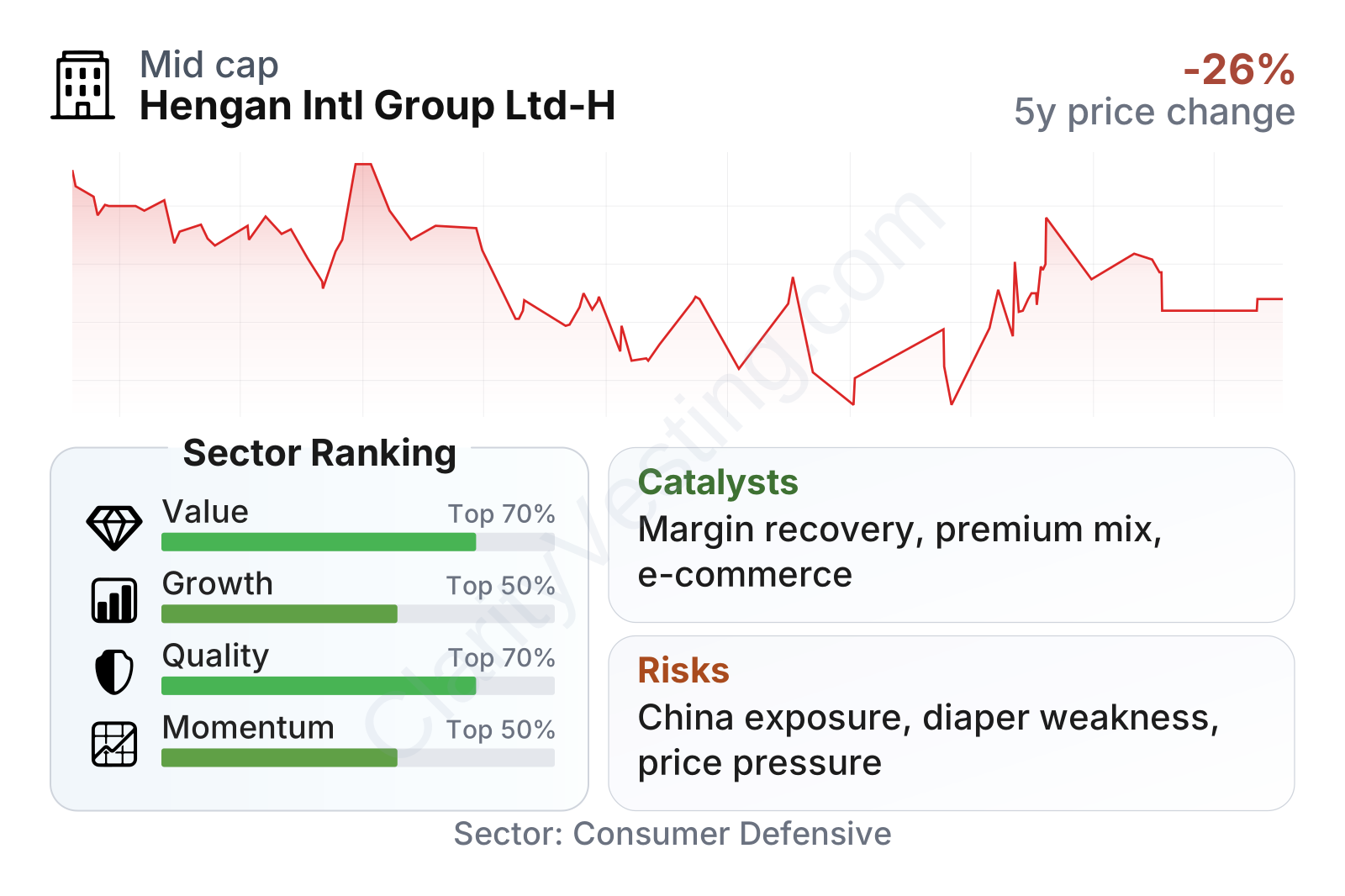
Hengan stands out most on balance sheet strength and headline valuation. The company’s market value places it in the mid-cap range, and its share-price volatility has been lower than the broader market, as reflected by a beta well below 1. On profitability, return on assets and profit margin are stronger than many peers in household and personal products, and current operating margin remains above the sector median even after recent pressure.
The balance sheet appears notably conservative in net terms. Net debt relative to EBIT and EBITDA is negative, which usually means cash exceeds borrowings after adjusting for earnings power. That is a meaningful cushion for a staples company operating in a competitive market. Free cash flow also remains substantial in absolute terms.
The weaker areas are growth and market performance. Recent revenue declined year over year, five-year revenue-per-share growth trails the sector median, and free-cash-flow and dividend trends over five years have moved in the wrong direction. Price momentum has also been soft, with the stock lagging the sector over both the last six months and the trailing one-year period excluding the most recent month.
Growth
Hengan operates in a sector that is fundamentally stable rather than fast-growing. Household paper and personal hygiene products benefit from recurring demand, urbanization, distribution scale, and brand familiarity. That gives the company exposure to a durable category, but not necessarily to rapid expansion. In China, the more mature parts of this market are increasingly driven by product upgrades, premiumization, channel execution, and market-share gains rather than by simple volume growth.
Its strategy broadly makes sense for that environment. Hengan has continued to focus on branded daily necessities, product upgrades, and cost discipline while maintaining a broad distribution footprint. For a mature staples company, that is more realistic than chasing aggressive expansion outside its core capabilities. The challenge is that sound strategy alone does not guarantee strong results if category demand is sluggish or competitors become more promotional.
One positive point is that the company still has room to improve earnings quality even without major top-line growth. Lower financing costs compared with earlier periods, a cash-rich balance sheet, and the ability to manage selling and administrative expenses can support profit resilience. If raw material costs such as pulp remain favorable or at least stable, margins could benefit because tissue and absorbent products are sensitive to input pricing.
A second possible catalyst is product mix improvement. Hengan’s strongest categories are those where trusted brands and retail presence matter. If management succeeds in steering consumers toward better-margin premium items in tissue and feminine care, the company may stabilize margins even if total sales growth stays modest. In a mature staples business, that kind of mix shift can matter more than headline volume growth.
Recent public company communications have also pointed to continued emphasis on brand building, e-commerce, and category optimization. None of these items on their own transform the growth profile, but together they suggest management is trying to protect the core franchise while improving execution rather than pursuing risky diversification.
Risks
This article is for informational purposes only and does not constitute financial advice. Some content is AI-generated. See Disclaimer


