Stock Analysis · Haidilao International Holding Ltd (HDALF)
Overview
Haidilao International Holding Ltd is a restaurant operator best known for its Haidilao hot pot brand. The company runs a large network of self-operated restaurants, mainly in mainland China, and has built its reputation around service quality, standardized operations, and a dining format that is highly recognizable. In simple terms, customers pay to cook meats, seafood, vegetables, and noodles in broth at the table, while the company earns from food, beverages, and related in-store services.
The business is still primarily a restaurant chain rather than a diversified food conglomerate. Based on the company’s recent annual reporting pattern, revenue is overwhelmingly generated from restaurant operations, with a much smaller contribution from delivery, condiment and ingredient sales, and other related activities.
- Restaurant operations: approximately 95% to 97% of revenue. This includes in-store food and beverage sales across the Haidilao restaurant network.
- Delivery business: approximately 2% to 4% of revenue. This covers meals and hot pot offerings delivered to customers.
- Other restaurant-related business: usually below 2% of revenue. This can include condiment products, retail items, and other ancillary activities.
One important point for long-term analysis is that Haidilao’s economics are driven less by one-off product innovation and more by restaurant traffic, table turnover, store productivity, and cost discipline. That makes the company easier to understand than many consumer businesses: if customer visits stay healthy and operating efficiency remains strong, profits can expand quickly; if demand weakens or competition forces discounting, results can swing the other way.
The longer-term financial pattern also shows a sharp recovery from the difficult pandemic period. Revenue, operating income, and net income improved materially from 2021 to 2024, though 2025 indicates that growth is not fully linear and margins can still fluctuate as the company invests and adjusts its network.
The flow of revenue to profit highlights a business that has moved from losses in 2021 to solid profitability, helped by much better operating income and lower interest burden. It also shows that food and operating costs remain the key variables to watch, because even modest changes there can have a large effect on earnings.
Key Figures
| Metric | Value | Sector ⓘ |
|---|---|---|
| Date | Oct 03, 2026 | |
| Context | ||
| Sector | Consumer Cyclical | |
| Industry | Restaurants | |
| Market Cap ⓘ | $7.03B | |
| Beta ⓘ | 0.72 | |
Value (Cheapness) | ||
| P/E Ratio ⓘ | 11.00 | 17.04 |
| P/B Ratio ⓘ | 0.64 | 1.61 |
| FCF Yield ⓘ | 125.57% | 9.02% |
| Dividend Yield ⓘ | 53.28% | 2.75% |
| EBIT / EV ⓘ | N/A | 6.69% |
| PEG ⓘ | 0.82 | |
Growth (Business expansion) | ||
| Revenue Growth ⓘ | 7.90% | 5.60% |
| RPS Growth (5Y CAGR) ⓘ | 1.39% | 9.04% |
| EPS Growth (5Y CAGR) ⓘ | -63.15% | -17.44% |
| BVPS Growth (5Y CAGR) ⓘ | 5.59% | 5.73% |
| Margin Growth (5Y Trend) ⓘ | 17.87% | -0.26% |
| FCF Growth (5Y CAGR) ⓘ | N/A | 4.91% |
| DPS Growth (5Y CAGR) ⓘ | 155.44% | 10.48% |
Quality (Business durability) | ||
| ROIC (Latest) ⓘ | 68.65% | 12.38% |
| ROA (Latest) ⓘ | 38.36% | 5.54% |
| ROIC (5Y Median) ⓘ | 26.90% | 10.63% |
| ROA (5Y Median) ⓘ | 17.58% | 5.44% |
| Net Debt / EBIT (Latest) ⓘ | -0.01 | 2.16 |
| Net Debt / EBIT (5Y Median) ⓘ | -0.18 | 2.31 |
| Net Debt / EBITDA (Latest) ⓘ | -0.01 | 1.52 |
| Net Debt / Assets ⓘ | -0.78% | 21.74% |
| EBITDA / Interest ⓘ | 40.23 | 9.06 |
| Operating Margin (Latest) ⓘ | 15.09% | 9.12% |
| Operating Margin (5Y Median) ⓘ | 11.50% | 9.56% |
| Debt to Equity (Latest) ⓘ | 60.51% | 76.18% |
| Profit Margin (Latest) ⓘ | 9.05% | 5.30% |
| Free Cash Flow (Latest) ⓘ | $8.83B | |
Momentum (Price trend) | ||
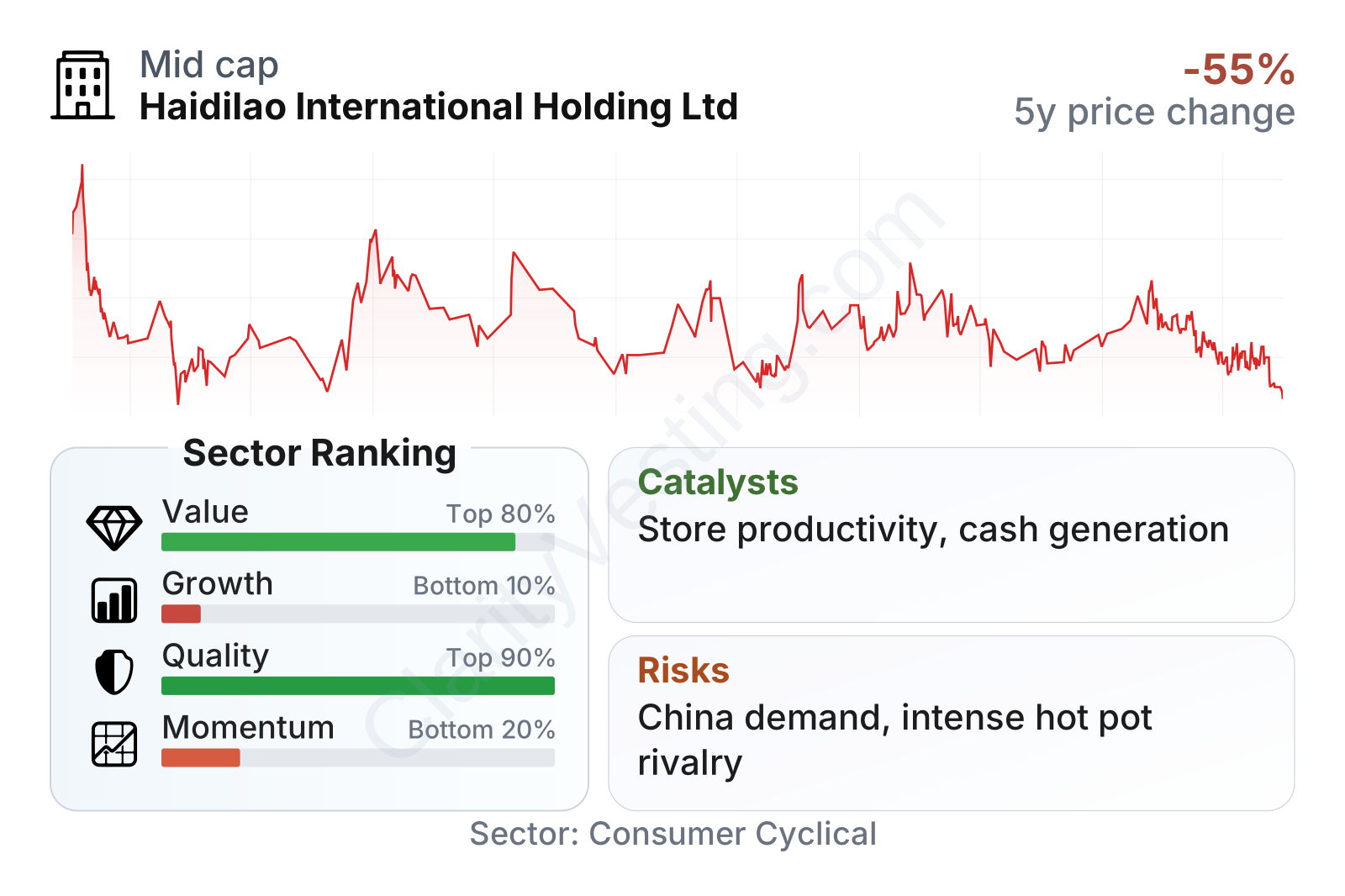
| 3Y Return ⓘ | -44.59% | +11.77% |
| 12M Return (excl. last month) ⓘ | +3.83% | +0.61% |
| 6M Return ⓘ | -38.48% | +1.32% |
| Price vs. 200-Day MA ⓘ | -30.45% | -3.47% |
Haidilao currently looks unusual in a positive way on balance-sheet strength and profitability, but less impressive on longer-term growth and recent share-price momentum. Returns on capital and assets are far above typical restaurant peers, profit margins are better than the sector median, and leverage appears moderate with net cash-like positioning on several debt measures. At the same time, the market has remained cautious, with weak multi-year price performance and a lower valuation than many consumer discretionary peers.
In practical terms, this combination means the company is not being priced like a high-growth restaurant expansion name. Instead, it is being valued more like a mature operator that generates cash well but still needs to prove that growth can be sustained beyond the post-recovery phase.
Growth
The broader sector remains attractive over the long run because dining out in China and across Asia is supported by urbanization, rising consumer spending over time, digital ordering habits, and the ability of strong brands to scale standardized formats. Hot pot is also a category with broad appeal and repeat-visit potential, which gives Haidilao a base to keep expanding store productivity, delivery, and related food offerings.
Haidilao’s strategy makes sense if viewed as a shift from aggressive expansion toward higher-quality growth. In recent years the company has put more emphasis on store efficiency, better site selection, tighter cost control, and rebuilding profitability after a difficult period. That is often a healthier path for a restaurant chain than adding units too quickly. The improvement in operating margin over the last five years suggests management has been able to restore discipline even if top-line growth has not been especially strong over a full multi-year period.
Recent yearly revenue growth remains positive and slightly ahead of the sector median, but the longer view is more mixed. Five-year revenue-per-share growth is modest, and earnings growth over that period was heavily distorted by the company’s earlier downturn. In other words, Haidilao has shown that it can recover strongly, but it has not yet re-established a consistently fast expansion profile.
The strongest catalyst is likely continued productivity gains from the existing store base rather than sheer restaurant count growth. If average sales per restaurant, table turnover, and customer traffic keep improving, margins can remain above peer averages. A second catalyst is the company’s cash generation, which creates room for dividends, selective expansion, technology upgrades, and supply-chain investment without relying heavily on debt.
Another supportive factor is that Haidilao still carries significant brand recognition in Chinese casual dining. In a crowded market, a recognized brand with proven operating systems can recover demand faster than smaller independent chains. Recent company communications have also emphasized refined management and operational optimization, which fits the current stage of the business better than pure expansion for expansion’s sake.
Risks
This article is for informational purposes only and does not constitute financial advice. Some content is AI-generated. See Disclaimer