Stock Analysis · Hiscox Ltd (HCXLY)
Overview
Hiscox Ltd is a specialist property and casualty insurer and reinsurer. The group focuses on areas where underwriting skill matters more than scale alone, especially high-value personal insurance, small business insurance, and complex commercial risks. It operates through a mix of retail insurance brands, broker-distributed specialty lines, and the Lloyd’s market, which gives it global access to large and unusual risks.
Its revenue base is primarily built on insurance premiums, supported by investment income from the float generated by holding policyholder funds before claims are paid. Based on recent annual reporting, the business is broadly organized around the following sources:
- Hiscox Retail: approximately 55% to 60% of insurance contract written premiums. This includes Hiscox UK, Hiscox Europe, and Hiscox USA. Products include small business insurance, professional liability, cyber, property, and high-net-worth personal lines.
- Hiscox London Market: approximately 25% to 30%. This segment writes larger and more specialized commercial risks through brokers, including property, casualty, marine, energy, terrorism, and other specialty classes.
- Hiscox Re & ILS: approximately 15% to 20%. This unit provides reinsurance and insurance-linked securities capabilities, helping the group participate in global catastrophe and specialty reinsurance markets while also managing third-party capital.
- Investment income and other insurance-related income: usually a smaller but meaningful contributor to overall earnings. In strong rate environments, this can materially support profit even when underwriting conditions are mixed.
What stands out in Hiscox’s model is the balance between steadier retail lines and more volatile specialty and catastrophe-exposed business. That mix can create attractive profitability when pricing is favorable, but it also means earnings can swing more than at a plain-vanilla personal insurer.
The long-term trend points to a much larger revenue base and stronger operating profit than a few years ago, even if net income has not moved in a straight line. That pattern fits an insurer benefiting from better pricing and investment returns, while still remaining exposed to claims volatility and catastrophe cycles.
Key Figures
Metric Value Sector ⓘ Date Oct 24, 2026 Context Sector Financial Services Industry Insurance - Property & Casualty Market Cap ⓘ $7.98B Beta ⓘ 0.37 P/E Ratio ⓘ 13.32 12.46 P/B Ratio ⓘ 2.13 1.25 FCF Yield ⓘ 11.20% 9.82% Dividend Yield ⓘ 2.07% 2.94% EBIT / EV ⓘ N/A 8.11% PEG ⓘ N/A Revenue Growth ⓘ 5.00% 9.10% RPS Growth (5Y CAGR) ⓘ 15.02% 12.31% EPS Growth (5Y CAGR) ⓘ 3.84% -6.97% BVPS Growth (5Y CAGR) ⓘ 11.74% 5.02% Margin Growth (5Y Trend) ⓘ 7.09% -4.00% FCF Growth (5Y CAGR) ⓘ N/A 4.71% DPS Growth (5Y CAGR) ⓘ 38.98% 8.92% ROIC (Latest) ⓘ N/A 9.18% ROE (Latest) ⓘ 25.26% 13.93% ROA (Latest) ⓘ 7.95% 1.57% ROIC (5Y Median) ⓘ 14.46% 7.80% ROE (5Y Median) ⓘ 15.86% 12.15% ROA (5Y Median) ⓘ 5.17% 1.28% Net Debt / EBIT (Latest) ⓘ N/A 1.02 Net Debt / EBIT (5Y Median) ⓘ -0.83 0.72 Net Debt / EBITDA (Latest) ⓘ N/A 0.88 Operating Margin (Latest) ⓘ N/A 22.30% Operating Margin (5Y Median) ⓘ 14.49% 24.50% Debt to Equity (Latest) ⓘ 20.95% 59.34% Profit Margin (Latest) ⓘ 15.57% 26.42% Free Cash Flow (Latest) ⓘ $893.76M 3Y Return ⓘ +132.70% +95.73% 12M Return (excl. last month) ⓘ +51.52% +17.30% 6M Return ⓘ +13.48% +6.07% Price vs. 200-Day MA ⓘ +11.40% +5.36%
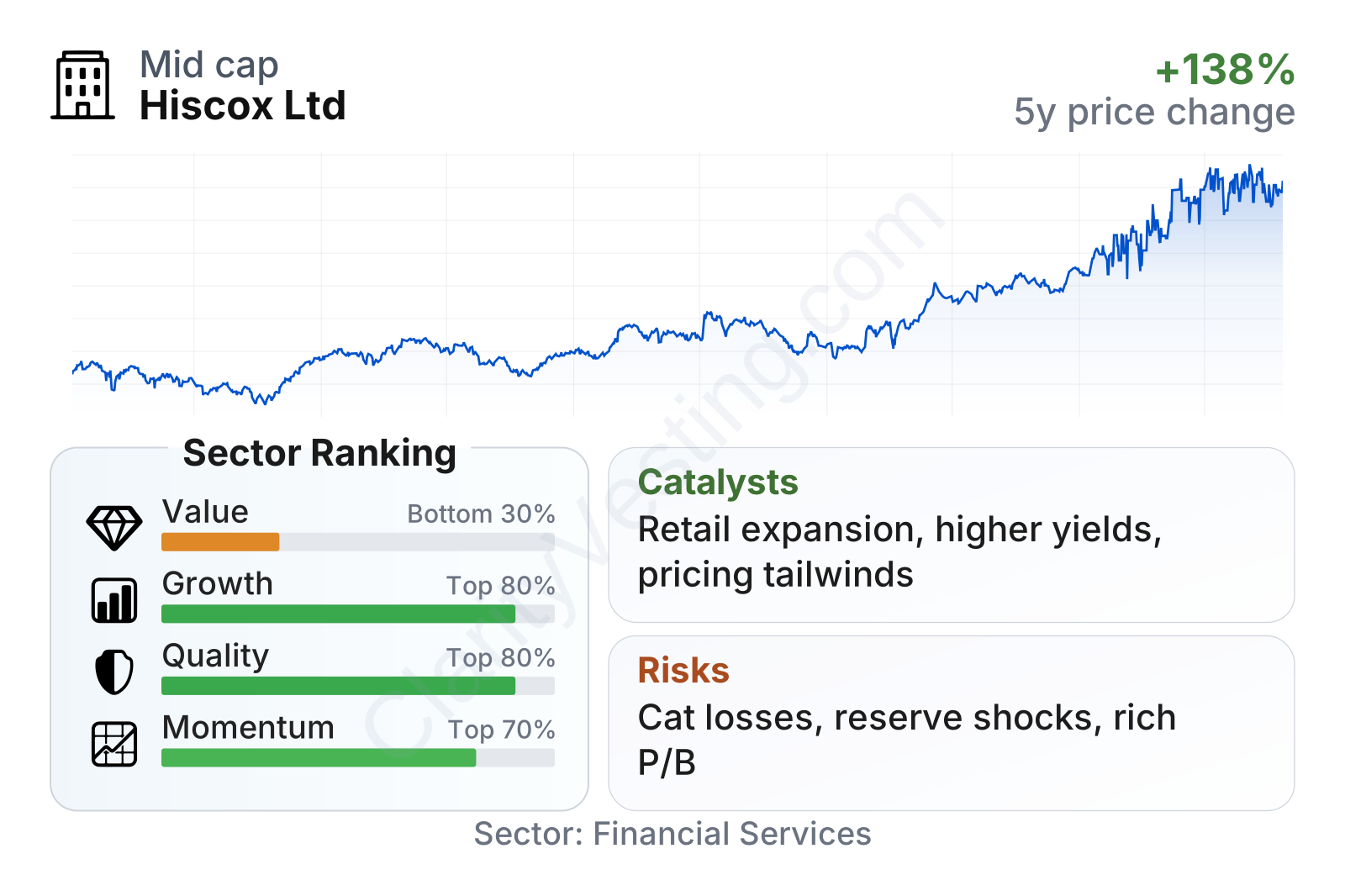
Hiscox sits in the mid-cap range and has shown unusually low share-price volatility for an insurer, with a beta well below 1. The stock’s recent performance has been strong, and over the last three years it has outpaced the sector median. On fundamentals, the picture is mixed but generally solid: growth and quality rank well versus peers, while valuation looks less obviously cheap because the market is assigning a premium to book value. Free cash flow generation is strong, leverage is modest, and returns on equity and assets are clearly above sector norms, which helps explain why the shares do not trade at a discount.
Growth
The company operates in parts of insurance that still have structural room to expand. Cyber insurance, affluent personal lines, small business coverage, and selected specialty commercial risks all benefit from rising risk complexity, inflation in insured values, and increasing demand for tailored policies. These are not markets where the lowest price always wins, which favors disciplined underwriters with recognized brands and specialist distribution.
Hiscox’s strategy is coherent for that environment. It has spent years building a retail platform alongside its Lloyd’s and reinsurance operations, which gives it more diversification than a pure catastrophe writer. Retail insurance, especially in the U.S. and Europe, can provide recurring premium growth and customer retention, while London Market and Re & ILS add access to higher-margin specialty opportunities when pricing is attractive.
Even without a visible EPS chart here, the broader earnings pattern suggests a business that has become structurally more profitable than it was earlier in the decade, though not without fluctuations. Five-year EPS growth is positive, and that matters because insurance earnings often depend not only on sales growth but also on reserve discipline, pricing adequacy, and investment income.
Book value per share has risen steadily over the last five years, climbing from the mid-teens to above $22 per share. For insurers, book value is a key signal because it reflects the accumulation of retained profits and capital strength. A double-digit annualized increase over that period suggests value has been created even through volatile claims years.
There are also near-term catalysts that support the growth case. Higher interest rates have improved reinvestment yields on insurers’ bond portfolios, which can lift investment income. In specialty insurance and reinsurance, pricing conditions have remained favorable after several years of loss inflation and catastrophe reassessment. If Hiscox continues to combine premium growth with underwriting discipline, profit growth does not need extraordinary volume expansion to remain healthy.
Recent company updates have also pointed to continued momentum in retail growth and a still-supportive rating environment in specialty lines. That combination is important: retail can expand the customer base, while specialty lines can protect margins if underwriting conditions remain rational.
Risks
This article is for informational purposes only and does not constitute financial advice. Some content is AI-generated. See Disclaimer


