Stock Analysis · Healthcare Services Group Inc (HCSG)
Overview
Healthcare Services Group Inc. is a support-services company focused on long-term care and post-acute healthcare facilities in the United States. Its clients are mainly nursing homes, rehabilitation centers, retirement communities, and similar care settings. Instead of providing direct medical treatment, the company handles essential daily operations that help facilities run smoothly, especially housekeeping, laundry, linen management, and dietary services.
The business is built around recurring service contracts with healthcare operators. That gives HCSG exposure to a part of healthcare that is less dependent on one-time procedures and more tied to ongoing resident occupancy and day-to-day facility needs.
Based on recent company reporting, revenue is primarily generated from two operating segments:
- Housekeeping, laundry, linen, and other facility services: approximately 55% to 60% of revenue. This includes cleaning and sanitizing resident rooms and common areas, laundry processing, linen distribution, and related support work.
- Dietary department services: approximately 40% to 45% of revenue. This includes food purchasing support, meal preparation, kitchen operations, menu planning, and nutrition-related department management for client facilities.
Revenue concentration appears fairly balanced across these two service lines, which reduces reliance on a single offering. At the same time, both segments are closely tied to labor availability and wage control, since this is a people-intensive business.
Over the last several years, the company’s revenue base has been relatively stable while profitability has improved more noticeably than sales. That points to a recovery driven less by explosive expansion and more by better contract pricing, improved labor efficiency, and tighter cost control.
The overall operating picture shows a business with a very high direct cost base, which is typical for outsourced service providers. What stands out more positively is the improvement in net income by 2025, helped by better gross profit and much lower interest expense.
Key Figures
| Metric | Value | Sector ⓘ |
|---|---|---|
| Date | Oct 17, 2026 | |
| Context | ||
| Sector | Healthcare | |
| Industry | Medical Care Facilities | |
| Market Cap ⓘ | $1.44B | |
| Beta ⓘ | 0.81 | |
Value (Cheapness) | ||
| P/E Ratio ⓘ | 12.29 | 24.79 |
| P/B Ratio ⓘ | 2.91 | 3.08 |
| FCF Yield ⓘ | 10.50% | 3.15% |
| Dividend Yield ⓘ | N/A | 1.94% |
| EBIT / EV ⓘ | 10.88% | 0.57% |
| PEG ⓘ | 2.39 | |
Growth (Business expansion) | ||
| Revenue Growth ⓘ | 2.70% | 7.45% |
| RPS Growth (5Y CAGR) ⓘ | 3.52% | 8.61% |
| EPS Growth (5Y CAGR) ⓘ | 11.15% | -17.81% |
| BVPS Growth (5Y CAGR) ⓘ | 3.71% | 3.72% |
| Margin Growth (5Y Trend) ⓘ | -0.29% | -0.62% |
| FCF Growth (5Y CAGR) ⓘ | 45.07% | 1.04% |
| DPS Growth (5Y CAGR) ⓘ | N/A | 6.77% |
Quality (Business durability) | ||
| ROIC (Latest) ⓘ | 22.90% | 3.24% |
| ROA (Latest) ⓘ | 15.13% | 3.01% |
| ROIC (5Y Median) ⓘ | 9.45% | 4.60% |
| ROA (5Y Median) ⓘ | 5.05% | 1.89% |
| Net Debt / EBIT (Latest) ⓘ | -0.99 | 1.34 |
| Net Debt / EBIT (5Y Median) ⓘ | -0.79 | 1.84 |
| Net Debt / EBITDA (Latest) ⓘ | -0.90 | 1.00 |
| Net Debt / Assets ⓘ | -17.28% | 5.45% |
| EBITDA / Interest ⓘ | 72.73 | 9.64 |
| Operating Margin (Latest) ⓘ | 7.65% | 9.27% |
| Operating Margin (5Y Median) ⓘ | 3.64% | 7.38% |
| Debt to Equity (Latest) ⓘ | 3.42% | 28.58% |
| Profit Margin (Latest) ⓘ | 6.59% | 3.59% |
| Free Cash Flow (Latest) ⓘ | $151.46M | |
Momentum (Price trend) | ||
| 3Y Return ⓘ | +110.93% | +42.80% |
| 12M Return (excl. last month) ⓘ | +37.19% | +18.50% |
| 6M Return ⓘ | +11.27% | +7.57% |
| Price vs. 200-Day MA ⓘ | +1.30% | +5.12% |
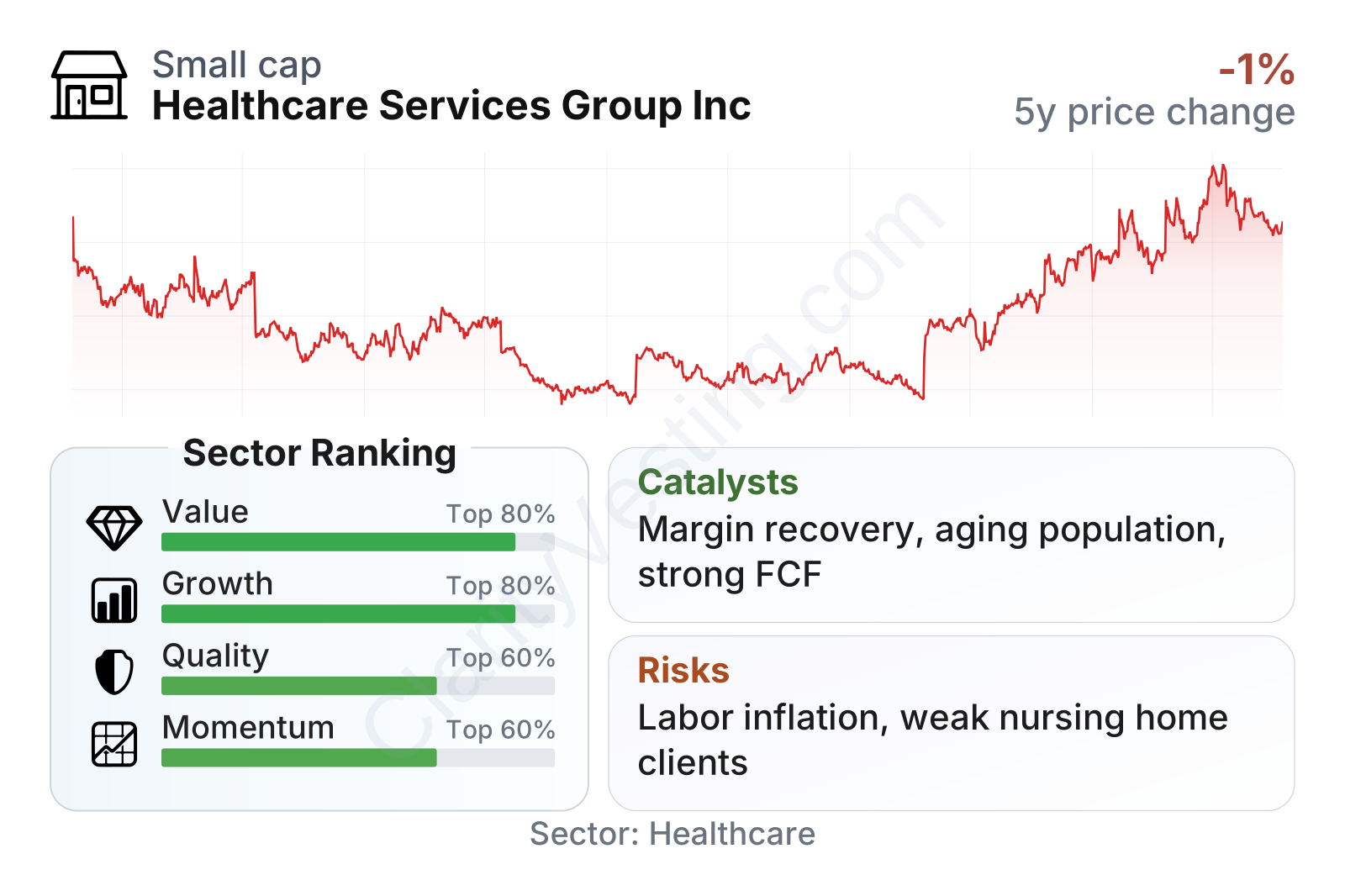
HCSG is a mid-sized healthcare services company with a lower share-price volatility than the broader market. Its valuation metrics currently look lighter than many healthcare peers, while cash generation and returns on capital are notably strong relative to the sector. Growth is more mixed: earnings and free cash flow have improved sharply, but revenue growth remains slower than the healthcare median. Overall, the profile is stronger on financial quality and cash generation than on top-line expansion.
Growth
HCSG operates in a segment that benefits from long-term demographic demand. An aging U.S. population should support the need for skilled nursing, rehabilitation, and senior-care facilities over time. That does not automatically create rapid growth, but it does provide a durable backdrop for outsourced services that these facilities need every day.
The company’s strategy is sensible for this kind of market. It is not trying to build a high-tech healthcare platform; instead, it focuses on services that are operationally critical and difficult for many facilities to staff consistently on their own. When labor remains tight and operators stay focused on cost control, outsourcing housekeeping and dietary functions can remain attractive.
Revenue growth has improved after a softer period in 2023, with stronger year-over-year gains through much of 2025 before moderating again in 2026. That pattern suggests the company did regain momentum, but it is still not operating like a fast-growth business. This remains a steady-service company rather than an aggressive expansion name.
Free cash flow is one of the more encouraging parts of the picture. It has climbed from near break-even territory a few years ago to a much stronger level recently. That matters because it gives the company more flexibility to manage operations, weather industry pressure, and potentially support shareholder returns or selective business investment without depending heavily on debt.
A meaningful catalyst is the continued recovery in margins following prior industry disruptions. Skilled nursing and long-term care operators experienced major labor and occupancy pressure in recent years. As those customers stabilize, HCSG can benefit from more normal service volumes, pricing resets, and better staffing execution. Another favorable factor is the company’s clean balance sheet, which leaves room to absorb temporary shocks while weaker competitors may be under more pressure.
Recent company updates have also emphasized contract discipline and operating efficiency. That is important because future progress likely depends more on executing well within existing markets than on dramatic acquisitions or headline-grabbing expansion.
Risks
This article is for informational purposes only and does not constitute financial advice. Some content is AI-generated. See Disclaimer


