Stock Analysis · HCA Healthcare Inc (HCA)
Overview
HCA Healthcare is one of the largest hospital operators in the United States. It owns and manages hospitals, outpatient centers, surgery centers, freestanding emergency rooms, physician clinics, and other care sites. Its business is centered on delivering medical care and being paid by private insurers, government programs such as Medicare and Medicaid, and patients directly.
The company’s revenue is heavily concentrated in patient services. Based on recent annual reporting, the business is mainly organized around hospital and outpatient care, with a smaller contribution from other activities.
- Inpatient hospital services: approximately 45% to 50% of revenue. This includes admissions for surgeries, intensive care, maternity, cardiovascular care, and other hospital-based treatment.
- Outpatient services: approximately 45% to 50% of revenue. This includes emergency visits, same-day surgeries, imaging, diagnostics, urgent care, and other procedures that do not require overnight admission.
- Other patient-related and ancillary revenue: approximately 5% to 10%. This includes physician-related services and other healthcare support activities.
Another useful way to understand HCA is by who pays the bills. Commercial insurance is typically its largest payment source, followed by Medicare, then Medicaid, with self-pay and other categories making up a smaller share. That mix matters because commercial plans usually reimburse at higher rates than government programs.
HCA’s scale is a central feature of the business. It operates across many local markets, which helps it spread fixed costs, negotiate with suppliers, recruit physicians, and direct patients across a broad network of facilities. In a business where staffing, compliance, and capital spending are major cost items, size can be a meaningful advantage.
Over the past several years, revenue has expanded steadily while net income has remained solid despite rising labor and interest costs. The broad pattern is a large and recurring revenue base, healthy operating profit, and meaningful cash generation.
Key Figures
| Metric | Value | Sector ⓘ |
|---|---|---|
| Date | Oct 24, 2026 | |
| Context | ||
| Sector | Healthcare | |
| Industry | Medical Care Facilities | |
| Market Cap ⓘ | $99.46B | |
| Beta ⓘ | 1.11 | |
Value (Cheapness) | ||
| P/E Ratio ⓘ | 15.40 | 25.42 |
| P/B Ratio ⓘ | N/A | 3.08 |
| FCF Yield ⓘ | 6.03% | 3.12% |
| Dividend Yield ⓘ | 0.64% | 1.85% |
| EBIT / EV ⓘ | 8.36% | 0.56% |
| PEG ⓘ | 1.34 | |
Growth (Business expansion) | ||
| Revenue Growth ⓘ | 8.70% | 7.50% |
| RPS Growth (5Y CAGR) ⓘ | 16.37% | 8.60% |
| EPS Growth (5Y CAGR) ⓘ | -3.58% | -17.73% |
| BVPS Growth (5Y CAGR) ⓘ | N/A | 3.72% |
| Margin Growth (5Y Trend) ⓘ | -3.42% | -0.57% |
| FCF Growth (5Y CAGR) ⓘ | 9.34% | 0.96% |
| DPS Growth (5Y CAGR) ⓘ | 11.59% | 6.69% |
Quality (Business durability) | ||
| ROIC (Latest) ⓘ | 23.54% | 3.17% |
| ROA (Latest) ⓘ | 11.37% | 2.98% |
| ROIC (5Y Median) ⓘ | 23.61% | 4.56% |
| ROA (5Y Median) ⓘ | 10.94% | 1.87% |
| Net Debt / EBIT (Latest) ⓘ | 3.93 | 1.34 |
| Net Debt / EBIT (5Y Median) ⓘ | 4.07 | 1.86 |
| Net Debt / EBITDA (Latest) ⓘ | 3.02 | 1.00 |
| Net Debt / Assets ⓘ | 78.91% | 5.06% |
| EBITDA / Interest ⓘ | 6.84 | 9.55 |
| Operating Margin (Latest) ⓘ | 15.59% | 9.25% |
| Operating Margin (5Y Median) ⓘ | 15.98% | 7.33% |
| Debt to Equity (Latest) ⓘ | -741.84% | 26.68% |
| Profit Margin (Latest) ⓘ | 8.77% | 3.34% |
| Free Cash Flow (Latest) ⓘ | $6.00B | |
Momentum (Price trend) | ||
| 3Y Return ⓘ | +98.44% | +51.61% |
| 12M Return (excl. last month) ⓘ | +8.32% | +19.90% |
| 6M Return ⓘ | -0.47% | +10.10% |
| Price vs. 200-Day MA ⓘ | +5.42% | +6.44% |
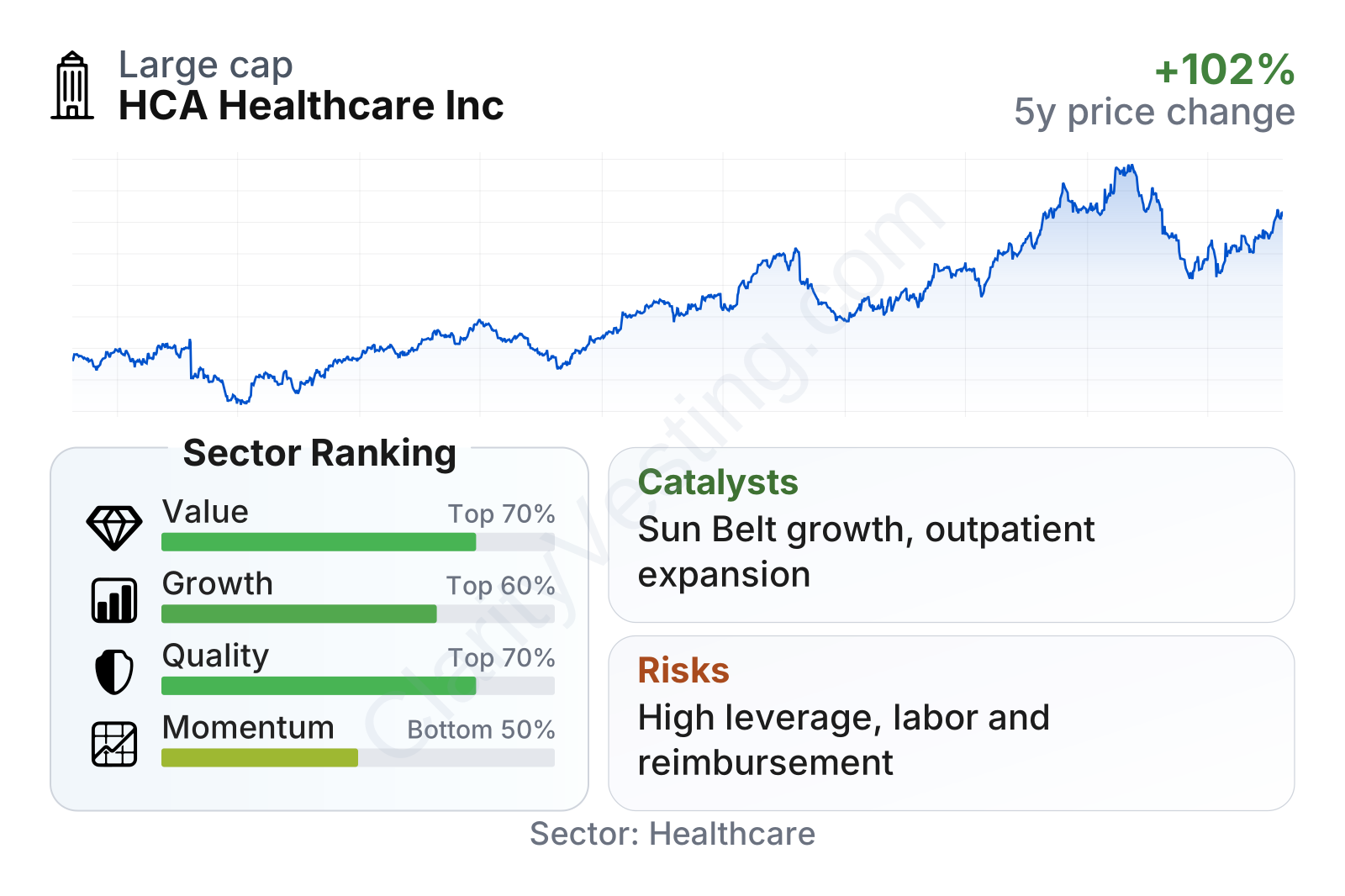
HCA stands out as a very large healthcare operator with profitability and returns on capital that are well above the sector median. Revenue growth has been better than many peers, and free cash flow generation is strong. The main offset is leverage: debt-related metrics are clearly heavier than typical healthcare companies, while recent share-price momentum has cooled after a strong multi-year run.
Growth
Healthcare services is a structurally growing sector. The most important long-term drivers are aging demographics, population growth in HCA’s core markets, rising healthcare utilization, and the ongoing shift of many procedures toward outpatient settings. Hospitals are not high-growth technology businesses, but demand tends to be durable because medical care is a recurring need rather than a discretionary purchase.
HCA’s strategy is aligned with those trends. The company continues to expand capacity in attractive markets, add outpatient access points, recruit physicians, and increase throughput inside existing facilities. That approach makes sense because growth in this industry often comes from serving more patients efficiently rather than from launching entirely new products.
Recent revenue growth has remained positive and generally solid, with the latest year-over-year pace slightly above the sector median. The pattern is not perfectly smooth, but it shows a business that has continued to expand through changing cost conditions and fluctuating admission trends.
Cash generation is another favorable point. Free cash flow has trended higher over time and recently moved to a notably stronger level. That matters because hospital systems require substantial spending on buildings, equipment, and technology. A company that can still produce billions of dollars in cash after those investments has more flexibility to fund expansion, repurchase shares, pay dividends, and manage debt.
Several catalysts support future growth. First, HCA remains exposed to Sun Belt markets such as Texas and Florida, where population growth and employer expansion can support patient volumes over time. Second, outpatient care keeps becoming more important across the industry, and HCA already has the footprint to capture that demand. Third, the company has continued to invest in digital tools, bed management, staffing efficiency, and clinical standardization, which can lift capacity without requiring the same pace of new construction.
Recent company updates have also pointed to continued capital deployment into new facilities, bed additions, and ambulatory sites. For HCA, that is significant because local density often reinforces market position: once a system has enough hospitals, physicians, and outpatient locations in a metro area, it can capture referrals more effectively and make each additional site more productive.
Risks
This article is for informational purposes only and does not constitute financial advice. Some content is AI-generated. See Disclaimer


