Stock Analysis · Hbt Financial Inc (HBT)
Overview
HBT Financial, Inc. is the parent company of Heartland Bank and Trust Company, a regional bank based in Illinois. It provides traditional banking services to individuals, families, small businesses, commercial clients, and public-sector customers. In simple terms, the company gathers deposits from customers, pays interest on some of those deposits, and then uses that funding to make loans and invest in securities. The difference between what it earns and what it pays is the core of the business.
Like most regional banks, HBT’s revenue is driven mainly by net interest income, with a smaller contribution from fees and service charges. Based on recent annual results, the revenue mix appears to be approximately:
- Net interest income: about 75% to 85% — income from commercial real estate loans, agricultural loans, commercial and industrial loans, residential real estate loans, consumer lending, and the securities portfolio, after funding costs are deducted.
- Noninterest income: about 15% to 25% — deposit account fees, wealth management and trust services, mortgage-related revenue, debit card and interchange fees, gains on sales, and other customer service fees.
That structure makes HBT a fairly straightforward bank to understand: its performance depends heavily on loan growth, deposit costs, credit quality, and the interest-rate environment. Over the last several years, total revenue has trended upward, and net income has also improved, even though higher interest expense has taken a larger share of revenue as deposit competition increased across the banking industry.
Because HBT is a community and regional lender rather than a national giant, its results are closely tied to the economic health of the Midwest markets it serves. That can be a strength when local relationships are durable, but it also means geographic concentration matters.
The business mix has become larger over time, with revenue rising from roughly $160 million in 2021 to just under $300 million in 2025. Expenses also rose, but operating income and net income still moved higher overall, suggesting the bank has expanded while largely preserving profitability.
Key Figures
| Metric | Value | Sector ⓘ |
|---|---|---|
| Date | Oct 17, 2026 | |
| Context | ||
| Sector | Financial Services | |
| Industry | Banks - Regional | |
| Market Cap ⓘ | $1.27B | |
| Beta ⓘ | 0.49 | |
Value (Cheapness) | ||
| P/E Ratio ⓘ | 15.06 | 12.26 |
| P/B Ratio ⓘ | 1.68 | 1.23 |
| FCF Yield ⓘ | 5.96% | 10.40% |
| Dividend Yield ⓘ | 2.49% | 3.02% |
| EBIT / EV ⓘ | 8.19% | 8.14% |
| PEG ⓘ | N/A | |
Growth (Business expansion) | ||
| Revenue Growth ⓘ | 37.70% | 9.35% |
| RPS Growth (5Y CAGR) ⓘ | 12.10% | 12.19% |
| EPS Growth (5Y CAGR) ⓘ | -15.12% | -9.53% |
| BVPS Growth (5Y CAGR) ⓘ | -40.13% | 4.99% |
| Margin Growth (5Y Trend) ⓘ | -10.99% | -3.86% |
| FCF Growth (5Y CAGR) ⓘ | 15.48% | 4.81% |
| DPS Growth (5Y CAGR) ⓘ | 8.86% | 8.79% |
Quality (Business durability) | ||
| ROIC (Latest) ⓘ | 9.87% | 9.49% |
| ROE (Latest) ⓘ | 11.40% | 13.90% |
| ROA (Latest) ⓘ | 1.32% | 1.55% |
| ROIC (5Y Median) ⓘ | 11.53% | 7.86% |
| ROE (5Y Median) ⓘ | 13.28% | 12.17% |
| ROA (5Y Median) ⓘ | 1.41% | 1.30% |
| Net Debt / EBIT (Latest) ⓘ | 0.16 | 0.96 |
| Net Debt / EBIT (5Y Median) ⓘ | 0.06 | 0.73 |
| Net Debt / EBITDA (Latest) ⓘ | 0.15 | 0.92 |
| Operating Margin (Latest) ⓘ | 31.83% | 22.30% |
| Operating Margin (5Y Median) ⓘ | 35.63% | 24.63% |
| Debt to Equity (Latest) ⓘ | 19.53% | 58.56% |
| Profit Margin (Latest) ⓘ | 29.24% | 26.57% |
| Free Cash Flow (Latest) ⓘ | $75.68M | |
Momentum (Price trend) | ||
| 3Y Return ⓘ | +117.38% | +88.33% |
| 12M Return (excl. last month) ⓘ | +48.20% | +19.38% |
| 6M Return ⓘ | +26.47% | +4.75% |
| Price vs. 200-Day MA ⓘ | +16.44% | +3.50% |
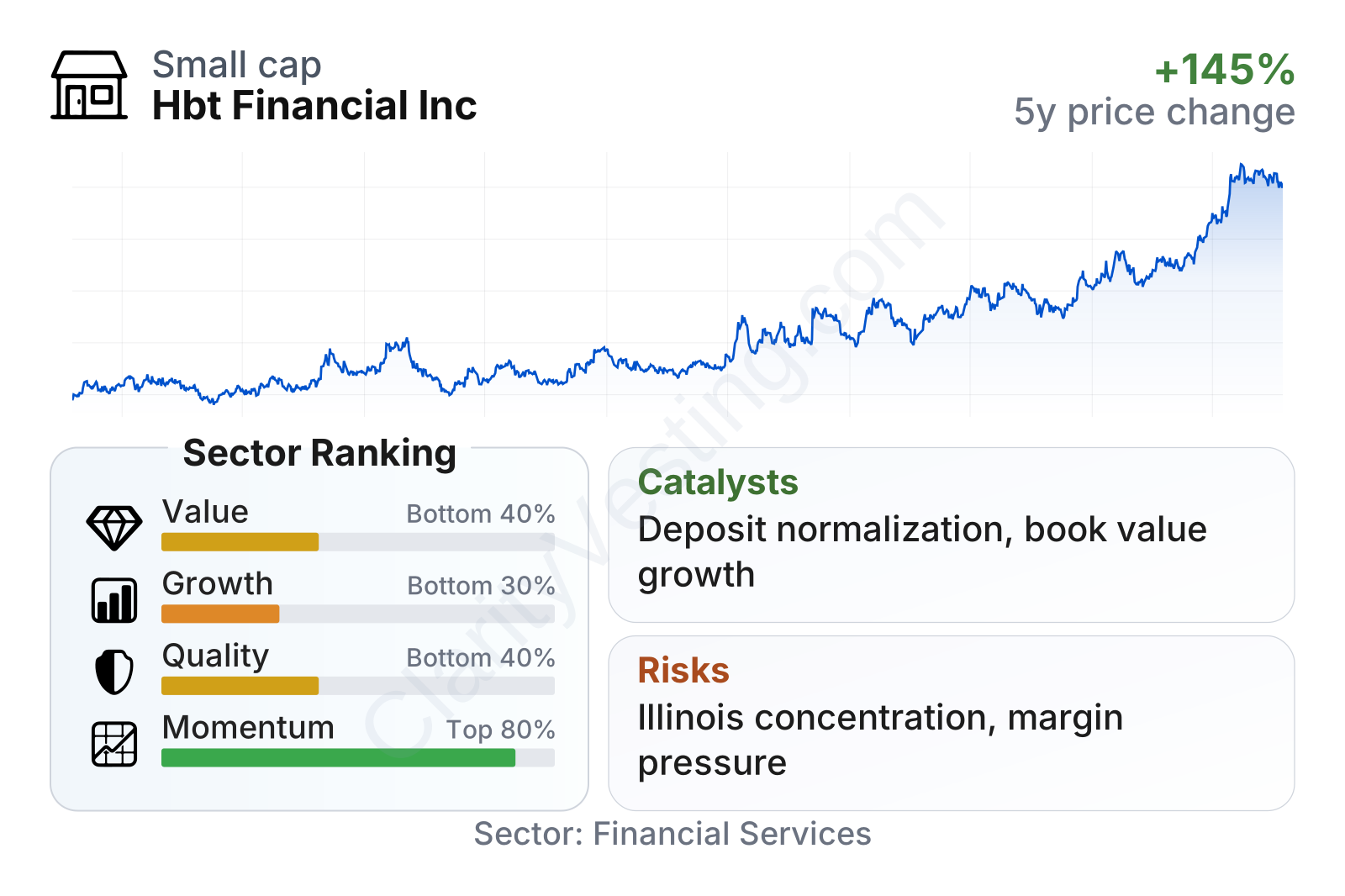
HBT sits in the small-cap range, and the recent share-price trend has been strong relative to much of the regional banking group. The factor breakdown is more mixed. Valuation looks somewhat richer than the sector median on both earnings and book value, while growth rankings remain weak despite a sharp recent revenue increase. Quality measures are near the middle to lower half of the peer set in the latest snapshot, although profitability is still solid in absolute terms, with profit margin around 29% and debt-to-equity notably lower than many peers. Momentum is the clearest area of strength.
The stock-price chart shows a powerful move higher since late 2023, with especially strong gains through 2025 and into 2026. That kind of performance often reflects improving earnings expectations, better confidence in balance-sheet resilience, or both.
Growth
Regional banking is not a high-growth industry in the way software or biotechnology can be, but it remains essential. Banks that can gather stable local deposits, lend carefully, and deepen relationships with businesses and households can still compound value over long periods. HBT operates in a mature sector, yet there is still room for growth through market share gains, selective branch expansion, commercial lending, treasury services, and wealth management.
The company’s strategy appears sensible for that kind of environment. Community banking can produce durable customer ties, especially in commercial, agricultural, and small-business markets where service and local decision-making matter. For HBT, one of the main opportunities is to keep growing loans and fee-generating relationships without letting funding costs or credit issues erode the benefit.
Earnings per share have been relatively steady to improving over the past several years, moving from a little above $2.00 in 2021 to the mid-$2 range more recently. That is not explosive growth, but it does show resilience through a difficult rate cycle for banks. The latest partial-year figures suggest the company is still profitable, though the pace of improvement has not been perfectly smooth.
Book value per share has also climbed meaningfully in recent years after an older outlier figure, reaching close to $20 by 2025. For a bank, book value matters because it reflects the underlying capital base supporting future lending and earnings. A rising book value per share generally points to retained profitability and balance-sheet building over time.
A notable near-term catalyst is the banking sector’s normalization after the stress that affected many regional banks in prior periods. If deposit costs stabilize and loan yields remain supportive, HBT could continue expanding net interest income. Public company updates in 2026 should also be watched for signs of loan growth, margin stability, commercial customer activity, and credit performance. In addition, if management continues to grow fee businesses such as wealth management and service charges, that could modestly diversify revenue away from pure spread income.
Risks
This article is for informational purposes only and does not constitute financial advice. Some content is AI-generated. See Disclaimer


