Stock Analysis · Harbour Energy PLC (HBRIY)
Overview
Harbour Energy PLC is an independent oil and gas producer. The company explores for hydrocarbons, develops fields, and produces crude oil, natural gas, and natural gas liquids. Historically, Harbour was heavily centered on the UK North Sea, but it has been expanding into a broader international portfolio through acquisitions and portfolio changes. That matters because oil and gas companies are shaped not only by commodity prices, but also by the geographic mix of their fields, tax regimes, and reserve life.
Its revenue mainly comes from selling produced hydrocarbons. Based on the company’s business model and recent annual reporting, the mix is primarily split between crude oil, natural gas, and natural gas liquids, with a smaller contribution from other income such as tariffs, trading-related activity, and hedging effects when applicable. A simple way to think about the business is:
- Crude oil: typically the largest contributor, driven by production volumes and global oil prices.
- Natural gas: an important second pillar, especially in the UK and European markets where domestic supply can carry strategic value.
- Natural gas liquids and other revenue: a smaller share, including liquids associated with gas production and certain non-core operating income.
Harbour does not operate a large refining, chemicals, or retail network like the integrated oil majors. Its economics therefore depend much more directly on upstream production, operating costs, field performance, and realized commodity prices. In recent years, revenue has been volatile rather than steadily compounding, which is typical for an exploration and production company.
Looking at the operating flow over time, the business has shown the ability to generate strong gross and operating profit in favorable markets, but taxes and financing costs have absorbed a large share of that value. This helps explain why strong operating results have not always translated into equally strong net profit.
Key Figures
| Metric | Value | Sector ⓘ |
|---|---|---|
| Date | Oct 17, 2026 | |
| Context | ||
| Sector | Energy | |
| Industry | Oil & Gas E&P | |
| Market Cap ⓘ | $5.69B | |
| Beta ⓘ | -0.30 | |
Value (Cheapness) | ||
| P/E Ratio ⓘ | 23.75 | 15.44 |
| P/B Ratio ⓘ | 1.58 | 1.73 |
| FCF Yield ⓘ | 57.83% | 8.20% |
| Dividend Yield ⓘ | 4.16% | 3.59% |
| EBIT / EV ⓘ | 64.81% | 7.46% |
| PEG ⓘ | N/A | |
Growth (Business expansion) | ||
| Revenue Growth ⓘ | 21.60% | 26.90% |
| RPS Growth (5Y CAGR) ⓘ | 10.62% | 6.90% |
| EPS Growth (5Y CAGR) ⓘ | N/A | -15.73% |
| BVPS Growth (5Y CAGR) ⓘ | 46.40% | 6.07% |
| Margin Growth (5Y Trend) ⓘ | 20.10% | 0.58% |
| FCF Growth (5Y CAGR) ⓘ | 16.06% | 1.86% |
| DPS Growth (5Y CAGR) ⓘ | 195.78% | 16.79% |
Quality (Business durability) | ||
| ROIC (Latest) ⓘ | 1.14% | 11.40% |
| ROA (Latest) ⓘ | 0.18% | 6.06% |
| ROIC (5Y Median) ⓘ | -0.73% | 10.30% |
| ROA (5Y Median) ⓘ | 0.06% | 5.42% |
| Net Debt / EBIT (Latest) ⓘ | 1.06 | 1.64 |
| Net Debt / EBIT (5Y Median) ⓘ | 1.95 | 1.83 |
| Net Debt / EBITDA (Latest) ⓘ | 0.58 | 1.08 |
| Net Debt / Assets ⓘ | 25.07% | 17.29% |
| EBITDA / Interest ⓘ | 17.92 | 9.64 |
| Operating Margin (Latest) ⓘ | 36.10% | 16.27% |
| Operating Margin (5Y Median) ⓘ | 25.38% | 20.39% |
| Debt to Equity (Latest) ⓘ | 211.08% | 54.76% |
| Profit Margin (Latest) ⓘ | 2.91% | 8.82% |
| Free Cash Flow (Latest) ⓘ | $3.29B | |
Momentum (Price trend) | ||
| 3Y Return ⓘ | +46.26% | +67.38% |
| 12M Return (excl. last month) ⓘ | +32.89% | +49.19% |
| 6M Return ⓘ | +1.79% | +7.07% |
| Price vs. 200-Day MA ⓘ | +10.72% | +9.56% |
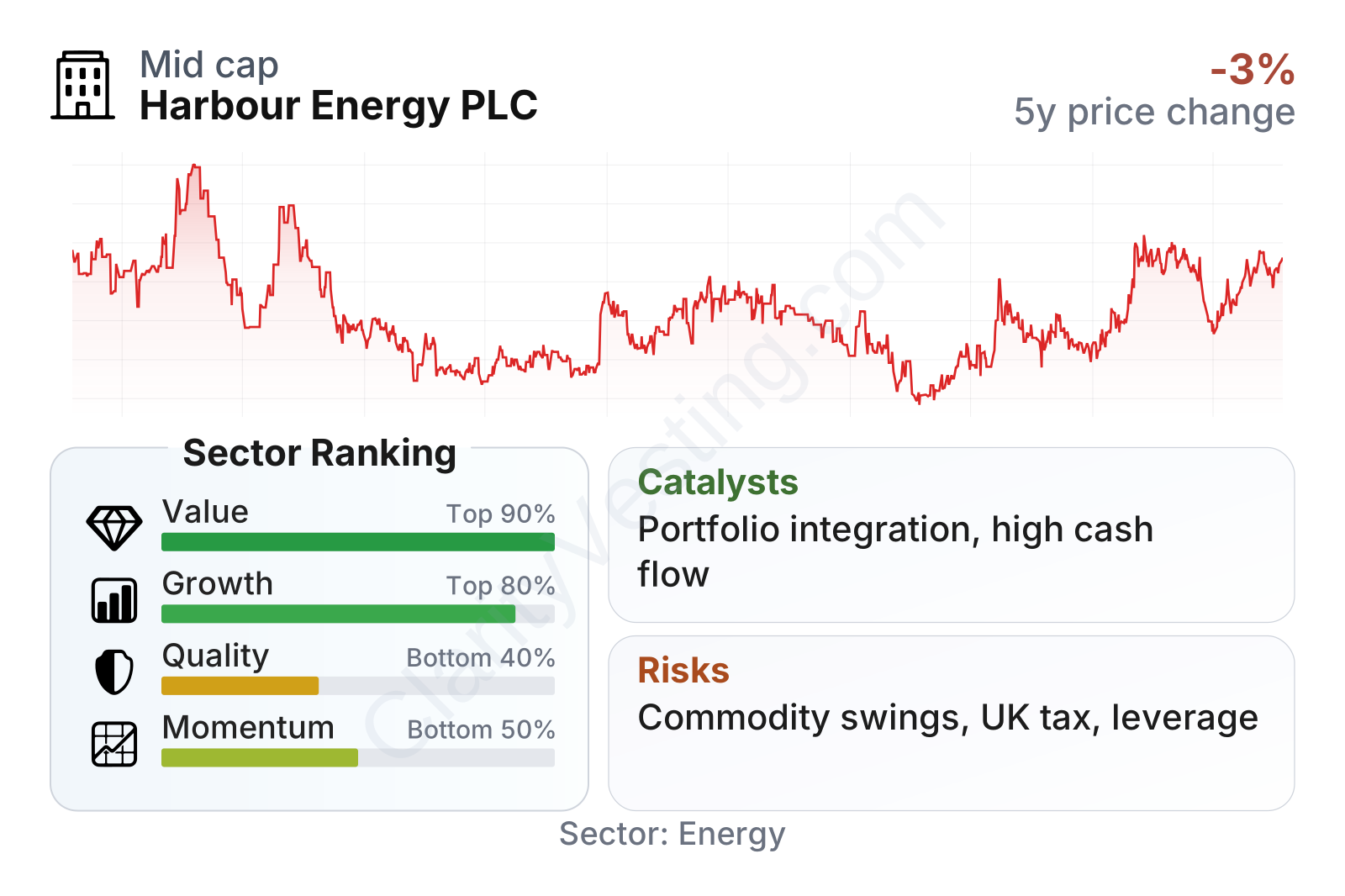
Harbour is a mid-sized energy company by market value. The stock’s recent path has been volatile, which is consistent with a commodity-sensitive producer rather than a stable utility-like energy business. In the factor snapshot, the company stands out most on value, ranking near the top of its sector, helped by a very high free cash flow yield, a strong EBIT-to-enterprise-value ratio, and a dividend yield slightly above the sector median. Growth also screens well, especially on multi-year revenue per share, free cash flow expansion, and book value growth.
The weaker areas are quality and momentum. Returns on assets and invested capital are low compared with the sector, while recent share-price performance has lagged many peers. This combination suggests a company that appears cheap on cash-based measures, but where the market is still discounting risks around profitability durability, leverage, and cyclicality.
Growth
The company operates in a sector that is mature rather than structurally high-growth. Global oil and gas demand is still substantial, and natural gas in particular is likely to remain important as a transition fuel in many markets, but this is not a business riding the same long runway as software or semiconductors. Long-term growth in this industry usually comes from acquiring reserves, bringing new fields online, improving recovery rates, and reallocating capital toward better-return assets.
Harbour’s strategy is logical for that environment. Instead of trying to transform into a broad clean-energy platform, it remains focused on what it knows best: upstream oil and gas. The key question is whether it can turn scale and portfolio reshaping into more durable production and cash generation. The company has been broadening beyond the UK, which is strategically important because it reduces dependence on a single mature basin and a single tax regime.
Revenue growth has been lumpy, with very strong jumps in some periods rather than a smooth upward trend. That usually reflects a mix of commodity prices, acquisitions, and changing production volumes. Over a five-year view, revenue per share growth has still been better than the sector median, which indicates that Harbour has created more business volume per share than many peers despite the volatility.
Free cash flow is one of the more encouraging points in the case. Recent trailing cash generation has been substantial for a company of Harbour’s size, and its five-year free cash flow growth rate is well above the industry midpoint. That gives management more room to fund development, manage debt, and maintain shareholder distributions. It also suggests that the market’s caution is not coming from an absence of cash generation, but from concern about how repeatable that cash flow is across different price environments.
A meaningful catalyst is the company’s enlarged international operating base after recent portfolio moves. A broader reserve and production footprint can improve field life, smooth regional operational issues, and create more opportunities to direct capital toward higher-return assets. Another catalyst is any sustained period of supportive oil and gas prices, because Harbour’s upstream exposure gives it high sensitivity to stronger realized prices.
Recent company updates have also pointed to continued integration and optimization work following major asset additions. If the company can convert that larger asset base into steadier production and lower unit costs, the market could place more weight on Harbour’s cash flow than on its current earnings volatility.
Risks
This article is for informational purposes only and does not constitute financial advice. Some content is AI-generated. See Disclaimer


