Stock Analysis · HSBC Holdings PLC (HBCYF)
Overview
HSBC Holdings PLC is one of the world’s largest banking groups. It provides everyday banking, lending, payments, wealth management, commercial banking, and global markets services to individuals, businesses, institutions, and governments. Its footprint is especially important in Asia, the Middle East, and the United Kingdom, and the group has increasingly focused its strategy on markets where cross-border trade and wealth creation are growing faster.
For a simple way to think about HSBC, it is a bank that earns money from three broad engines: lending and deposit spreads, fees from wealth and transaction services, and capital markets activities. Because it operates across many countries, it is also a major facilitator of international money flows for multinational companies and affluent clients.
Based on recent annual reporting, HSBC’s revenue mix is led by the following business lines:
- Wealth and Personal Banking: about 40% of revenue. This includes retail banking, deposits, mortgages, credit cards, insurance, and wealth products for mass-market and affluent customers.
- Commercial Banking: about 30% of revenue. This covers lending, cash management, trade finance, foreign exchange, and treasury services for small, medium-sized, and large corporate clients.
- Global Banking and Markets: about 25% of revenue. This segment serves large corporates, financial institutions, and investors through financing, advisory, securities, and trading-related activities.
- Corporate Centre and other items: roughly 5%, varying by period. This typically includes central costs, legacy positions, and valuation or funding-related effects.
Geographically, Asia remains the core profit center. Hong Kong is usually the single most important market, while the UK is still a major operating base. This matters because HSBC is not just a generic global bank; it is increasingly positioned as a bank tied to Asian wealth, trade, and capital flows.
The business flow over recent years shows a strong rise in total revenue through 2024 and 2025, helped by higher interest income and resilient profitability. Net income also stayed at a high level, although operating costs rose in 2025, which is worth watching.
Key Figures
| Metric | Value | Sector ⓘ |
|---|---|---|
| Date | Oct 10, 2026 | |
| Context | ||
| Sector | Financial Services | |
| Industry | Banks - Diversified | |
| Market Cap ⓘ | $308.99B | |
| Beta ⓘ | 0.58 | |
Value (Cheapness) | ||
| P/E Ratio ⓘ | 12.38 | 12.38 |
| P/B Ratio ⓘ | 1.70 | 1.23 |
| FCF Yield ⓘ | 6.98% | 10.23% |
| Dividend Yield ⓘ | 3.97% | 3.01% |
| EBIT / EV ⓘ | N/A | 8.08% |
| PEG ⓘ | 2.55 | |
Growth (Business expansion) | ||
| Revenue Growth ⓘ | 25.40% | 9.50% |
| RPS Growth (5Y CAGR) ⓘ | 26.92% | 12.21% |
| EPS Growth (5Y CAGR) ⓘ | -4.97% | -9.62% |
| BVPS Growth (5Y CAGR) ⓘ | -7.32% | 4.98% |
| Margin Growth (5Y Trend) ⓘ | -19.58% | -4.07% |
| FCF Growth (5Y CAGR) ⓘ | -44.48% | 4.76% |
| DPS Growth (5Y CAGR) ⓘ | 16.69% | 8.79% |
Quality (Business durability) | ||
| ROIC (Latest) ⓘ | 7.42% | 9.35% |
| ROE (Latest) ⓘ | 13.43% | 13.91% |
| ROA (Latest) ⓘ | 0.77% | 1.53% |
| ROIC (5Y Median) ⓘ | 4.72% | 7.86% |
| ROE (5Y Median) ⓘ | 13.09% | 12.22% |
| ROA (5Y Median) ⓘ | 0.73% | 1.29% |
| Net Debt / EBIT (Latest) ⓘ | -2.87 | 0.99 |
| Net Debt / EBIT (5Y Median) ⓘ | -3.52 | 0.73 |
| Net Debt / EBITDA (Latest) ⓘ | -2.43 | 0.93 |
| Operating Margin (Latest) ⓘ | 25.72% | 22.19% |
| Operating Margin (5Y Median) ⓘ | 36.80% | 24.30% |
| Debt to Equity (Latest) ⓘ | 67.57% | 60.24% |
| Profit Margin (Latest) ⓘ | 37.80% | 26.49% |
| Free Cash Flow (Latest) ⓘ | $21.56B | |
Momentum (Price trend) | ||
| 3Y Return ⓘ | +171.00% | +88.52% |
| 12M Return (excl. last month) ⓘ | +77.19% | +19.65% |
| 6M Return ⓘ | -3.30% | +6.00% |
| Price vs. 200-Day MA ⓘ | -4.28% | +3.61% |
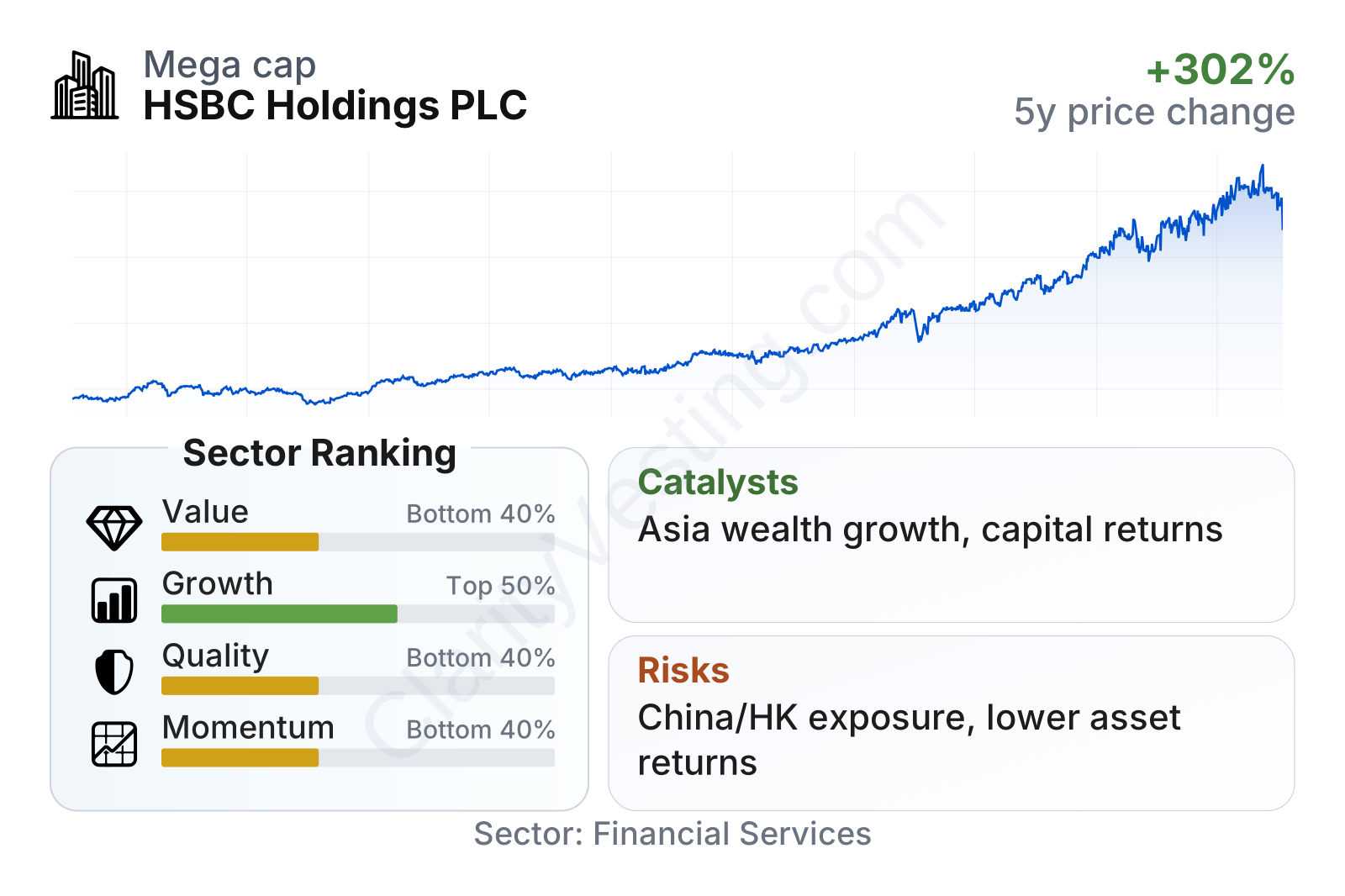
HSBC is a very large bank with a relatively low share-price volatility profile, reflected by a beta well below 1. On valuation, its earnings multiple is close to the sector median, but its price-to-book ratio has moved above the sector median after a strong stock run. Income remains a notable part of the profile, with a trailing dividend yield around 4%, which is above the sector median.
On growth, the recent picture is stronger than it first appears. Revenue growth over the last year and over the last five years has outpaced much of the sector, even though earnings per share growth over five years has been mixed and book value per share has been less consistent. Quality metrics are more balanced: profit margin and operating margin are solid, but return on assets remains below many peers, which is common for a large balance-sheet-heavy bank with substantial low-yield assets.
Growth
HSBC operates in a sector that is mature in developed markets but still has real expansion potential in the areas that matter most to it: Asian wealth accumulation, cross-border trade, international payments, and corporate treasury services. These are not early-stage trends, but they are durable ones. Rising affluence in Asia, growing demand for wealth products, and continued complexity in global supply chains all support HSBC’s strategic direction.
The company’s strategy also makes practical sense. Management has spent several years simplifying the group, cutting lower-return operations, redeploying capital toward Asia and higher-return segments, and emphasizing fee-based wealth activities alongside traditional banking income. For a large bank, that is generally a sensible mix: wealth management can improve fee generation, while transaction banking and trade finance can deepen customer relationships without relying only on loan growth.
Earnings per share have improved meaningfully since 2021, with annual results trending upward through 2025. That suggests the restructuring and rate environment have both helped. Even so, long-term readers should separate cyclical help from structural progress. A portion of the recent earnings strength came from higher interest rates, which boosted net interest income across banking. The more durable question is whether HSBC can keep growing fees, client assets, and cross-border business even if rates normalize.
Book value per share has been less stable than earnings, reflecting capital returns, currency effects, and the shifting shape of the balance sheet. That does not automatically weaken the business, but it does mean growth has not been uniform across every measure. In other words, HSBC’s recent progress looks more driven by profitability and business mix improvement than by steady balance-sheet compounding.
A meaningful catalyst is the bank’s strength in Hong Kong and the broader Asia corridor. HSBC has a rare combination of consumer banking scale, commercial banking relationships, and institutional market access in that region. Another potential tailwind is continued demand from affluent and internationally mobile clients who want one bank for savings, investment products, payments, and cross-border needs. Ongoing capital distributions and efficiency actions also support the overall growth case, as long as revenue stays resilient enough to absorb cost inflation.
Risks
This article is for informational purposes only and does not constitute financial advice. Some content is AI-generated. See Disclaimer


