Stock Analysis · Huntington Bancshares Incorporated (HBAN)
Overview
Huntington Bancshares Incorporated is a large regional bank based in the Midwest. It provides everyday banking services such as checking and savings accounts, mortgages, auto lending, commercial loans, treasury management, wealth management, and payments services. Its customer base spans consumers, small businesses, middle-market companies, larger commercial clients, and specialized verticals such as equipment finance and vehicle lending.
Like most banks, Huntington does not operate with one simple product line. Its revenue mainly comes from earning more on loans and securities than it pays on deposits and other funding, plus a layer of fees from customer services. Based on its recent annual reporting, the mix is approximately as follows:
- Net interest income: about 65% to 75% of total revenue. This is the spread between interest earned on loans and securities and interest paid on deposits and borrowings. It is the core earnings engine for the bank.
- Noninterest income: about 25% to 35% of total revenue. This includes service charges on deposit accounts, card and payment income, wealth and asset management fees, mortgage banking, capital markets activity, leasing, and other customer-related fees.
- Within lending, commercial and industrial, commercial real estate, residential mortgage, home equity, and auto finance are major balance-sheet categories that support interest income, though banks do not usually break total revenue cleanly by each loan type.
Huntington’s business model is relatively straightforward for a bank: gather deposits at scale, lend those funds across consumer and commercial categories, cross-sell fee-based services, and control credit losses and operating costs. Over the last several years, total revenue has expanded meaningfully, but rising funding costs have also become a larger part of the picture, which is important for understanding current profitability.
The long-term trend shows a bigger revenue base than a few years ago, but also a sharp increase in interest expense as deposit and funding costs reset higher. That means growth has not translated one-for-one into stronger returns, even though net income has remained solid in dollar terms.
Key Figures
| Metric | Value | Sector ⓘ |
|---|---|---|
| Date | Oct 03, 2026 | |
| Context | ||
| Sector | Financial Services | |
| Industry | Banks - Regional | |
| Market Cap ⓘ | $30.83B | |
| Beta ⓘ | 0.94 | |
Value (Cheapness) | ||
| P/E Ratio ⓘ | 11.74 | 12.60 |
| P/B Ratio ⓘ | 0.92 | 1.23 |
| FCF Yield ⓘ | 9.59% | 10.16% |
| Dividend Yield ⓘ | 4.06% | 2.96% |
| EBIT / EV ⓘ | N/A | 7.77% |
| PEG ⓘ | 1.63 | |
Growth (Business expansion) | ||
| Revenue Growth ⓘ | 47.60% | 9.50% |
| RPS Growth (5Y CAGR) ⓘ | 15.11% | 12.10% |
| EPS Growth (5Y CAGR) ⓘ | -15.99% | -9.45% |
| BVPS Growth (5Y CAGR) ⓘ | 4.98% | 5.01% |
| Margin Growth (5Y Trend) ⓘ | -4.64% | -4.07% |
| FCF Growth (5Y CAGR) ⓘ | 5.84% | 4.96% |
| DPS Growth (5Y CAGR) ⓘ | -0.55% | 8.79% |
Quality (Business durability) | ||
| ROIC (Latest) ⓘ | N/A | 9.60% |
| ROE (Latest) ⓘ | 8.75% | 13.84% |
| ROA (Latest) ⓘ | 0.97% | 1.53% |
| ROIC (5Y Median) ⓘ | 6.17% | 7.86% |
| ROE (5Y Median) ⓘ | 10.05% | 12.20% |
| ROA (5Y Median) ⓘ | 1.03% | 1.29% |
| Net Debt / EBIT (Latest) ⓘ | N/A | 0.91 |
| Net Debt / EBIT (5Y Median) ⓘ | 1.35 | 0.74 |
| Net Debt / EBITDA (Latest) ⓘ | 5.31 | 0.97 |
| Operating Margin (Latest) ⓘ | N/A | 22.12% |
| Operating Margin (5Y Median) ⓘ | 22.12% | 24.39% |
| Debt to Equity (Latest) ⓘ | 66.97% | 60.37% |
| Profit Margin (Latest) ⓘ | 26.13% | 26.62% |
| Free Cash Flow (Latest) ⓘ | $2.96B | |
Momentum (Price trend) | ||
| 3Y Return ⓘ | +71.31% | +89.23% |
| 12M Return (excl. last month) ⓘ | -4.35% | +17.35% |
| 6M Return ⓘ | -2.53% | +10.00% |
| Price vs. 200-Day MA ⓘ | -8.63% | +3.73% |
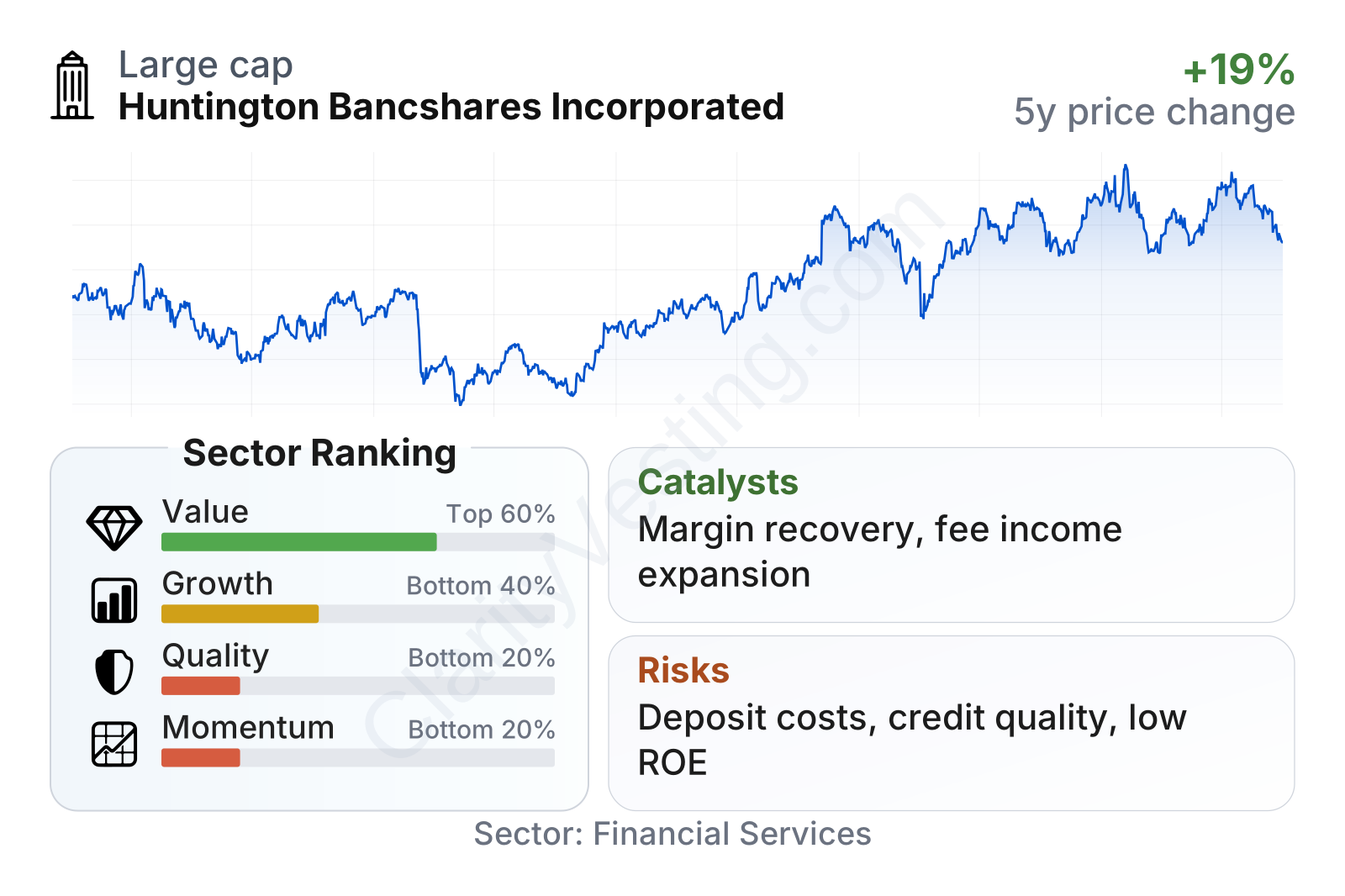
Huntington sits in the large regional-bank category, with a market value of roughly $32 billion and a beta just under 1, which suggests share-price volatility broadly in line with the wider market. On valuation, the stock trades near the sector median on earnings and below the sector median on price-to-book, while its dividend yield is above the sector median.
The more mixed picture appears in business quality and market performance. Revenue growth has recently been strong, but the broader growth profile is less impressive because earnings per share and dividend growth over five years have lagged. Profitability ratios such as return on equity and return on assets are below many regional-bank peers, and recent share-price momentum has also been weaker than the sector median.
Growth
Huntington operates in a mature industry, not a high-growth one. Regional banking generally grows with population, business formation, credit demand, payments activity, and economic expansion in its footprint. That means the company’s long-term opportunity is more about disciplined market share gains, smart balance-sheet management, and selective expansion than about explosive industry growth.
Its strategy does make sense for that environment. Huntington has emphasized relationship banking in the Midwest, expansion into adjacent markets, a broad consumer and commercial product set, and specialty businesses that can add fee income and improve customer retention. The combination of traditional lending with treasury management, payments, wealth, and capital-markets services can deepen client relationships and raise revenue per customer over time.
Earnings have been uneven rather than steadily compounding. The pattern shows that Huntington can produce solid profit levels, but it is still exposed to the banking cycle: changes in deposit pricing, loan growth, credit costs, and interest rates all matter. That does not undermine the franchise, but it does mean growth should be viewed as cyclical and operational rather than purely structural.
Book value per share has recovered and moved higher after earlier pressure, which is an important signal for a bank. In simple terms, book value tracks the balance-sheet capital that supports future lending and earnings. A rising trend here can strengthen flexibility for growth, dividends, and absorbing credit shocks.
A meaningful catalyst is the interest-rate environment. If deposit costs stabilize while asset yields remain supportive, net interest income can improve. Huntington also continues to benefit from scale in commercial banking, payments, and wealth-related services, which can diversify revenue beyond spread income. In addition, continued economic activity in its core Midwest footprint, especially among commercial clients and consumers, can support loan demand.
Recent company updates have also pointed to continued investment in digital capabilities, efficiency efforts, and customer acquisition across both consumer and business banking. None of these changes alone transforms the company, but together they support a practical long-term growth path for a regional bank.
Risks
This article is for informational purposes only and does not constitute financial advice. Some content is AI-generated. See Disclaimer