Stock Analysis · Hays PLC (HAYPY)
Overview
Hays PLC is a global recruitment and workforce solutions company. It helps employers find permanent staff, temporary workers, and contractors across a wide range of professions. The business is especially active in specialist recruitment, meaning it focuses on trained professionals rather than broad low-skill hiring. Its operations span many countries, with meaningful exposure to Europe, the United Kingdom and Ireland, Australia and New Zealand, and parts of Asia and the Americas.
The company mainly earns money from recruitment fees and placement-related income. In broad terms, temporary and contracting activity tends to generate recurring fee income as long as workers remain on assignment, while permanent placement income is more transactional and usually more sensitive to hiring slowdowns.
Based on Hays’ reporting structure and recent annual disclosures, revenue and fees are primarily driven by the following areas:
- Temporary recruitment and contracting: the largest activity, generally estimated at around 55% to 65% of group net fees in recent years. This includes placing workers into temporary assignments and contractor roles, often in areas such as technology, engineering, construction, accountancy, and business support.
- Permanent recruitment: generally around 35% to 45% of group net fees. This is the traditional placement business where Hays earns a fee when a client hires a candidate into a full-time role.
- Other HR and related services: a smaller share, typically a low-single-digit percentage of activity. This can include managed services and other workforce support offerings depending on the country mix.
Geographically, Hays has historically had its largest exposure to Germany, followed by the United Kingdom & Ireland, then Australia & New Zealand, with the rest spread across continental Europe and other international markets. That diversification matters because hiring cycles often weaken at different times across regions and sectors.
The broad financial picture has become tougher. Revenue has stayed large in absolute terms, but profitability has fallen sharply from the post-pandemic high. The business model still converts a substantial amount of activity into cash, yet margins are very thin, which means even a modest deterioration in hiring conditions can push earnings down quickly.
The flow of revenue and costs shows a clear squeeze over the last several years. Sales remain in the multi-billion range, but operating profit has compressed from healthy levels in 2022 and 2023 to near break-even and then a loss. That highlights the central feature of Hays today: scale is still there, but earnings power has weakened materially.
Key Figures
| Metric | Value | Sector ⓘ |
|---|---|---|
| Date | Oct 22, 2026 | |
| Context | ||
| Sector | Industrials | |
| Industry | Staffing & Employment Services | |
| Market Cap ⓘ | $1.16B | |
| Beta ⓘ | 0.95 | |
Value (Cheapness) | ||
| P/E Ratio ⓘ | N/A | 22.29 |
| P/B Ratio ⓘ | 3.17 | 1.98 |
| FCF Yield ⓘ | 14.07% | 6.26% |
| Dividend Yield ⓘ | 0.73% | 1.92% |
| EBIT / EV ⓘ | N/A | 4.83% |
| PEG ⓘ | N/A | |
Growth (Business expansion) | ||
| Revenue Growth ⓘ | -2.20% | 9.30% |
| RPS Growth (5Y CAGR) ⓘ | 0.95% | 7.76% |
| EPS Growth (5Y CAGR) ⓘ | -14.97% | -13.17% |
| BVPS Growth (5Y CAGR) ⓘ | -14.51% | 6.13% |
| Margin Growth (5Y Trend) ⓘ | -3.31% | 0.74% |
| FCF Growth (5Y CAGR) ⓘ | -20.11% | 10.79% |
| DPS Growth (5Y CAGR) ⓘ | -55.27% | 9.41% |
Quality (Business durability) | ||
| ROIC (Latest) ⓘ | N/A | 10.75% |
| ROA (Latest) ⓘ | -3.97% | 5.41% |
| ROIC (5Y Median) ⓘ | -0.97% | 9.37% |
| ROA (5Y Median) ⓘ | -0.27% | 4.95% |
| Net Debt / EBIT (Latest) ⓘ | 5.91 | 2.04 |
| Net Debt / EBIT (5Y Median) ⓘ | 2.31 | 2.27 |
| Net Debt / EBITDA (Latest) ⓘ | 0.95 | 1.39 |
| Net Debt / Assets ⓘ | 8.14% | 19.27% |
| EBITDA / Interest ⓘ | 5.22 | 9.58 |
| Operating Margin (Latest) ⓘ | 0.17% | 10.49% |
| Operating Margin (5Y Median) ⓘ | 0.41% | 10.30% |
| Debt to Equity (Latest) ⓘ | 60.68% | 64.82% |
| Profit Margin (Latest) ⓘ | -0.91% | 6.67% |
| Free Cash Flow (Latest) ⓘ | $162.71M | |
Momentum (Price trend) | ||
| 3Y Return ⓘ | -26.98% | +67.77% |
| 12M Return (excl. last month) ⓘ | -44.80% | +12.05% |
| 6M Return ⓘ | +75.27% | 0.00% |
| Price vs. 200-Day MA ⓘ | -29.46% | +0.67% |
Hays is a mid-sized staffing company by market value, with share-price volatility close to the broader market rather than extreme levels. The most notable takeaway from the current metrics is the contrast between cash generation and weak profitability. Free cash flow yield stands well above the sector median, which suggests the market is pricing in a difficult operating environment. At the same time, growth, quality, and momentum metrics rank near the bottom of the sector.
Recent operating performance has been soft. Revenue is down slightly year over year while many industry peers are still showing positive median growth. Margins are especially thin: operating margin is around 0.2% versus a sector median above 10%, and net margin is negative. Return on assets is also negative, which is unusual for a healthy staffing firm. Balance-sheet leverage is not extreme on an asset basis, but earnings coverage has weakened enough that debt looks less comfortable when measured against EBIT.
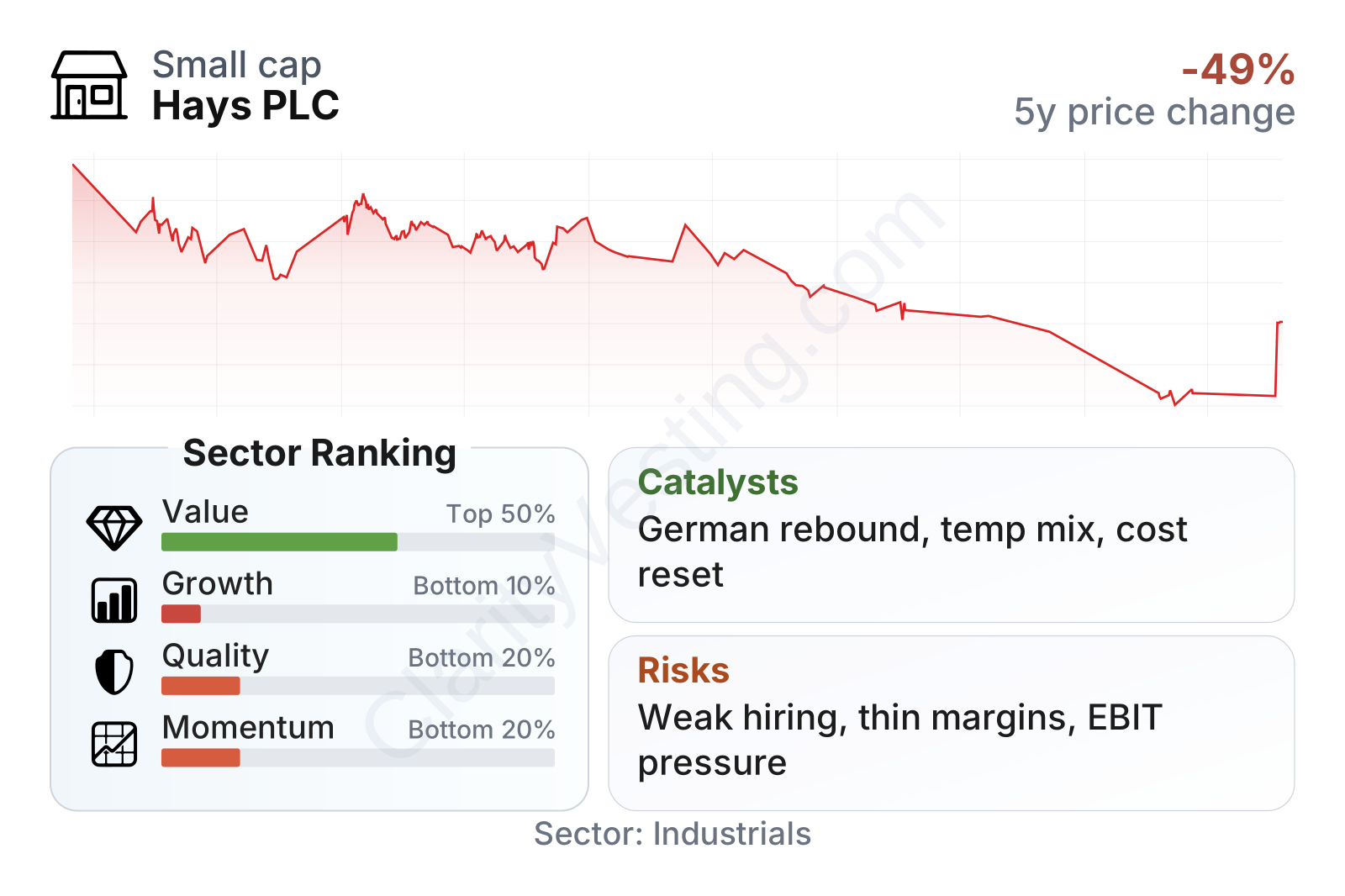
The stock’s long-term market performance also reflects that pressure. Over three years, the shares have declined substantially, and they remain well below their earlier levels despite a rebound over the last six months. That pattern is typical of a company where the market is waiting for proof that profits can recover, not just revenue stability.
Growth
The staffing and employment services industry is structurally supported by long-term trends. Companies increasingly want flexible hiring, specialist talent is hard to source internally, and many labor markets remain skill-constrained in areas such as technology, engineering, life sciences, and finance. That creates a real long-term role for firms like Hays.
Hays’ strategy also makes industrial sense. The company focuses on specialist recruitment, international diversification, and a mix of temporary and permanent placements. In stronger labor markets, that mix can work well: temporary recruitment provides recurring fee streams, while permanent hiring can lift margins when business confidence improves. The company has also emphasized productivity tools, consultant discipline, and cost actions to protect profitability during weaker cycles.
The main growth question is timing rather than relevance. Hays operates in a sector that can recover sharply when hiring confidence returns, but the current backdrop has been challenging, especially in Europe and white-collar recruitment. A meaningful improvement in business sentiment, lower interest rates, or stronger corporate hiring budgets could lift placement volumes relatively quickly. Germany is especially important here because it has been one of Hays’ biggest profit centers historically; a cyclical rebound there would matter a lot.
A second potential catalyst is operational recovery. Because margins have fallen so low, even a moderate improvement in fees or consultant productivity can have an outsized effect on profits. In other words, Hays currently has more earnings sensitivity than growth visibility. If demand normalizes, the business has room for a large percentage rebound in earnings from a depressed base.
Recent company communications have also pointed to cost control and selective investment rather than aggressive expansion. That is not a dramatic growth headline, but it is sensible for the cycle Hays is in. For this company, preserving consultant quality, client relationships, and cash generation during a downturn may be more important than chasing volume.
Risks
This article is for informational purposes only and does not constitute financial advice. Some content is AI-generated. See Disclaimer


