Stock Analysis · HawkEye 360 Inc (HAWK)
Overview
HawkEye 360 Inc. is a space-based data and analytics company focused on radio frequency, or RF, intelligence. In simple terms, it operates satellites that detect, geolocate, and analyze radio signals coming from Earth. Those signals can help customers track ships, monitor borders, detect GPS interference, support disaster response, and improve military and intelligence awareness. The company sits at the intersection of commercial space infrastructure, geospatial data, and defense technology.
Its business model is mainly built around selling access to data products and analytical services derived from its satellite constellations. The customer base has a strong government component, especially in defense, intelligence, and national security, but the platform also targets commercial uses such as maritime awareness and supply-chain visibility.
Based on recent company disclosures, revenue is primarily generated from a small number of activities:
- Data analytics and subscription-style RF intelligence products: the core business and the largest source of revenue. This includes recurring or repeat sales of geolocation data, signal mapping, maritime domain awareness, and related analytical outputs delivered to government and commercial customers.
- Government contracts and mission support services: a major contributor, often tied to U.S. defense and intelligence agencies as well as allied governments. These arrangements can include customized analytics, integration work, and operational support.
- Engineering, licensing, and other services: a smaller category that can include specialized development work, partnerships, and ancillary offerings connected to the company’s RF platform.
Public filings do not provide a clean, universally consistent percentage split across these categories in the same way that more mature diversified companies often do. What is clear is that government-related work remains the economic backbone of the business, while commercial applications are still developing from a smaller base.
The financial flow also shows a business that scaled meaningfully in 2025: revenue rose sharply, gross profit improved, and the company moved from a sizeable net loss in 2024 to modest profitability in 2025. At the same time, operating expenses remained high, with research and development and selling costs still consuming a large share of revenue. That combination is typical of a company trying to build a strategic data platform before margins fully mature.
Key Figures
| Metric | Value | Sector ⓘ |
|---|---|---|
| Date | Oct 17, 2026 | |
| Context | ||
| Sector | Industrials | |
| Industry | Aerospace & Defense | |
| Market Cap ⓘ | $1.27B | |
| Beta ⓘ | N/A | |
Value (Cheapness) | ||
| P/E Ratio ⓘ | N/A | 22.10 |
| P/B Ratio ⓘ | 0.96 | 1.97 |
| FCF Yield ⓘ | -1.10% | 6.38% |
| Dividend Yield ⓘ | N/A | 1.94% |
| EBIT / EV ⓘ | -2.00% | 4.79% |
| PEG ⓘ | N/A | |
Growth (Business expansion) | ||
| Revenue Growth ⓘ | 87.10% | 9.30% |
| RPS Growth (5Y CAGR) ⓘ | N/A | 7.81% |
| EPS Growth (5Y CAGR) ⓘ | N/A | -13.06% |
| BVPS Growth (5Y CAGR) ⓘ | N/A | 6.14% |
| Margin Growth (5Y Trend) ⓘ | N/A | 0.88% |
| FCF Growth (5Y CAGR) ⓘ | N/A | 11.01% |
| DPS Growth (5Y CAGR) ⓘ | N/A | 9.48% |
Quality (Business durability) | ||
| ROIC (Latest) ⓘ | N/A | 10.84% |
| ROA (Latest) ⓘ | N/A | 5.41% |
| ROIC (5Y Median) ⓘ | N/A | 9.38% |
| ROA (5Y Median) ⓘ | N/A | 4.95% |
| Net Debt / EBIT (Latest) ⓘ | N/A | 2.08 |
| Net Debt / EBIT (5Y Median) ⓘ | N/A | 2.27 |
| Net Debt / EBITDA (Latest) ⓘ | -49.04 | 1.39 |
| Net Debt / Assets ⓘ | -53.82% | 19.28% |
| EBITDA / Interest ⓘ | 3.94 | 9.58 |
| Operating Margin (Latest) ⓘ | -12.71% | 10.50% |
| Operating Margin (5Y Median) ⓘ | N/A | 10.29% |
| Debt to Equity (Latest) ⓘ | 2.10% | 65.48% |
| Profit Margin (Latest) ⓘ | -12.89% | 6.67% |
| Free Cash Flow (Latest) ⓘ | -$13.96M | |
Momentum (Price trend) | ||
| 3Y Return ⓘ | N/A | +61.68% |
| 12M Return (excl. last month) ⓘ | N/A | +12.58% |
| 6M Return ⓘ | N/A | 0.00% |
| Price vs. 200-Day MA ⓘ | N/A | +0.02% |
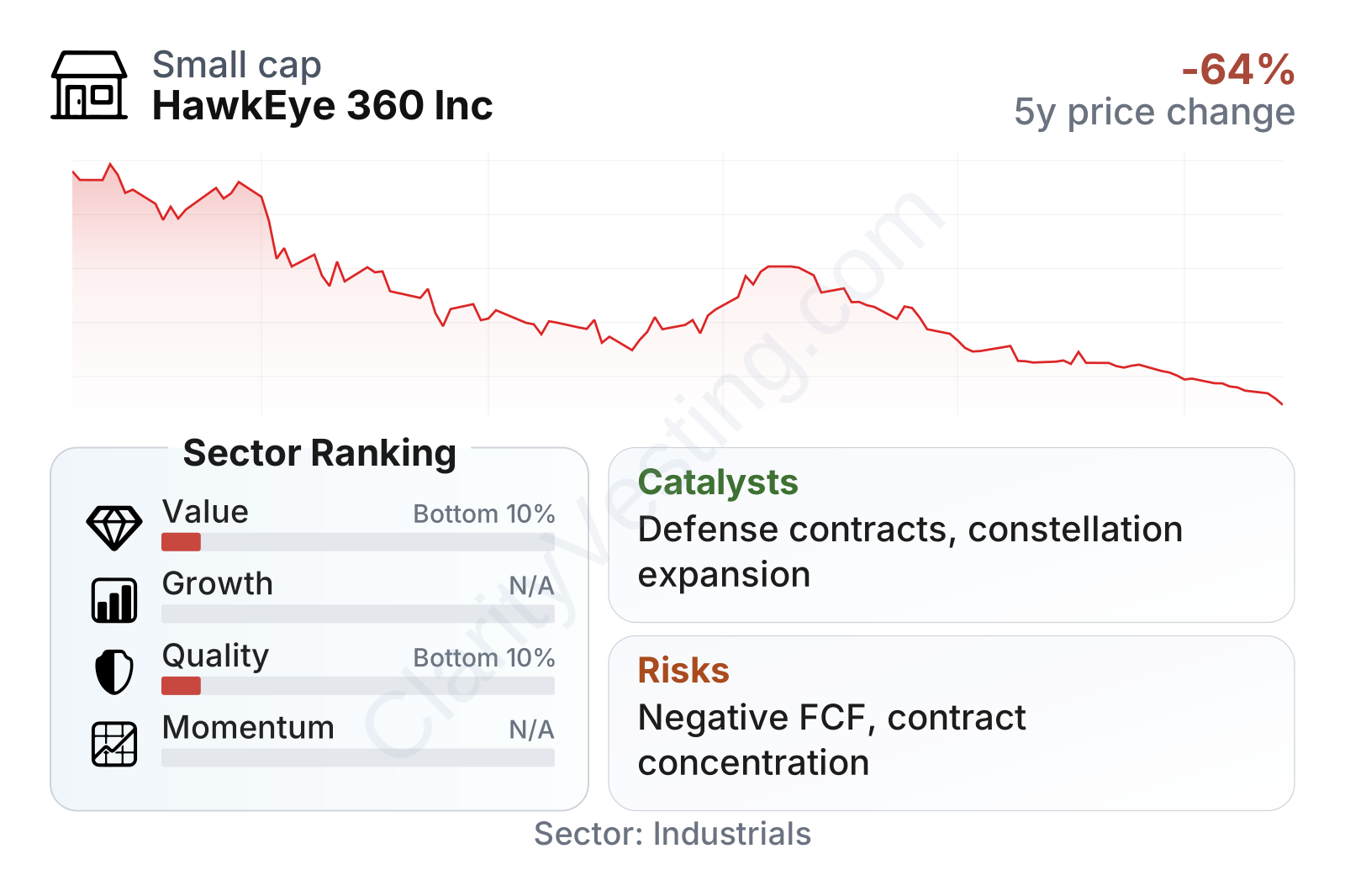
The company is still in an early-stage financial profile. Revenue growth has been far stronger than the sector median, which highlights real commercial traction. However, profitability and cash generation remain weak relative to most aerospace and defense peers. Margins are still negative on a trailing basis, free cash flow is below zero, and returns on capital are not yet where established defense contractors typically operate.
One notable counterbalance is the balance sheet. HawkEye 360 appears lightly levered, with very low debt relative to equity and net cash rather than heavy net debt. That matters because many young space companies struggle not only with losses, but also with burdensome financing structures. Even so, interest coverage is not especially strong, so the company still needs operating performance to improve rather than relying on financial engineering.
The stock has also been volatile. The share price pulled back materially from May to August 2026, which suggests that the market is reassessing either execution pace, valuation expectations, or both. For a smaller company in a fast-moving defense and space niche, that kind of swing is not unusual.
Growth
HawkEye 360 operates in a part of the market with attractive long-term demand drivers. Governments are spending more on space capabilities, persistent surveillance, electronic warfare awareness, and resilient intelligence systems. At the same time, commercial customers increasingly want real-time location and activity data that traditional imagery alone cannot always provide. RF sensing can add a different layer of information by showing where emitters are active, even when optical conditions are poor or targets are trying to avoid visibility.
The company’s strategy broadly makes sense for that environment. It is building a proprietary constellation and converting the resulting data into software-like products and mission analytics. If successful, that can create a stronger business than simply manufacturing hardware, because recurring data sales and mission-critical intelligence services can be harder to replace than one-time equipment purchases.
A major catalyst is the continued expansion of defense and intelligence demand for commercial space data. HawkEye 360 has repeatedly positioned itself as a provider to U.S. and allied government agencies, and that alignment matters because national security budgets have been more resilient than many other end markets. International adoption is another potential driver, especially as more allied governments look for independent situational awareness tools without building their own full satellite systems.
Another important opportunity is product expansion. The more signals the company can detect, classify, and analyze, the broader its use cases become. Maritime tracking, detection of GPS jamming and spoofing, border monitoring, and battlefield sensing all extend the addressable market. That widens the company’s relevance beyond one narrow niche and can support larger contract sizes over time.
Recent company communications have also emphasized constellation growth, new contracts, and deeper government relationships. For a company of this size, each meaningful contract win can have an outsized impact on annual revenue growth, and that helps explain why the business posted an exceptionally strong year-over-year revenue increase compared with the broader sector.
Risks
This article is for informational purposes only and does not constitute financial advice. Some content is AI-generated. See Disclaimer


