Stock Analysis · Happen Inc (HAPN)
Overview
Happen Inc is a regional banking company in the Financial Services sector. In simple terms, it makes money mainly by gathering deposits from customers and turning those funds into loans and other earning assets. Like most regional banks, its business model depends on the spread between what it earns on loans and investments and what it pays on deposits and borrowings, while also generating fees from customer services.
Public financial disclosures for banks typically group revenue into broad categories rather than product-by-product consumer-style segments. Based on the company’s filings and reported results, Happen’s revenue mix appears to be concentrated in the usual regional bank sources:
- Net interest income: likely the largest source of revenue, generated from commercial and consumer loans, securities, and cash management balances after funding costs.
- Non-interest income: service charges, card and payment fees, wealth-related or treasury-related fees, mortgage or loan-related income, and other banking services.
- Other income items: smaller and often more variable sources such as securities activity or balance-sheet-related adjustments.
The broad financial flow shows a business that experienced a strong revenue rebound in 2025 after a weaker 2023-2024 period. Operating expenses have been more contained than revenue, which helped operating income recover. At the same time, interest expense rose sharply in 2023 and 2024 before easing somewhat, a reminder that funding costs remain one of the key moving parts in the bank’s earnings profile.
Key Figures
| Metric | Value | Sector ⓘ |
|---|---|---|
| Date | Oct 24, 2026 | |
| Context | ||
| Sector | Financial Services | |
| Industry | Banks - Regional | |
| Market Cap ⓘ | $1.70B | |
| Beta ⓘ | 1.89 | |
Value (Cheapness) | ||
| P/E Ratio ⓘ | 8.87 | 12.46 |
| P/B Ratio ⓘ | 1.09 | 1.25 |
| FCF Yield ⓘ | -174.05% | 9.82% |
| Dividend Yield ⓘ | N/A | 2.94% |
| EBIT / EV ⓘ | 30.05% | 8.11% |
| PEG ⓘ | N/A | |
Growth (Business expansion) | ||
| Revenue Growth ⓘ | 6.50% | 9.10% |
| RPS Growth (5Y CAGR) ⓘ | 6.29% | 12.31% |
| EPS Growth (5Y CAGR) ⓘ | -9.91% | -6.97% |
| BVPS Growth (5Y CAGR) ⓘ | 10.97% | 5.02% |
| Margin Growth (5Y Trend) ⓘ | 20.89% | -4.00% |
| FCF Growth (5Y CAGR) ⓘ | N/A | 4.71% |
| DPS Growth (5Y CAGR) ⓘ | N/A | 8.92% |
Quality (Business durability) | ||
| ROIC (Latest) ⓘ | N/A | 9.18% |
| ROE (Latest) ⓘ | 12.91% | 13.93% |
| ROA (Latest) ⓘ | 1.66% | 1.57% |
| ROIC (5Y Median) ⓘ | N/A | 7.80% |
| ROE (5Y Median) ⓘ | 3.96% | 12.15% |
| ROA (5Y Median) ⓘ | 0.55% | 1.28% |
| Net Debt / EBIT (Latest) ⓘ | -0.00 | 1.02 |
| Net Debt / EBIT (5Y Median) ⓘ | -13.94 | 0.72 |
| Net Debt / EBITDA (Latest) ⓘ | -0.00 | 0.88 |
| Operating Margin (Latest) ⓘ | 18.19% | 22.30% |
| Operating Margin (5Y Median) ⓘ | 5.60% | 24.50% |
| Debt to Equity (Latest) ⓘ | 0.73% | 59.34% |
| Profit Margin (Latest) ⓘ | 14.03% | 26.42% |
| Free Cash Flow (Latest) ⓘ | -$2.96B | |
Momentum (Price trend) | ||
| 3Y Return ⓘ | +172.65% | +95.73% |
| 12M Return (excl. last month) ⓘ | -9.39% | +17.30% |
| 6M Return ⓘ | -18.42% | +6.07% |
| Price vs. 200-Day MA ⓘ | -15.24% | +5.36% |
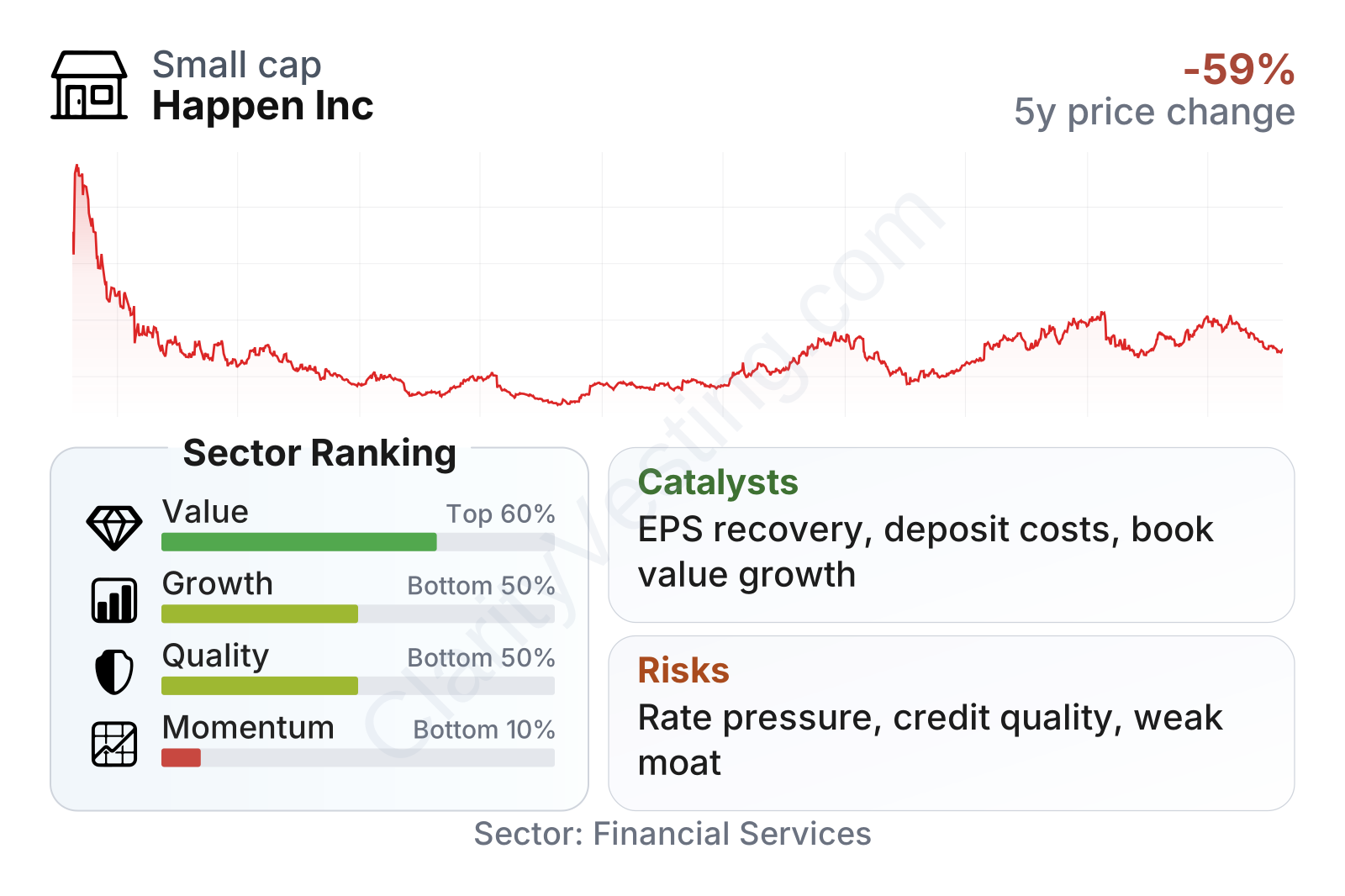
Happen is a mid-sized regional bank with a stock that has been notably volatile, reflected in a beta close to 1.9. The share price has recovered significantly from the lows seen during the regional banking stress period, but recent momentum remains weaker than much of the sector. On valuation metrics, the stock trades at a lower earnings multiple than the sector median and around book value, which suggests the market is not assigning a large premium. Growth indicators are mixed: recent revenue growth is positive, but the longer earnings record is uneven. Quality metrics also show a split picture, with very low balance-sheet leverage on these measures and improving profitability, but margins and long-term returns that still trail stronger peers.
Growth
Regional banking is not a high-growth industry in the way software or semiconductors can be, but it can still offer durable expansion through deposit gathering, loan growth, market share gains, and disciplined pricing. The sector’s medium-term outlook is tied to interest rates, local economic activity, credit quality, and the ability to retain low-cost deposits. In that setting, Happen’s growth case looks more like an improvement-and-execution story than a pure industry boom.
The recent direction is encouraging. Revenue has returned to growth, and the company’s operating margin trend over the past five years has improved materially even though absolute profitability still has room to strengthen. Reported annual revenue moved from just under $0.9 billion in 2021 to roughly $1.33 billion in 2025, although the path was not smooth. That matters because for banks, stable growth is usually valued more highly than one-off surges.
Earnings per share illustrate that uneven path clearly: profit expanded sharply in 2022, weakened in 2023, then recovered in 2024 and 2025. That pattern suggests Happen has earnings power, but it also shows how sensitive results can be to the funding environment and credit conditions. A further normalization in deposit costs or a stronger loan mix could support future earnings, while a tougher rate backdrop could slow that progress.
Book value per share has moved steadily higher over time, with a five-year compounded growth rate above the sector median. For a bank, that is an important sign because book value growth often reflects retained earnings, capital build, and the underlying ability to compound shareholder equity. It does not guarantee faster earnings growth, but it does suggest the franchise has continued to add balance-sheet value even through a difficult period for many regional banks.
As for catalysts, the most important ones are practical rather than speculative: better deposit costs, sustained loan growth, continued expense discipline, and further recovery in profitability metrics. If the company can keep lifting returns while preserving capital strength, the market may become more willing to value it closer to stronger regional bank peers.
Risks
This article is for informational purposes only and does not constitute financial advice. Some content is AI-generated. See Disclaimer


