Stock Analysis · Halozyme Therapeutics Inc (HALO)
Overview
Halozyme Therapeutics is a biotechnology company focused on drug delivery and specialty medicines. Its core asset is ENHANZE, a technology based on recombinant human hyaluronidase that helps certain medicines be delivered under the skin instead of through longer intravenous infusions. In practical terms, Halozyme often works with larger pharmaceutical companies that use this platform in their own products, while Halozyme earns royalties, license revenue, and other partnership-related payments. The company also has a smaller proprietary products business.
This business model matters because it is different from many biotech companies that depend mainly on one internally developed drug. Halozyme has built a platform that can be used across multiple therapies and partners. That creates recurring revenue streams tied to commercial products already on the market, while also giving the company exposure to future launches from its development pipeline of partnered programs.
Based on the company’s recent filings, revenue is primarily generated from the following sources:
- Royalties: approximately 55% to 65% of total revenue. These are ongoing payments from partners selling approved ENHANZE-enabled products.
- Collaborative agreements and licenses: approximately 25% to 35%. This includes upfront payments, milestone payments, and other revenue recognized from partnership arrangements.
- Product sales: approximately 10% or less. This mainly reflects Halozyme’s proprietary product business, which is much smaller than the platform-based royalty stream.
The broad pattern is clear: Halozyme is increasingly a royalty-driven business with a high-margin platform at the center of its economics. That tends to make the company more scalable than a traditional drug manufacturer because revenue can grow without a matching rise in operating costs.
The financial flow over the last several years shows a favorable structure: revenue has climbed sharply, gross profit has expanded even faster than operating costs, and research spending has remained disciplined relative to sales. Net income has been more volatile than revenue because milestone timing and accounting can affect results, but the underlying business has become meaningfully larger and more profitable.
Key Figures
| Metric | Value | Sector ⓘ |
|---|---|---|
| Date | Oct 10, 2026 | |
| Context | ||
| Sector | Healthcare | |
| Industry | Biotechnology | |
| Market Cap ⓘ | $12.57B | |
| Beta ⓘ | 0.88 | |
Value (Cheapness) | ||
| P/E Ratio ⓘ | 32.11 | 24.79 |
| P/B Ratio ⓘ | 92.75 | 2.97 |
| FCF Yield ⓘ | 6.41% | 3.11% |
| Dividend Yield ⓘ | N/A | 2.04% |
| EBIT / EV ⓘ | 4.11% | 0.57% |
| PEG ⓘ | -2.50 | |
Growth (Business expansion) | ||
| Revenue Growth ⓘ | 47.70% | 7.35% |
| RPS Growth (5Y CAGR) ⓘ | 39.00% | 8.61% |
| EPS Growth (5Y CAGR) ⓘ | 11.97% | -18.43% |
| BVPS Growth (5Y CAGR) ⓘ | -26.39% | 3.94% |
| Margin Growth (5Y Trend) ⓘ | -27.51% | -0.61% |
| FCF Growth (5Y CAGR) ⓘ | 21.28% | 0.88% |
| DPS Growth (5Y CAGR) ⓘ | N/A | 6.74% |
Quality (Business durability) | ||
| ROIC (Latest) ⓘ | 22.25% | 3.34% |
| ROA (Latest) ⓘ | 17.24% | 2.95% |
| ROIC (5Y Median) ⓘ | 18.21% | 4.60% |
| ROA (5Y Median) ⓘ | 15.75% | 1.89% |
| Net Debt / EBIT (Latest) ⓘ | 3.29 | 1.36 |
| Net Debt / EBIT (5Y Median) ⓘ | 3.76 | 1.86 |
| Net Debt / EBITDA (Latest) ⓘ | 2.76 | 1.02 |
| Net Debt / Assets ⓘ | 76.96% | 5.85% |
| EBITDA / Interest ⓘ | 35.39 | 9.60 |
| Operating Margin (Latest) ⓘ | 36.28% | 9.19% |
| Operating Margin (5Y Median) ⓘ | 44.27% | 7.53% |
| Debt to Equity (Latest) ⓘ | 1495.48% | 29.44% |
| Profit Margin (Latest) ⓘ | 24.86% | 3.52% |
| Free Cash Flow (Latest) ⓘ | $806.22M | |
Momentum (Price trend) | ||
| 3Y Return ⓘ | +196.54% | +34.80% |
| 12M Return (excl. last month) ⓘ | +42.79% | +19.33% |
| 6M Return ⓘ | +67.87% | +7.18% |
| Price vs. 200-Day MA ⓘ | +38.67% | +3.20% |
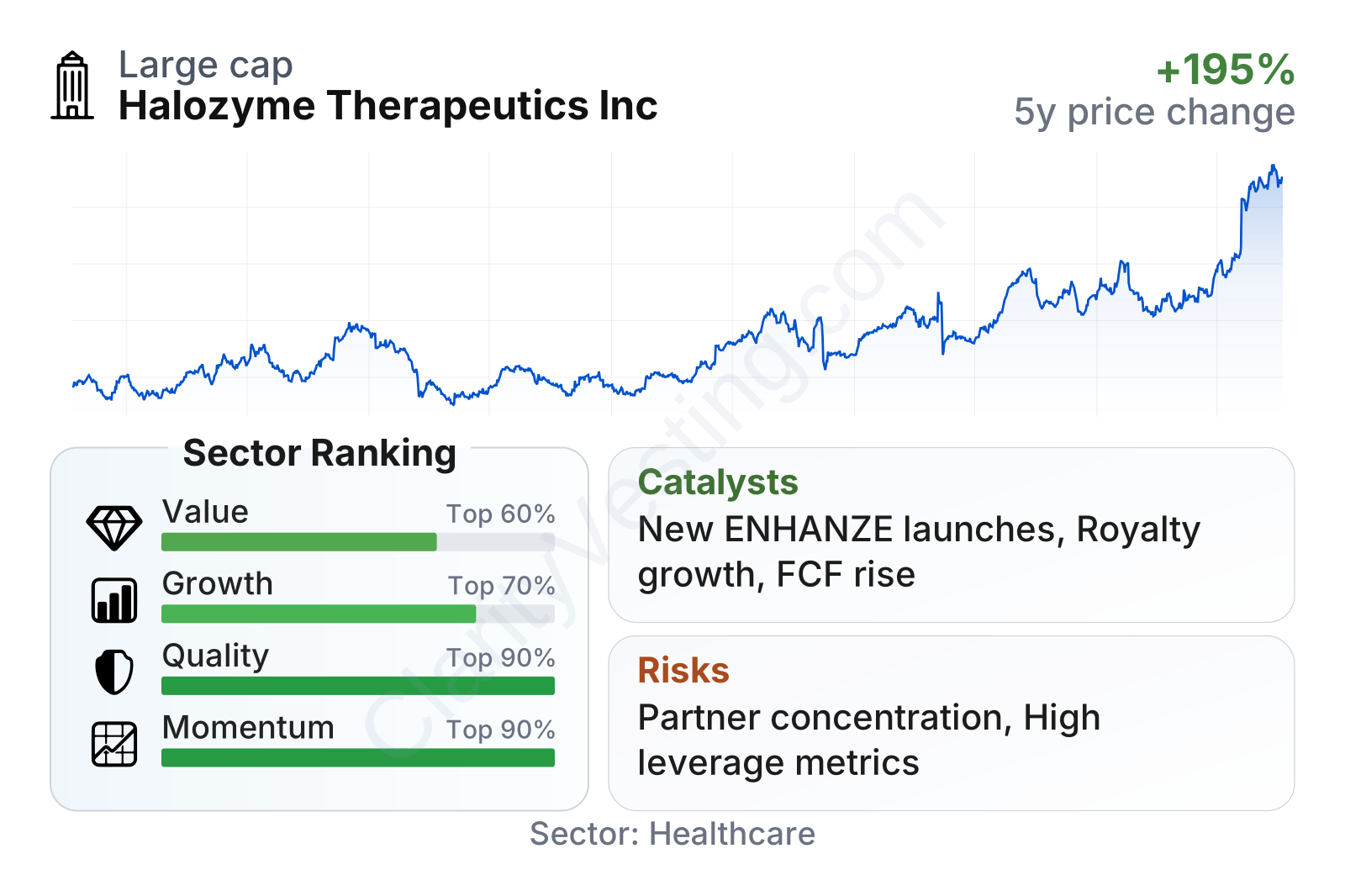
Halozyme stands out on business quality and market momentum. Profitability measures are far above the biotechnology sector median, and cash generation is strong for a company in this industry. Growth metrics are also well above typical sector levels, although the balance sheet looks unusual because debt is high relative to equity. That does not erase the company’s strengths, but it does mean the capital structure needs to be watched alongside operating performance.
Growth
Halozyme operates in an attractive part of healthcare: making drug administration easier, faster, and potentially more convenient. The shift from intravenous delivery to subcutaneous delivery has a clear real-world logic. It can reduce time in infusion centers, improve patient convenience, and help healthcare systems use resources more efficiently. Those benefits give pharmaceutical partners a practical reason to adopt ENHANZE where clinically appropriate.
The company’s strategy for future growth is coherent. Instead of trying to commercialize many large products alone, Halozyme partners its platform with major drug makers that already have clinical, regulatory, and commercial infrastructure. This spreads risk across multiple programs and can turn one technology into many revenue-producing products. It also means future growth can come from three directions at once: higher sales of already approved partner drugs, new product launches, and additional licensing agreements.
Recent revenue growth has been consistently strong, with year-over-year gains often far above normal sector levels. That supports the idea that Halozyme is not relying on a one-time spike. While quarterly growth can move around depending on milestone timing, the broader trend still points upward.
Free cash flow has also trended meaningfully higher over time, which is especially important in biotech. Many companies in this sector grow revenue without producing durable cash. Halozyme appears to be doing both, which gives it more flexibility for debt service, share repurchases, business development, or further internal investment.
A major growth catalyst remains the expanding list of ENHANZE-based partner products and programs. Each new approval can add another royalty stream, and each successful launch can deepen the installed base of recurring revenue. Company updates in 2026 have continued to point to progression across partnered programs and commercial execution around existing royalty-generating assets, reinforcing the platform model rather than changing it.
Risks
This article is for informational purposes only and does not constitute financial advice. Some content is AI-generated. See Disclaimer