Stock Analysis · Hafnia Limited (HAFN)
Overview
Hafnia Limited is a marine shipping company focused on transporting refined oil products and, to a smaller extent, crude and specialty chemicals. In simple terms, it operates tanker vessels that move fuels such as gasoline, diesel, jet fuel, and naphtha between refineries, storage hubs, and end markets around the world. The company is one of the largest product tanker operators globally and runs a sizable fleet through a mix of owned, chartered-in, and pooled vessels. That scale matters because shipping is a volume business: larger operators can spread costs, optimize routes, and offer customers broader coverage.
The business makes money mainly from freight income earned when customers pay to use its ships. Based on company reporting, Hafnia’s revenue is primarily tied to time-charter equivalent earnings from product tankers, with additional contributions from pool management, bunker procurement and related services, and a smaller exposure to chemical and dirty tanker activities depending on fleet deployment and market conditions.
- Product tanker freight revenue: approximately 85% to 95% of total revenue. This is the core of the business and includes transport of refined petroleum products across long-haul and regional routes.
- Pool and commercial management services: approximately 3% to 8%. This includes managing vessels in commercial pools and earning fees tied to chartering and optimization activities.
- Ancillary and other shipping-related revenue: approximately 2% to 7%. This may include bunker-related activities, demurrage, and other voyage-related items.
Over the last several years, Hafnia’s business mix has stayed concentrated in product tankers, which is important for long-term readers: this is not a diversified industrial group, but a focused shipping operator whose results rise and fall with tanker freight markets. The financial flow also shows how dramatic that cycle can be. Revenue expanded sharply from 2021 through 2024 as freight conditions improved, while profits remained strong even though 2025 softened from the peak.
The operating picture improved significantly after 2021: losses turned into very large profits in 2022 through 2024, interest costs moved lower, and net income stayed solid even as revenue and gross profit cooled in 2025. That pattern suggests a business with meaningful earnings power, but also one that remains highly exposed to freight-rate cycles.
Key Figures
| Metric | Value | Sector ⓘ |
|---|---|---|
| Date | Oct 04, 2026 | |
| Context | ||
| Sector | Industrials | |
| Industry | Marine Shipping | |
| Market Cap ⓘ | $5.49B | |
| Beta ⓘ | -0.15 | |
Value (Cheapness) | ||
| P/E Ratio ⓘ | 7.88 | 22.45 |
| P/B Ratio ⓘ | 1.96 | 1.98 |
| FCF Yield ⓘ | 9.95% | 6.29% |
| Dividend Yield ⓘ | 11.03% | 1.96% |
| EBIT / EV ⓘ | 11.50% | 4.81% |
| PEG ⓘ | N/A | |
Growth (Business expansion) | ||
| Revenue Growth ⓘ | 47.20% | 9.10% |
| RPS Growth (5Y CAGR) ⓘ | 20.18% | 7.75% |
| EPS Growth (5Y CAGR) ⓘ | -16.10% | -13.59% |
| BVPS Growth (5Y CAGR) ⓘ | 10.87% | 6.22% |
| Margin Growth (5Y Trend) ⓘ | 19.03% | 0.72% |
| FCF Growth (5Y CAGR) ⓘ | 50.88% | 10.98% |
| DPS Growth (5Y CAGR) ⓘ | N/A | 9.48% |
Quality (Business durability) | ||
| ROIC (Latest) ⓘ | 17.87% | 10.92% |
| ROA (Latest) ⓘ | 17.15% | 5.41% |
| ROIC (5Y Median) ⓘ | 29.30% | 9.21% |
| ROA (5Y Median) ⓘ | 20.17% | 4.94% |
| Net Debt / EBIT (Latest) ⓘ | 0.89 | 2.07 |
| Net Debt / EBIT (5Y Median) ⓘ | 1.49 | 2.28 |
| Net Debt / EBITDA (Latest) ⓘ | 0.67 | 1.43 |
| Net Debt / Assets ⓘ | 13.43% | 19.27% |
| EBITDA / Interest ⓘ | 15.62 | 9.53 |
| Operating Margin (Latest) ⓘ | 22.83% | 10.50% |
| Operating Margin (5Y Median) ⓘ | 28.96% | 10.27% |
| Debt to Equity (Latest) ⓘ | 33.41% | 65.48% |
| Profit Margin (Latest) ⓘ | 24.70% | 6.62% |
| Free Cash Flow (Latest) ⓘ | $546.24M | |
Momentum (Price trend) | ||
| 3Y Return ⓘ | +154.27% | +58.56% |
| 12M Return (excl. last month) ⓘ | +61.37% | +16.33% |
| 6M Return ⓘ | +42.55% | +4.19% |
| Price vs. 200-Day MA ⓘ | +46.75% | +1.27% |
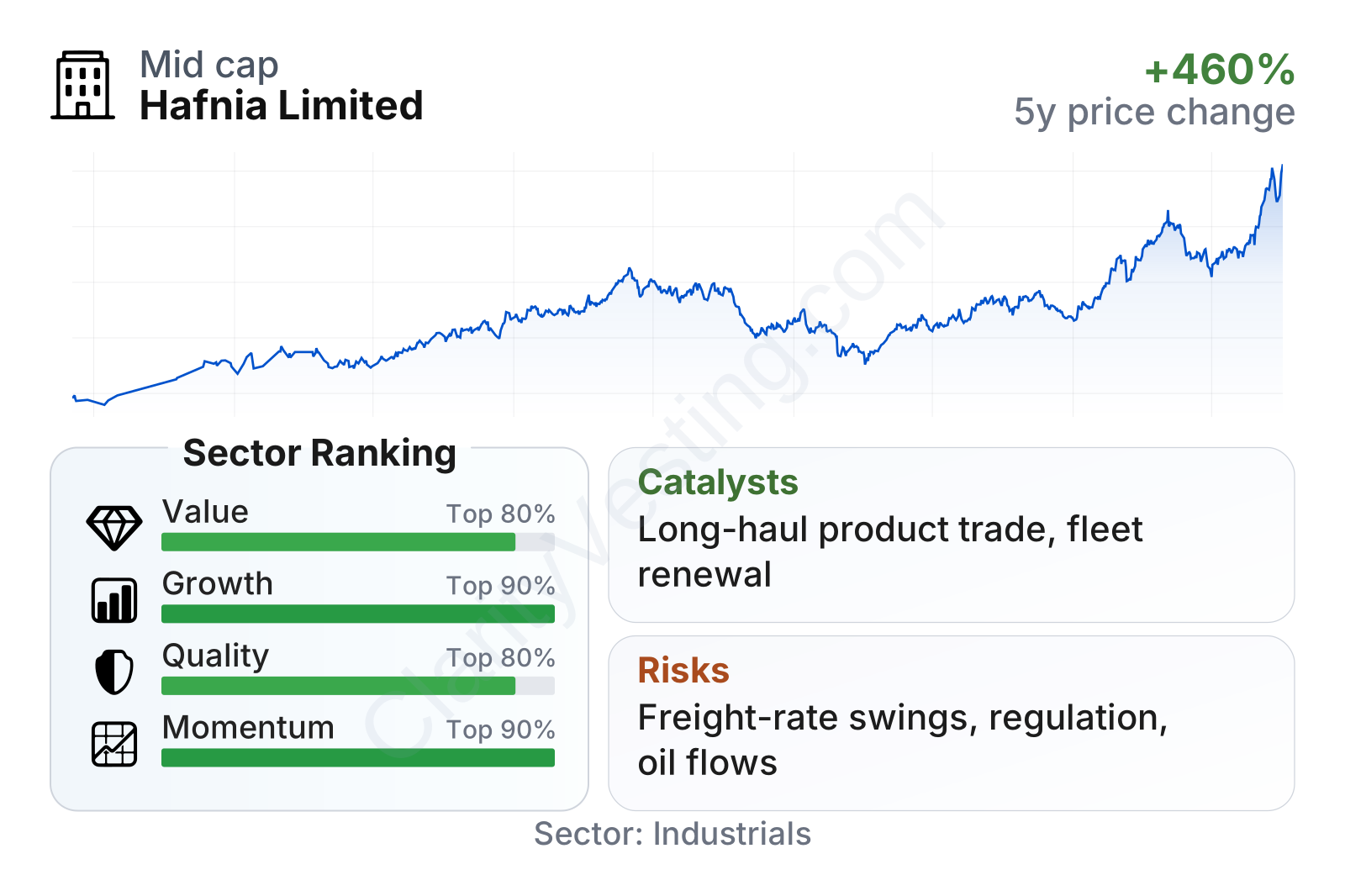
Hafnia stands out as a large company within marine shipping, with a market value in the multi-billion-dollar range. Across value, growth, quality, and momentum, its current profile ranks well above many industrial peers. Profitability remains unusually strong for the sector, leverage is lower than the industry median, and free cash flow generation has been robust. The main point to keep in mind is that these strong metrics come from a shipping market that can change quickly, so headline numbers should be read together with the cyclical nature of the business.
The stock performance chart also reflects that volatility. The share price has risen strongly over the last several years, but not in a straight line, with sharp advances followed by pullbacks. That pattern is common in shipping, where market expectations can reset rapidly as freight rates move.
Growth
Hafnia operates in a sector that is mature, but still capable of attractive growth in favorable conditions. Product tanker shipping is supported by global oil demand, refinery dislocation, and trade route complexity. A key structural driver has been the growing distance between where refined fuels are produced and where they are consumed. When cargoes travel farther, tanker demand can improve even if total oil consumption grows only modestly.
Hafnia’s strategy is sensible for this market. The company has emphasized commercial scale, fleet optimization, pool participation, fuel procurement, and selective fleet renewal. In shipping, size helps because it improves vessel utilization and customer access. Hafnia’s broad network and operating platform can support more efficient deployment than what a smaller owner can usually achieve.
Revenue growth has been volatile, which is normal for tanker shipping. After an exceptional surge in 2022 and 2023, growth slowed and turned negative during parts of 2024 and 2025 before recovering again in 2026. That pattern does not look like a steady compounding business; it looks like a company tied to freight cycles. Still, the recent return to positive year-over-year growth suggests that market conditions have improved again after a softer period.
Cash generation remains one of the more attractive parts of the case. Free cash flow moved from negative territory in 2022 to very strong levels in 2023 through 2025, then eased in 2026 while staying positive. That is still a favorable sign because it indicates the company has been able to convert strong market conditions into real cash, not just accounting profits.
Potential catalysts for future growth are tied less to new technology and more to shipping fundamentals. Global refinery shifts, sanctions-related trade rerouting, longer voyage distances, and limited near-term fleet supply can all help tanker owners. New vessel supply matters a lot in this industry, and if fleet growth stays disciplined while cargo demand remains firm, earnings conditions can remain supportive. Hafnia may also benefit from continued optimization of its large commercial platform and from opportunities to add ships at attractive points in the cycle.
Recent company communications have also highlighted fleet renewal and financing activity, which can matter over the long term. Newer vessels are generally more efficient, easier to charter, and better positioned for tightening environmental requirements. For a shipping company, that can support both competitiveness and asset values.
Risks
This article is for informational purposes only and does not constitute financial advice. Some content is AI-generated. See Disclaimer