Stock Analysis · Haemonetics Corporation (HAE)
Overview
Haemonetics Corporation is a medical device company focused on blood and plasma collection, hospital transfusion management, and technologies used in procedures where blood components are separated and returned to the patient. In simple terms, the company helps collect plasma from donors, supports blood centers, and provides tools used by hospitals and clinicians to manage bleeding, transfusions, and certain surgical procedures.
Its business is organized around three main segments, with plasma collection clearly the largest contributor. Based on the latest annual filing for fiscal 2026, the revenue mix is approximately:
- Plasma: about 52% of revenue. This includes plasma collection systems, disposable kits, software, and related services used by plasma collection centers.
- Hospital: about 31% of revenue. This segment includes hemostasis management, blood management technologies, and products used in surgery, transfusion, and hospital-based care.
- Blood Center: about 17% of revenue. This includes equipment and disposables used by blood centers for collecting whole blood and blood components.
The business mix matters because plasma collection tends to be the biggest growth engine, while the hospital and blood center activities help diversify the company across different parts of the blood-management chain. Over the last several years, revenue expanded meaningfully and profitability improved before softening in fiscal 2026, when sales were slightly lower and earnings came under pressure. Even so, the company still generated solid gross profit and remained cash generative.
The long-term pattern shows a larger revenue base and much higher gross profit than four years ago, but also a clear fiscal 2026 setback in operating income and net income. That mix suggests a business with real operating leverage, but one that is still exposed to product mix shifts, execution issues, and higher financing costs.
Key Figures
| Metric | Value | Sector ⓘ |
|---|---|---|
| Date | Nov 14, 2026 | |
| Context | ||
| Sector | Healthcare | |
| Industry | Medical Devices | |
| Market Cap ⓘ | $5.49B | |
| Beta ⓘ | 0.59 | |
Value (Cheapness) | ||
| P/E Ratio ⓘ | 54.05 | 25.84 |
| P/B Ratio ⓘ | 6.35 | 4.34 |
| FCF Yield ⓘ | 5.53% | 2.57% |
| Dividend Yield ⓘ | N/A | 1.62% |
| EBIT / EV ⓘ | 2.61% | 2.92% |
| PEG ⓘ | 1.94 | |
Growth (Business expansion) | ||
| Revenue Growth ⓘ | 9.30% | 7.15% |
| RPS Growth (5Y CAGR) ⓘ | 9.86% | 8.64% |
| EPS Growth (5Y CAGR) ⓘ | -5.45% | -9.67% |
| BVPS Growth (5Y CAGR) ⓘ | 3.61% | 3.71% |
| Margin Growth (5Y Trend) ⓘ | 1.16% | -0.63% |
| FCF Growth (5Y CAGR) ⓘ | 36.17% | 1.59% |
| DPS Growth (5Y CAGR) ⓘ | N/A | 6.69% |
Quality (Business durability) | ||
| ROIC (Latest) ⓘ | 5.92% | 5.79% |
| ROA (Latest) ⓘ | 4.24% | 2.88% |
| ROIC (5Y Median) ⓘ | 10.25% | 4.60% |
| ROA (5Y Median) ⓘ | 5.69% | 1.82% |
| Net Debt / EBIT (Latest) ⓘ | 5.14 | 1.33 |
| Net Debt / EBIT (5Y Median) ⓘ | 3.72 | 1.92 |
| Net Debt / EBITDA (Latest) ⓘ | 3.11 | 0.91 |
| Net Debt / Assets ⓘ | 35.80% | 5.89% |
| EBITDA / Interest ⓘ | 7.78 | 9.68 |
| Operating Margin (Latest) ⓘ | 12.14% | 9.24% |
| Operating Margin (5Y Median) ⓘ | 14.31% | 7.30% |
| Debt to Equity (Latest) ⓘ | 125.07% | 28.47% |
| Profit Margin (Latest) ⓘ | 7.52% | 3.33% |
| Free Cash Flow (Latest) ⓘ | $303.81M | |
Momentum (Price trend) | ||
| 3Y Return ⓘ | +41.85% | +48.98% |
| 12M Return (excl. last month) ⓘ | +143.39% | +13.65% |
| 6M Return ⓘ | +115.23% | +14.05% |
| Price vs. 200-Day MA ⓘ | +51.29% | +8.64% |
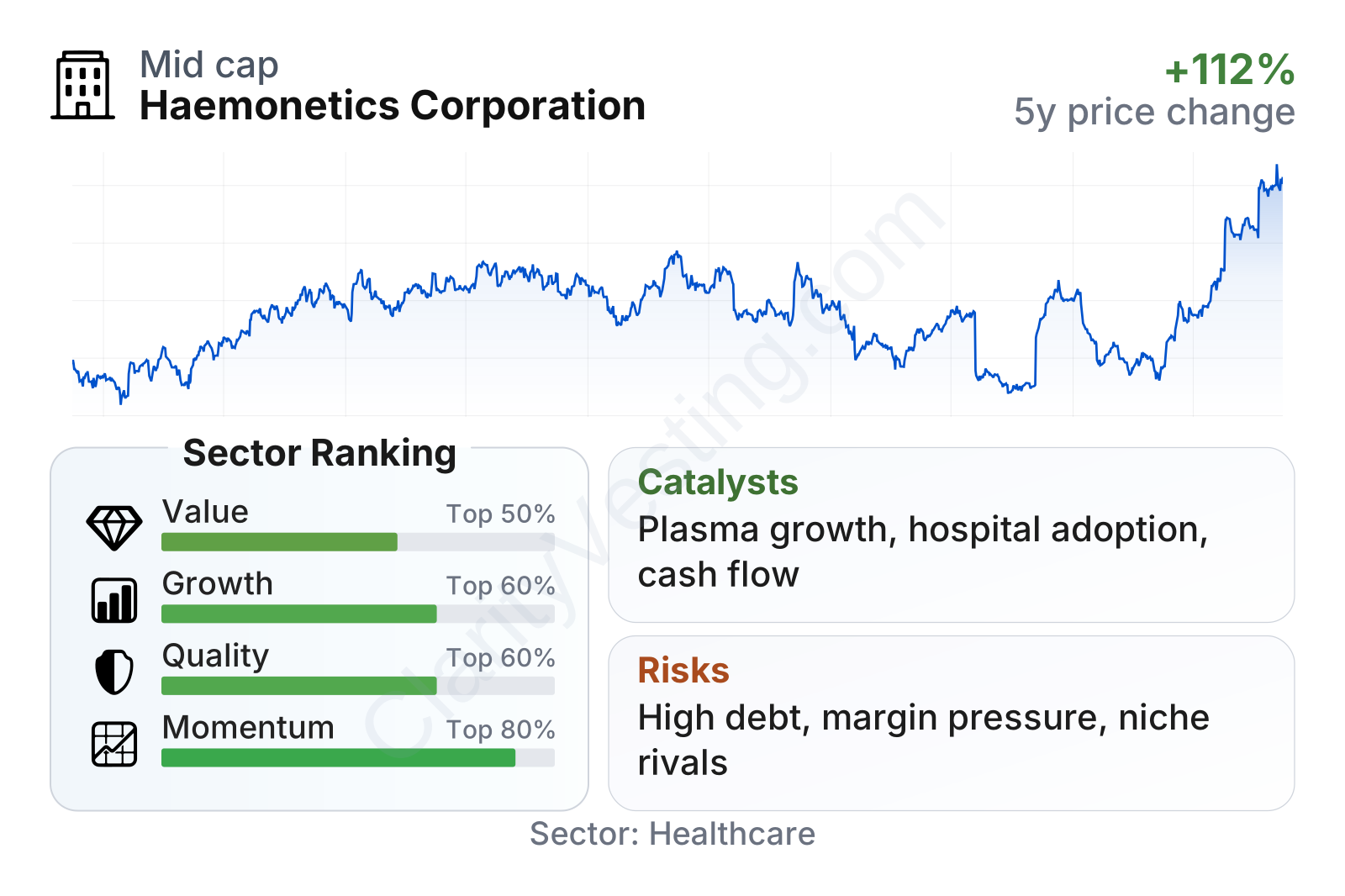
Haemonetics stands out as a mid-sized medical device company with relatively low share-price volatility, but the table points to a more mixed fundamental profile than the recent stock surge alone would suggest. Growth and profitability are better than many healthcare peers, free cash flow generation has strengthened sharply over time, and margins remain above sector medians. At the same time, leverage is elevated, and valuation multiples now sit well above typical sector levels after a very strong move in the stock.
The share price history has been volatile rather than steadily rising. After several swings between 2022 and early 2026, the stock rebounded sharply in 2026. That kind of move usually means the market is pricing in improving execution or future recovery, which raises the importance of checking whether operating results can catch up with the new valuation.
Growth
Haemonetics operates in a healthcare niche with attractive long-term demand drivers. Plasma collection is supported by continued use of plasma-derived therapies, an area tied to chronic and often growing medical needs. Hospitals also continue to need better blood management, transfusion efficiency, and tools that can reduce complications, waste, or unnecessary use of blood products. These are not short-lived themes; they are linked to demographics, procedure volumes, and the push for more efficient care.
The company’s strategy also makes industrial sense. It is concentrated in specialized areas where recurring disposable products, installed equipment, and workflow integration can create ongoing customer relationships. That is particularly important in plasma and blood collection, where consumables and software can make revenue more repeatable than one-time equipment sales alone. Haemonetics has also been reshaping its portfolio over time toward higher-growth and higher-margin categories, especially plasma and hospital technologies.
Revenue growth has not been perfectly smooth. The company posted strong double-digit expansion through much of 2022 to 2024, then moved into a period of contraction in 2025 before returning to positive growth in 2026. The latest trend is encouraging because it shows the business recovering from a weaker stretch rather than continuing to deteriorate. Current yearly growth is also above the healthcare sector median, which suggests Haemonetics is still expanding faster than many peers despite the recent disruption.
Cash generation is one of the more constructive parts of the picture. Free cash flow has risen substantially over the past few years and is now far above the level seen in 2022. That improvement matters because it gives the company more room to fund research, support product launches, reduce debt over time, and absorb temporary earnings volatility. In medical devices, durable cash conversion is often a better sign of business resilience than a single year of accounting earnings.
A notable recent opportunity is the company’s continued focus on the plasma market, where large collection customers value efficiency, donor throughput, and reliability. If Haemonetics can deepen relationships with major plasma operators and keep improving software and device productivity, this segment could remain the clearest growth catalyst. On the hospital side, technologies tied to bleeding management and procedure efficiency could also provide support if adoption broadens across surgical settings.
Risks
This article is for informational purposes only and does not constitute financial advice. Some content is AI-generated. See Disclaimer