Stock Analysis · Gaztransport & Technigaz SA (GZPZY)
Overview
Gaztransport & Technigaz SA, usually called GTT, is a French engineering and technology company best known for designing membrane containment systems used to transport and store liquefied natural gas, or LNG. In simple terms, its technology helps shipyards and vessel owners build tanks that can safely keep gas at extremely low temperatures inside LNG carriers and other specialized vessels. The company does not mainly earn money by building ships itself. Its business is centered on intellectual property, engineering know-how, approvals, and service fees, which gives it a very different financial profile from most industrial companies.
Its revenue base is still heavily tied to LNG shipping and related cryogenic applications. Based on the company’s recent annual disclosures, the largest sources of revenue can be summarized as follows:
- LNG carrier and related vessel royalties: approximately 75% to 85% of revenue in recent years. This includes license and royalty income from shipyards building LNG carriers using GTT’s containment systems.
- Onshore and offshore infrastructure, including tanks and floating units: approximately 5% to 15%. This covers certain storage and energy infrastructure applications using the company’s cryogenic expertise.
- Digital solutions, services, approvals, engineering assistance, and training: approximately 5% to 10%. This includes performance monitoring, vessel optimization software, inspections, and technical support.
- Emerging businesses such as LNG as fuel, very large ethane carriers, and new low-carbon applications: typically a small but growing share. Precise percentages are not always broken out in a stable way from year to year.
What stands out most is the business model. GTT’s costs of revenue are very low compared with sales because a large part of its income comes from licensing proprietary technology rather than manufacturing equipment. That creates unusually high margins and strong cash generation when vessel orders are healthy.
The multi-year earnings flow also shows how scalable the model is. Revenue has risen sharply since 2023, while costs have increased much more slowly, allowing operating income and net income to expand even faster. That pattern is consistent with a company whose value comes from technology leadership and contractual royalties rather than heavy industrial assets.
Key Figures
| Metric | Value | Sector ⓘ |
|---|---|---|
| Date | Oct 17, 2026 | |
| Context | ||
| Sector | Energy | |
| Industry | Oil & Gas Equipment & Services | |
| Market Cap ⓘ | $9.04B | |
| Beta ⓘ | 0.42 | |
Value (Cheapness) | ||
| P/E Ratio ⓘ | 17.54 | 15.44 |
| P/B Ratio ⓘ | 14.81 | 1.73 |
| FCF Yield ⓘ | 9.03% | 8.20% |
| Dividend Yield ⓘ | 4.24% | 3.59% |
| EBIT / EV ⓘ | N/A | 7.46% |
| PEG ⓘ | N/A | |
Growth (Business expansion) | ||
| Revenue Growth ⓘ | -0.40% | 26.90% |
| RPS Growth (5Y CAGR) ⓘ | 26.30% | 6.90% |
| EPS Growth (5Y CAGR) ⓘ | -30.39% | -15.73% |
| BVPS Growth (5Y CAGR) ⓘ | 23.89% | 6.07% |
| Margin Growth (5Y Trend) ⓘ | 9.27% | 0.58% |
| FCF Growth (5Y CAGR) ⓘ | 17.77% | 1.86% |
| DPS Growth (5Y CAGR) ⓘ | 24.49% | 16.79% |
Quality (Business durability) | ||
| ROIC (Latest) ⓘ | 146.18% | 11.40% |
| ROA (Latest) ⓘ | 85.43% | 6.06% |
| ROIC (5Y Median) ⓘ | 66.58% | 10.30% |
| ROA (5Y Median) ⓘ | 36.58% | 5.42% |
| Net Debt / EBIT (Latest) ⓘ | -0.29 | 1.64 |
| Net Debt / EBIT (5Y Median) ⓘ | -1.11 | 1.83 |
| Net Debt / EBITDA (Latest) ⓘ | -0.28 | 1.08 |
| Net Debt / Assets ⓘ | -25.93% | 17.29% |
| EBITDA / Interest ⓘ | N/A | 9.64 |
| Operating Margin (Latest) ⓘ | 61.48% | 16.27% |
| Operating Margin (5Y Median) ⓘ | 54.43% | 20.39% |
| Debt to Equity (Latest) ⓘ | 17.06% | 54.76% |
| Profit Margin (Latest) ⓘ | 55.38% | 8.82% |
| Free Cash Flow (Latest) ⓘ | $816.35M | |
Momentum (Price trend) | ||
| 3Y Return ⓘ | +126.22% | +67.38% |
| 12M Return (excl. last month) ⓘ | +43.68% | +49.19% |
| 6M Return ⓘ | +5.12% | +7.07% |
| Price vs. 200-Day MA ⓘ | +8.16% | +9.56% |
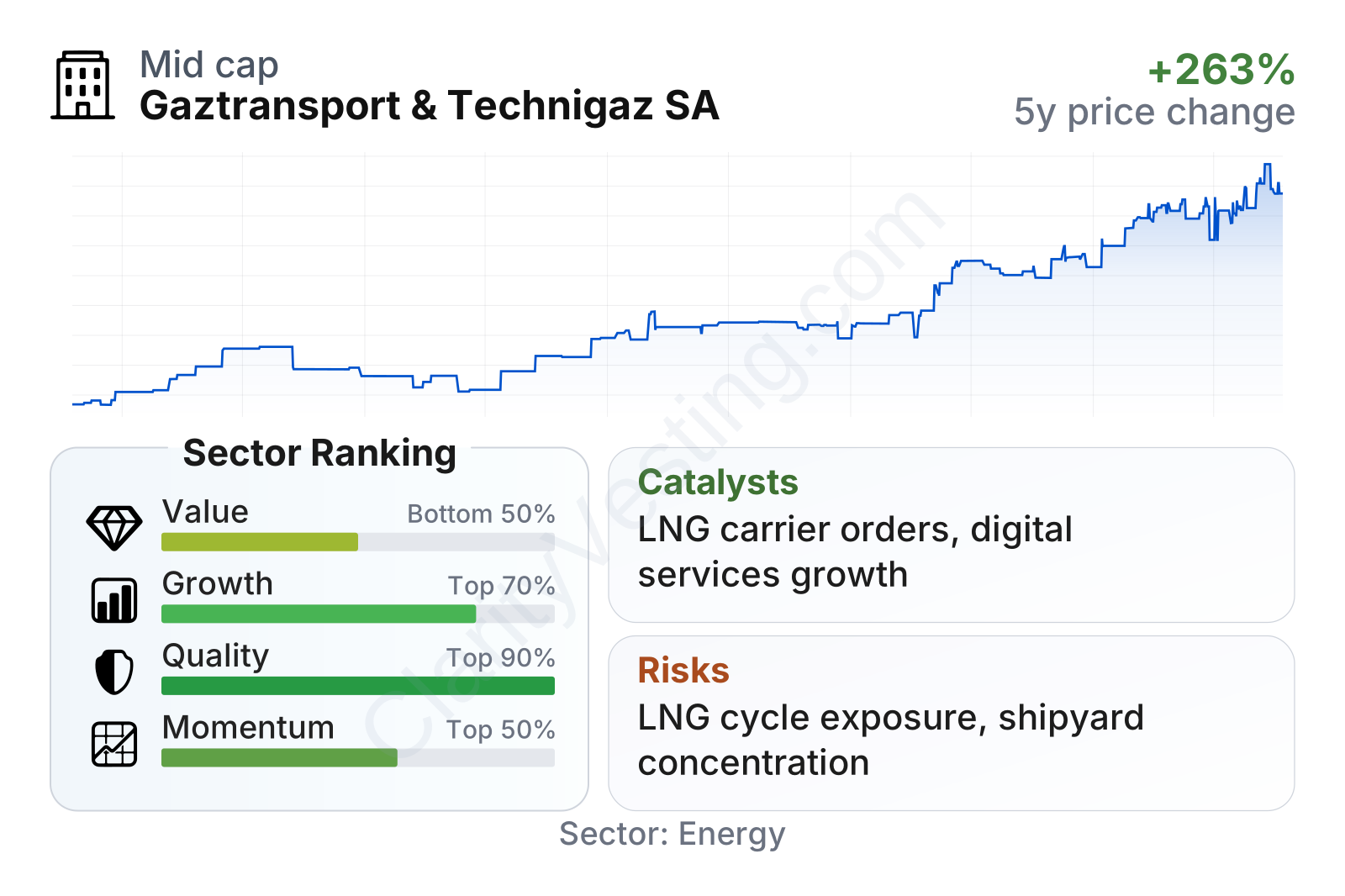
The market currently treats GTT as a large, highly profitable niche industrial technology company rather than a typical oilfield services name. Profitability metrics are exceptionally strong versus the broader energy equipment sector, with operating margin above 60% and net margin above 50%. Balance sheet risk also looks limited, as the company carries net cash rather than meaningful net debt.
Growth measures are more mixed in the short term. Recent year-over-year revenue change is close to flat, but the longer trend remains strong, with five-year growth in revenue per share, free cash flow, and dividends clearly ahead of sector medians. The share price has also had a strong three-year run, although recent momentum has been less extreme than the earlier surge. On valuation, the earnings multiple is only modestly above the sector median, but the price-to-book ratio is far higher, which is common for an asset-light business built on intellectual property rather than factories and heavy equipment.
Growth
GTT operates in a part of the energy and maritime market that has had structural support over the last several years. LNG has remained important for energy security, global gas trade, and flexible power supply, especially in regions seeking alternatives to pipeline gas. That has supported demand for LNG carriers, floating storage and regasification units, and related infrastructure. Since GTT earns much of its money from vessels ordered at shipyards, its growth is linked more to the order cycle for LNG transport capacity than to spot gas prices alone.
The company’s strategy for future expansion is logical. First, it continues to defend and deepen its position in LNG carrier containment systems, which remains the core earnings engine. Second, it is extending its know-how into adjacent areas such as LNG-fueled ships, digital vessel performance tools, and other cryogenic applications. Third, it has been exploring opportunities tied to lower-carbon shipping and new molecules, including ammonia-related work, although those activities are still much smaller than the core LNG business.
A major catalyst is the still-large installed and ordered base of LNG carriers using GTT technology. Each new vessel order can feed future royalty income, while the installed fleet creates recurring opportunities in services, maintenance support, and digital offerings. Another favorable element is that LNG shipping capacity often needs to grow when liquefaction projects in the United States, Qatar, and other exporting regions move forward. More cargo supply generally requires more ships, and more ships can translate into more licensing revenue for GTT.
Recent company communications have also pointed to a high level of order visibility and continued activity in LNG shipping. For a business with limited capital needs, that matters a lot because strong order intake can convert into a disproportionate rise in profit and cash generation. In other words, even moderate growth in end demand can have a large effect on earnings because the business model has substantial operating leverage in the right direction.
Risks
This article is for informational purposes only and does not constitute financial advice. Some content is AI-generated. See Disclaimer


