Stock Analysis · Galaxy Entertainment Group Ltd (GXYEF)
Overview
Galaxy Entertainment Group Ltd is a Hong Kong-based resort and casino operator with most of its business concentrated in Macau, the only place in China where casino gambling is legal. The company develops and runs large integrated resorts that combine gaming floors with hotels, shopping, dining, entertainment, and convention space. Its best-known assets include Galaxy Macau, StarWorld Macau, Broadway Macau, and City Clubs. It also has an international development pipeline through its interest in a project on Boracay in the Philippines and other non-gaming expansion plans.
In practical terms, Galaxy makes money mainly when visitors come to its properties to gamble, stay in hotels, eat, shop, and attend events. The business is therefore tied to tourism flows into Macau, consumer spending, and the company’s ability to keep its resorts attractive to both mass-market visitors and premium players.
Based on company reporting, the main revenue sources are organized primarily by business activity, with gaming remaining the clear core of the group.
- Gaming revenue: approximately 80% to 85% of total revenue in recent normal operating periods. This includes mass-market table games, VIP-related gaming, slot machines, and electronic gaming. Mass gaming has become increasingly important across Macau after the structural decline of the old junket-driven VIP model.
- Hotel, food and beverage, mall rental, and other non-gaming revenue: approximately 15% to 20%. This includes room bookings, restaurants, retail leasing, shows, leisure attractions, and other resort services. While smaller than gaming, this segment matters because Macau concession terms increasingly emphasize tourism diversification beyond casinos.
Galaxy’s business mix is still heavily Macau-centered, which gives it strong exposure to one of the world’s largest gaming markets, but also means concentration risk is unusually high for a company of its size.
The long-term picture shows a sharp pandemic-era disruption in 2022 followed by a strong rebound in 2023 and 2024. Revenue and operating profit recovered materially as travel normalized, and profitability remained solid afterward, although yearly figures can still swing because gaming volumes and visitor spending are cyclical.
Key Figures
| Metric | Value | Sector ⓘ |
|---|---|---|
| Date | Oct 31, 2026 | |
| Context | ||
| Sector | Consumer Cyclical | |
| Industry | Resorts & Casinos | |
| Market Cap ⓘ | $18.96B | |
| Beta ⓘ | 0.52 | |
Value (Cheapness) | ||
| P/E Ratio ⓘ | 13.97 | 17.02 |
| P/B Ratio ⓘ | 0.23 | 1.61 |
| FCF Yield ⓘ | 90.41% | 8.71% |
| Dividend Yield ⓘ | 39.26% | 2.66% |
| EBIT / EV ⓘ | N/A | 6.51% |
| PEG ⓘ | 1.59 | |
Growth (Business expansion) | ||
| Revenue Growth ⓘ | 4.20% | 5.50% |
| RPS Growth (5Y CAGR) ⓘ | 10.58% | 9.01% |
| EPS Growth (5Y CAGR) ⓘ | 27.94% | -16.46% |
| BVPS Growth (5Y CAGR) ⓘ | 4.71% | 5.64% |
| Margin Growth (5Y Trend) ⓘ | 24.29% | -0.17% |
| FCF Growth (5Y CAGR) ⓘ | N/A | 5.33% |
| DPS Growth (5Y CAGR) ⓘ | 21.65% | 10.21% |
Quality (Business durability) | ||
| ROIC (Latest) ⓘ | 21.08% | 12.02% |
| ROA (Latest) ⓘ | 20.84% | 5.51% |
| ROIC (5Y Median) ⓘ | 6.68% | 10.72% |
| ROA (5Y Median) ⓘ | 8.12% | 5.44% |
| Net Debt / EBIT (Latest) ⓘ | -0.74 | 2.17 |
| Net Debt / EBIT (5Y Median) ⓘ | -1.71 | 2.30 |
| Net Debt / EBITDA (Latest) ⓘ | -0.52 | 1.49 |
| Net Debt / Assets ⓘ | -13.08% | 21.53% |
| EBITDA / Interest ⓘ | 68.99 | 9.26 |
| Operating Margin (Latest) ⓘ | 23.68% | 9.01% |
| Operating Margin (5Y Median) ⓘ | 20.06% | 9.56% |
| Debt to Equity (Latest) ⓘ | 3.02% | 75.88% |
| Profit Margin (Latest) ⓘ | 21.31% | 5.30% |
| Free Cash Flow (Latest) ⓘ | $17.14B | |
Momentum (Price trend) | ||
| 3Y Return ⓘ | -12.09% | +22.25% |
| 12M Return (excl. last month) ⓘ | -18.87% | -4.14% |
| 6M Return ⓘ | -0.28% | -0.38% |
| Price vs. 200-Day MA ⓘ | -0.24% | -1.19% |
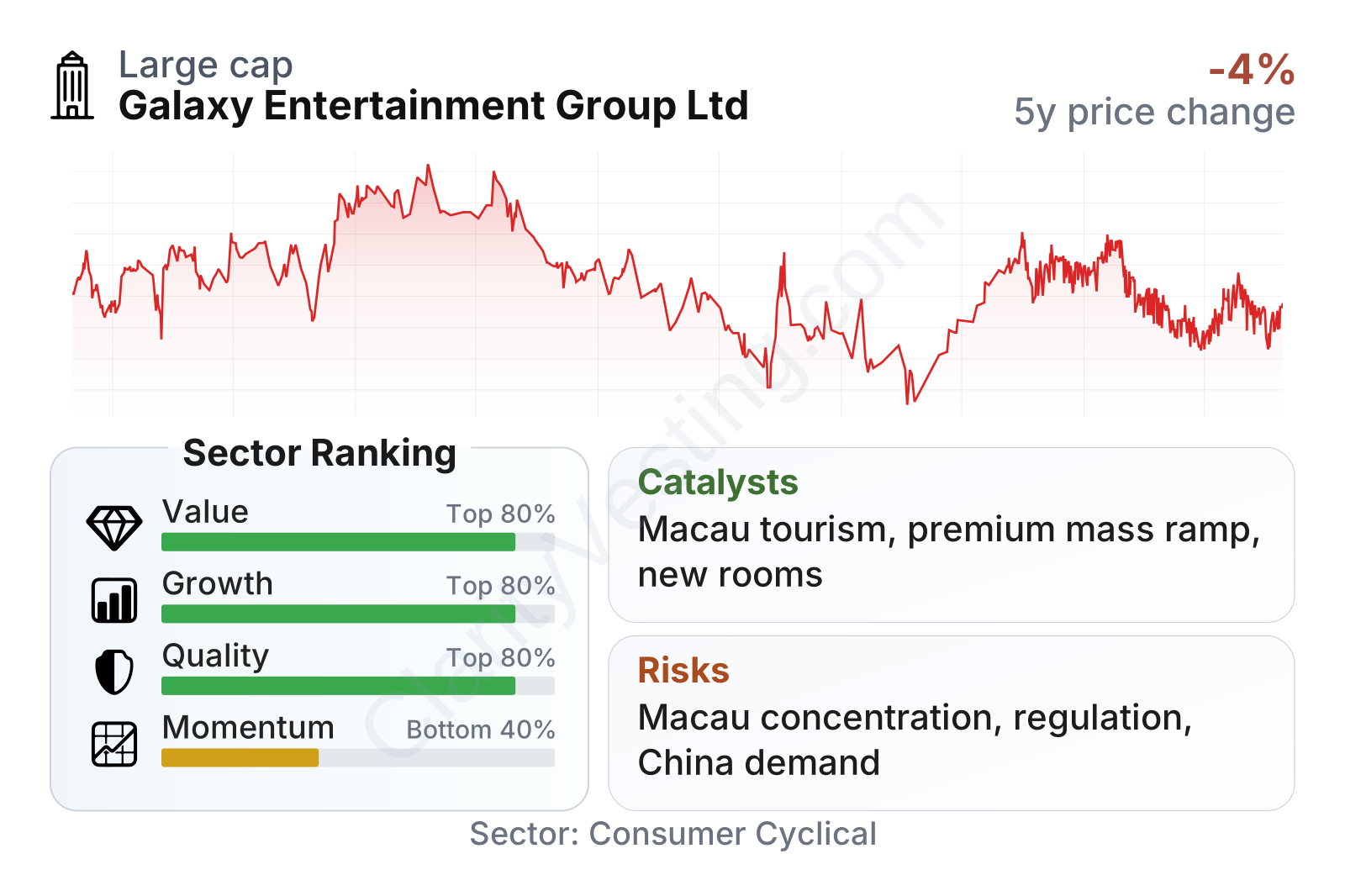
Galaxy stands out as a large company in the resorts and casinos space with unusually low share-price volatility for the sector. The broader financial profile is notable for strong profitability, high cash generation, and a very conservative balance sheet. Value metrics appear inexpensive relative to sector norms, especially on price-to-book and earnings multiples, while quality indicators are comfortably above many peers. The weaker area is market momentum: the stock has lagged the wider consumer cyclical group over the last several months and over a multi-year period, reflecting ongoing caution around Macau demand and China-related spending trends.
Growth
Galaxy operates in a sector that still has structural growth potential, even though it is cyclical. Macau remains a unique gaming destination with very high barriers to entry because the number of concessions is limited and large-scale resort development requires major capital, government approval, and operating experience. Over time, growth depends on rising visitation, longer stays, more family and entertainment traffic, and a larger mix of non-gaming spending.
Galaxy’s strategy broadly fits that direction. The company has continued to invest in new hotel rooms, entertainment capacity, premium offerings, and amenities that attract tourists beyond pure casino play. This matters because Macau’s policy environment now favors operators that help diversify the local economy. Companies that can combine gaming with retail, conventions, luxury accommodation, and event programming are better positioned to align with that policy framework.
Recent operating trends suggest a business that has already completed its main post-pandemic rebound but may now be entering a more normal growth phase. Near-term revenue growth is not especially fast compared with the sector median, yet the five-year record for revenue per share and earnings growth remains strong. Margin improvement over that same period is especially important: it suggests Galaxy did not simply recover volumes, but also rebuilt profitability effectively.
The main catalysts are tied to continued recovery in Macau tourism, premium mass gaming demand, and the ramp-up of added capacity inside Galaxy Macau. Additional hotel inventory and upgraded entertainment or retail offerings can support spending per visitor. Another meaningful opportunity is policy support for non-gaming attractions, which can help Galaxy monetize its resort footprint more fully and reduce reliance on one category of customer spending.
Recent company updates have also highlighted ongoing capital returns and strong liquidity, which give management flexibility to fund expansion, refresh properties, and maintain shareholder distributions while still preserving balance-sheet strength.
Risks
This article is for informational purposes only and does not constitute financial advice. Some content is AI-generated. See Disclaimer


