Stock Analysis · GXO Logistics Inc (GXO)
Overview
GXO Logistics is a contract logistics company. In simple terms, it helps other businesses run warehouses, manage inventory, prepare online orders, handle returns, and move goods through supply chains more efficiently. The company focuses on outsourced logistics rather than traditional package delivery. Its customers include retailers, e-commerce companies, industrial groups, food and consumer products businesses, and technology-related clients that want to hand over complex warehouse and fulfillment operations to a specialist.
Its business model is built around long-term contracts, large warehouse networks, automation, and customized services. GXO often operates inside customer-dedicated facilities or multi-customer sites, where it can use robotics, data tools, and labor management systems to improve productivity. This makes the company more exposed to warehousing and fulfillment trends than to day-to-day freight spot pricing.
Based on company disclosures, revenue is primarily generated from contract logistics services, with exposure spread across end markets and geographies rather than a large number of separate reporting lines. The broad sources of revenue can be summarized as follows:
- Warehouse operations and fulfillment services: the largest revenue source, likely representing well above 70% of total revenue. This includes storing inventory, picking and packing orders, e-commerce fulfillment, and managing customer-specific logistics sites.
- Value-added services: a meaningful secondary source, likely in the low double-digit percentage range. This includes reverse logistics, returns processing, packaging, light assembly, and other supply-chain support activities.
- Transportation management and related services: a smaller portion of revenue, likely in the single-digit to low double-digit range depending on contract mix. This covers coordinating shipments and optimizing transport flows connected to warehouse operations.
- Automation and technology-enabled solutions: generally embedded across contracts rather than always reported separately, but increasingly important in supporting pricing, retention, and margin potential.
Geographically, GXO has a large presence in Europe and North America, with Europe historically representing the bigger share of revenue. That mix matters because labor costs, energy prices, regulation, and customer demand can vary significantly by region.
Over the last several years, the company has clearly expanded its scale. Revenue has grown from about $7.9 billion in 2021 to more than $13 billion in 2025, but the path from revenue to profit has become tighter. Gross profit increased over that period, yet operating income and net income did not keep pace, showing that recent expansion has come with pressure from costs, integration work, and higher interest expense.
The business has become much larger, but profitability has not expanded at the same rate. Revenue and gross profit moved higher over time, while interest expense rose sharply and net income weakened materially in 2024 and 2025. That pattern suggests that scale alone has not yet translated into stronger bottom-line efficiency.
Key Figures
| Metric | Value | Sector ⓘ |
|---|---|---|
| Date | Oct 10, 2026 | |
| Context | ||
| Sector | Industrials | |
| Industry | Integrated Freight & Logistics | |
| Market Cap ⓘ | $5.32B | |
| Beta ⓘ | 1.57 | |
Value (Cheapness) | ||
| P/E Ratio ⓘ | 41.06 | 22.32 |
| P/B Ratio ⓘ | 1.80 | 1.98 |
| FCF Yield ⓘ | 3.38% | 6.34% |
| Dividend Yield ⓘ | N/A | 1.95% |
| EBIT / EV ⓘ | 2.91% | 4.71% |
| PEG ⓘ | 1.14 | |
Growth (Business expansion) | ||
| Revenue Growth ⓘ | 4.30% | 9.25% |
| RPS Growth (5Y CAGR) ⓘ | 13.33% | 7.75% |
| EPS Growth (5Y CAGR) ⓘ | -22.62% | -13.37% |
| BVPS Growth (5Y CAGR) ⓘ | 6.13% | 6.12% |
| Margin Growth (5Y Trend) ⓘ | -0.39% | 0.81% |
| FCF Growth (5Y CAGR) ⓘ | -14.41% | 11.01% |
| DPS Growth (5Y CAGR) ⓘ | N/A | 9.48% |
Quality (Business durability) | ||
| ROIC (Latest) ⓘ | 3.19% | 10.70% |
| ROA (Latest) ⓘ | 1.08% | 5.38% |
| ROIC (5Y Median) ⓘ | 5.38% | 9.26% |
| ROA (5Y Median) ⓘ | 2.21% | 4.94% |
| Net Debt / EBIT (Latest) ⓘ | 17.43 | 2.08 |
| Net Debt / EBIT (5Y Median) ⓘ | 14.21 | 2.29 |
| Net Debt / EBITDA (Latest) ⓘ | 6.89 | 1.43 |
| Net Debt / Assets ⓘ | 43.25% | 19.34% |
| EBITDA / Interest ⓘ | 7.77 | 9.54 |
| Operating Margin (Latest) ⓘ | 2.25% | 10.34% |
| Operating Margin (5Y Median) ⓘ | 2.19% | 10.29% |
| Debt to Equity (Latest) ⓘ | 204.85% | 65.52% |
| Profit Margin (Latest) ⓘ | 0.96% | 6.63% |
| Free Cash Flow (Latest) ⓘ | $180.00M | |
Momentum (Price trend) | ||
| 3Y Return ⓘ | -17.71% | +61.33% |
| 12M Return (excl. last month) ⓘ | -8.19% | +14.82% |
| 6M Return ⓘ | -13.67% | +3.53% |
| Price vs. 200-Day MA ⓘ | -12.17% | +0.88% |
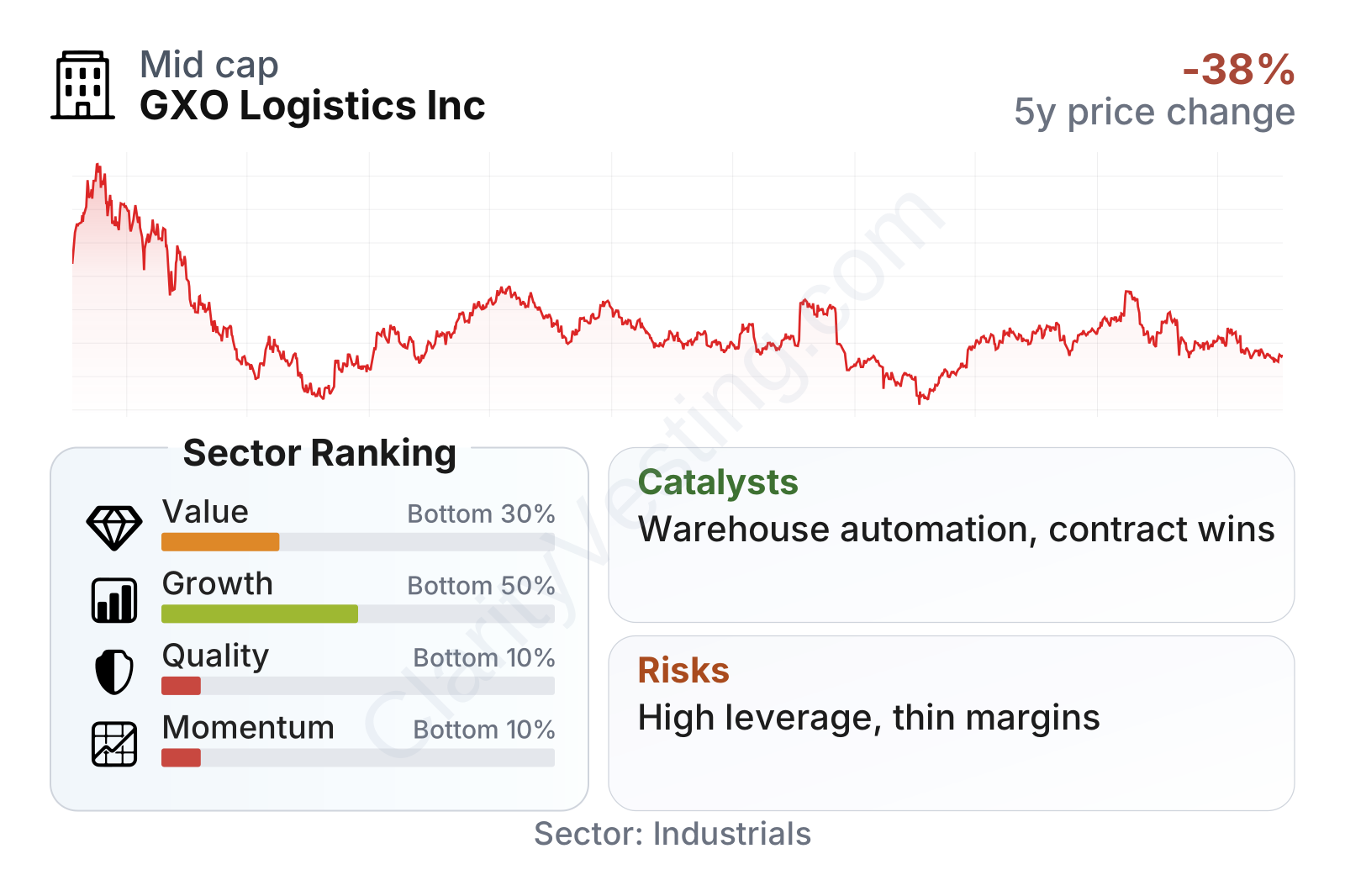
GXO is a mid-sized public company within the industrials universe, and its recent profile looks mixed. On valuation, the shares trade at earnings multiples above the sector median, while cash-flow-based measures look less favorable. On growth, near-term revenue growth is positive but slower than the sector median, even though the longer five-year revenue-per-share trend has been solid. The weakest area is quality: returns on capital and assets are low versus peers, margins are thin, and leverage is clearly elevated. Price momentum has also lagged the broader sector over multiple time frames, which shows the market remains cautious about the company’s current earnings power.
Growth
Contract logistics remains a structurally attractive segment of the supply-chain industry. Companies continue to outsource warehousing and fulfillment because supply chains are becoming more complex, labor is harder to manage, and online commerce still requires sophisticated order handling and returns capabilities. In that context, GXO is operating in a market with long-term demand drivers, especially where automation can lower costs and improve service levels.
Its strategy broadly makes sense for future growth. GXO emphasizes high-complexity warehouses, automation, and multi-year contracts rather than lower-value commodity logistics work. That can support customer retention and create switching costs, because once a warehouse network is designed around GXO’s systems, processes, and robotics, changing providers is disruptive. The company has also used acquisitions to expand scale and customer reach, which can open cross-selling opportunities if integration goes well.
Revenue growth has remained positive, but the pace has cooled from earlier peaks. After several quarters of double-digit or better expansion, recent growth has come down to low single digits. That does not mean demand has disappeared, but it does suggest GXO is moving from a rapid expansion phase into a period where execution and profitability matter more than headline sales growth.
Cash generation is another area to watch closely. Free cash flow remains positive, which is important for a logistics operator with meaningful capital needs, but the recent trend has been weaker than a few years ago. A business like GXO does not need huge accounting margins if it can consistently convert operations into cash; however, softer free cash flow reduces flexibility for debt reduction, acquisitions, and shareholder returns.
A major catalyst for GXO is the continued adoption of warehouse automation. Retailers and manufacturers want faster fulfillment, better inventory accuracy, and lower labor intensity. GXO’s focus on robotics, goods-to-person systems, and data-driven warehouse design fits those needs. Another catalyst is the ongoing complexity of reverse logistics, especially in e-commerce, where returns handling has become a specialized service rather than a simple add-on.
Recent company announcements and investor communications have also pointed to contract wins, automation deployments, and integration efforts as important opportunities. For a company in GXO’s position, large new customer deals matter not just for revenue, but because they can deepen specialization in sectors such as consumer goods, technology, and omnichannel retail.
Risks
This article is for informational purposes only and does not constitute financial advice. Some content is AI-generated. See Disclaimer