Stock Analysis · WW Grainger Inc (GWW)
Overview
W.W. Grainger is a large industrial distributor that helps businesses keep facilities running. It sells maintenance, repair, and operating products used every day in factories, warehouses, hospitals, schools, government buildings, and commercial sites. Its catalog covers safety gear, material handling equipment, motors, pumps, fasteners, tools, lighting, cleaning supplies, and many other routine but essential items.
The business is built around availability, speed, and breadth of assortment rather than manufacturing. Grainger acts as a middleman with scale: it sources products from many suppliers, stocks them in its distribution network, and delivers them through a mix of sales representatives, branches, websites, and digital procurement tools. That model matters because many customers care less about finding the absolute cheapest item than about getting the right part quickly enough to avoid downtime.
Based on the company’s reporting structure, revenue mainly comes from two operating segments.
- High-Touch Solutions North America: about 78% of 2025 revenue. This is the core U.S., Canada, and Mexico business serving larger and more complex customers. It includes field sales, technical support, inventory management, onsite services, and a broad maintenance and industrial supply offering.
- Endless Assortment: about 22% of 2025 revenue. This includes online-oriented operations such as Zoro in the U.S. and MonotaRO outside the U.S. The focus is a very wide product catalog, digital self-service purchasing, and smaller order sizes with less hands-on support.
That mix is useful for long-term analysis because it gives Grainger both a traditional relationship-driven distribution engine and a faster-growing digital marketplace-style business. Over the last several years, sales have expanded steadily, while gross profit and operating income have also risen, showing that the company has not relied only on volume growth but has also kept pricing and cost discipline fairly strong.
The multiyear flow of revenue and profit shows a business that has grown meaningfully since 2021. Revenue has climbed from roughly $13 billion to nearly $18 billion by 2025, while gross profit has also moved higher. Operating income and net income improved strongly through 2024, although 2025 shows some pressure from heavier operating expenses, especially selling and administrative costs.
Key Figures
| Metric | Value | Sector ⓘ |
|---|---|---|
| Date | Oct 24, 2026 | |
| Context | ||
| Sector | Industrials | |
| Industry | Industrial Distribution | |
| Market Cap ⓘ | $62.92B | |
| Beta ⓘ | 1.01 | |
Value (Cheapness) | ||
| P/E Ratio ⓘ | 34.07 | 22.29 |
| P/B Ratio ⓘ | 17.06 | 1.98 |
| FCF Yield ⓘ | 2.40% | 6.26% |
| Dividend Yield ⓘ | 0.70% | 1.92% |
| EBIT / EV ⓘ | 4.46% | 4.83% |
| PEG ⓘ | 1.73 | |
Growth (Business expansion) | ||
| Revenue Growth ⓘ | 10.30% | 9.30% |
| RPS Growth (5Y CAGR) ⓘ | 10.64% | 7.76% |
| EPS Growth (5Y CAGR) ⓘ | -5.86% | -13.17% |
| BVPS Growth (5Y CAGR) ⓘ | 22.90% | 6.13% |
| Margin Growth (5Y Trend) ⓘ | 2.08% | 0.74% |
| FCF Growth (5Y CAGR) ⓘ | 18.19% | 10.79% |
| DPS Growth (5Y CAGR) ⓘ | 9.21% | 9.41% |
Quality (Business durability) | ||
| ROIC (Latest) ⓘ | 32.60% | 10.75% |
| ROA (Latest) ⓘ | 20.25% | 5.41% |
| ROIC (5Y Median) ⓘ | 35.46% | 9.37% |
| ROA (5Y Median) ⓘ | 21.82% | 4.95% |
| Net Debt / EBIT (Latest) ⓘ | 0.80 | 2.04 |
| Net Debt / EBIT (5Y Median) ⓘ | 1.03 | 2.27 |
| Net Debt / EBITDA (Latest) ⓘ | 0.73 | 1.39 |
| Net Debt / Assets ⓘ | 22.96% | 19.27% |
| EBITDA / Interest ⓘ | 37.32 | 9.58 |
| Operating Margin (Latest) ⓘ | 14.68% | 10.49% |
| Operating Margin (5Y Median) ⓘ | 14.47% | 10.30% |
| Debt to Equity (Latest) ⓘ | 67.71% | 64.82% |
| Profit Margin (Latest) ⓘ | 9.92% | 6.67% |
| Free Cash Flow (Latest) ⓘ | $1.51B | |
Momentum (Price trend) | ||
| 3Y Return ⓘ | +100.47% | +67.77% |
| 12M Return (excl. last month) ⓘ | +30.45% | +12.05% |
| 6M Return ⓘ | +15.90% | 0.00% |
| Price vs. 200-Day MA ⓘ | +10.60% | +0.67% |
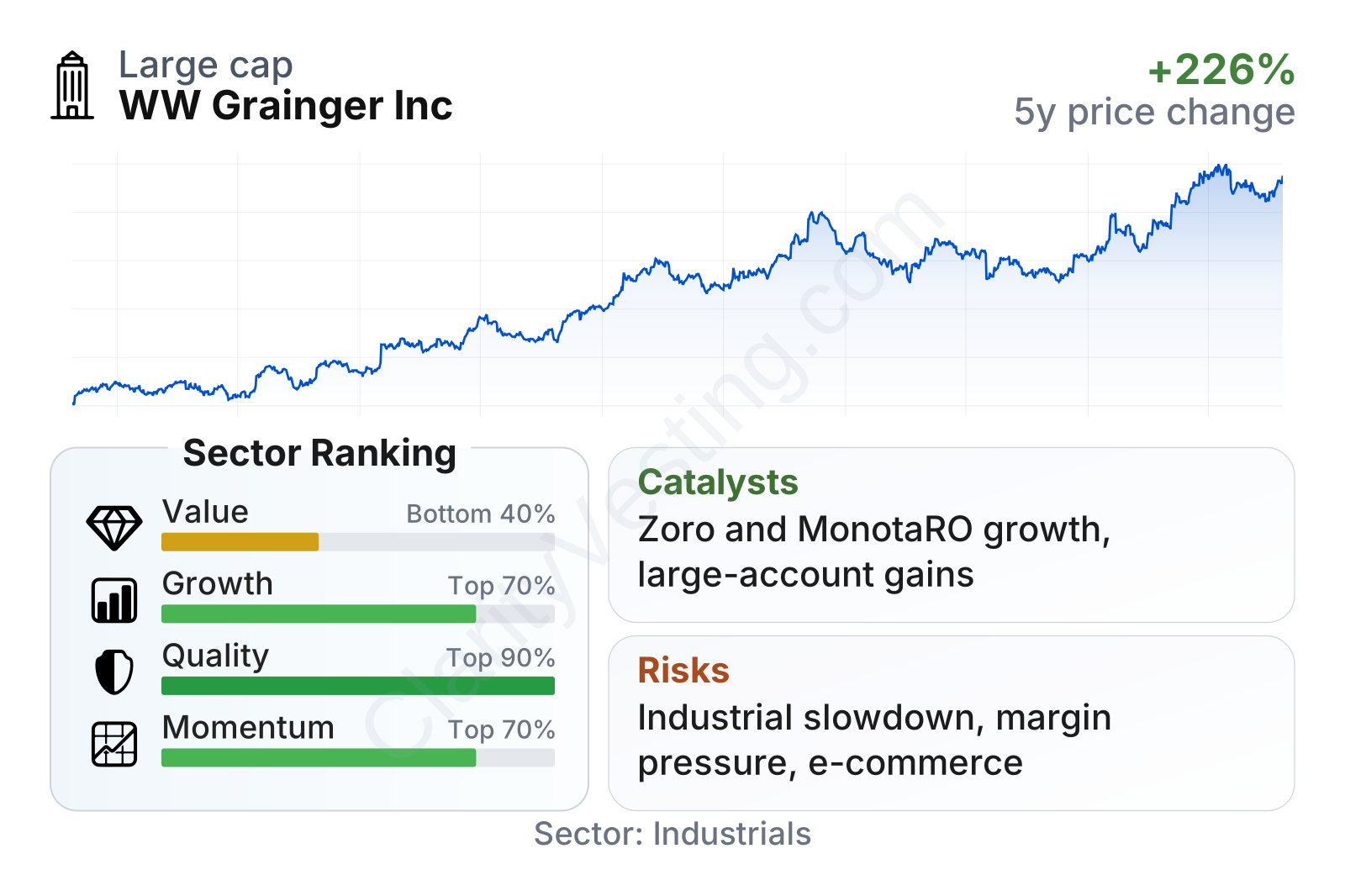
Grainger stands out most on business quality. Profitability and returns on assets are well above typical industrial peers, and leverage looks manageable rather than aggressive. Growth indicators are also solid, with revenue and free cash flow expansion ahead of many sector companies over a multi-year period. The weaker area is valuation: earnings multiple, book multiple, and free cash flow yield all point to a stock priced at a premium.
Grainger is a large company in industrial distribution, with stock-price volatility close to the broader market rather than unusually high. Recent market performance has been strong, which helps explain why valuation measures now sit above sector norms.
Growth
Grainger operates in a sector that is not usually described as high-growth in the way software or semiconductors are, but it does benefit from durable long-term demand. Businesses will continue to need replacement parts, safety supplies, and maintenance products regardless of economic cycles. Over time, the main growth drivers tend to be industrial activity, e-commerce adoption in procurement, outsourcing of inventory management, and the rising importance of supply-chain reliability.
Its strategy for future growth looks coherent. In North America, Grainger is trying to deepen relationships with larger customers that value service, product availability, and integrated purchasing systems. In digital channels, it is using Zoro and MonotaRO to capture customers who prefer broad online selection and self-service ordering. This two-part model reduces dependence on any single customer type and gives the company exposure to both stable recurring demand and digital expansion.
Revenue growth has cooled from the unusually strong pace seen in 2021 and 2022, which is normal after a period shaped by inflation, elevated product demand, and supply-chain disruption. More recently, growth has reaccelerated into the low-double-digit range, which suggests demand has remained healthy and the company is still taking share in parts of the market.
Cash generation remains an important strength even though free cash flow has come down from its recent peak. The business is still producing well over $1 billion in trailing free cash flow, which supports dividends, share repurchases, technology investment, and distribution-network spending without putting obvious strain on the balance sheet.
A major catalyst is continued digital procurement adoption. Many organizations are moving routine industrial purchasing away from fragmented local buying and toward larger platforms integrated with internal systems. Grainger is well positioned for that shift because it already combines a large catalog, fulfillment infrastructure, and procurement software connections. Another growth tailwind is the increasing focus on uptime, safety compliance, and labor efficiency at customer sites, all of which favor distributors that can simplify replenishment and reduce downtime.
Recent company communications have also emphasized investments in customer service, supply-chain capabilities, and assortment expansion. Those are not flashy developments, but they fit Grainger’s model well: the company tends to compound through execution rather than through one transformative event.
Risks
This article is for informational purposes only and does not constitute financial advice. Some content is AI-generated. See Disclaimer