Stock Analysis · Givaudan SA (GVDNY)
Overview
Givaudan is a Swiss specialty ingredients company best known for making flavors, fragrances, and related functional ingredients used by consumer brands around the world. Its products are usually not sold directly to the public. Instead, they are embedded in everyday items such as perfumes, skin care, detergents, beverages, snacks, dairy products, and health-oriented food products. This makes Givaudan more of a business-to-business supplier than a household name, even though its formulas are present in many familiar products.
The business is organized into two main divisions, and company reporting shows a fairly balanced mix between them.
- Taste & Wellbeing: about 53% of 2025 sales. This division includes flavors for food and beverages, taste solutions, functional and nutritional ingredients, and products aimed at health and wellness trends.
- Fragrance & Beauty: about 47% of 2025 sales. This division includes fine fragrances, consumer products fragrances, and ingredients used in personal care and beauty applications.
That revenue mix matters because it gives Givaudan exposure to both relatively resilient everyday consumption and higher-value premium categories. Food, beverages, home care, and personal care tend to be recurring end markets, which can help smooth demand over time even when the broader economy slows.
Over the last five years, the company’s revenue moved from roughly CHF 6.7 billion to about CHF 7.5 billion, while profitability improved more sharply than sales. Operating income and net income both expanded meaningfully in 2024 before easing only slightly in 2025, suggesting that pricing, product mix, and cost control have recently mattered as much as volume growth.
The income profile shows a notable improvement since 2023: revenue has risen, cost of sales has stayed comparatively controlled, and operating profit remains well above earlier levels. Research and development spending has also stayed substantial, which fits a business where formulation know-how and customer-specific innovation are central to staying competitive.
Key Figures
| Metric | Value | Sector ⓘ |
|---|---|---|
| Date | Oct 24, 2026 | |
| Context | ||
| Sector | Basic Materials | |
| Industry | Specialty Chemicals | |
| Market Cap ⓘ | $44.32B | |
| Beta ⓘ | 0.62 | |
Value (Cheapness) | ||
| P/E Ratio ⓘ | 37.08 | 16.92 |
| P/B Ratio ⓘ | 10.23 | 1.66 |
| FCF Yield ⓘ | 4.99% | 5.83% |
| Dividend Yield ⓘ | 1.90% | 2.07% |
| EBIT / EV ⓘ | N/A | 6.38% |
| PEG ⓘ | 4.55 | |
Growth (Business expansion) | ||
| Revenue Growth ⓘ | -1.70% | 11.25% |
| RPS Growth (5Y CAGR) ⓘ | 2.88% | 4.49% |
| EPS Growth (5Y CAGR) ⓘ | 6.82% | -15.24% |
| BVPS Growth (5Y CAGR) ⓘ | 3.54% | 5.49% |
| Margin Growth (5Y Trend) ⓘ | 3.24% | -1.54% |
| FCF Growth (5Y CAGR) ⓘ | 3.99% | 0.37% |
| DPS Growth (5Y CAGR) ⓘ | 2.35% | 5.91% |
Quality (Business durability) | ||
| ROIC (Latest) ⓘ | 26.88% | 9.59% |
| ROA (Latest) ⓘ | 17.03% | 4.92% |
| ROIC (5Y Median) ⓘ | 12.48% | 7.91% |
| ROA (5Y Median) ⓘ | 7.89% | 3.92% |
| Net Debt / EBIT (Latest) ⓘ | 1.60 | 1.36 |
| Net Debt / EBIT (5Y Median) ⓘ | 3.46 | 1.69 |
| Net Debt / EBITDA (Latest) ⓘ | 1.27 | 0.93 |
| Net Debt / Assets ⓘ | 37.99% | 13.69% |
| EBITDA / Interest ⓘ | 16.62 | 12.38 |
| Operating Margin (Latest) ⓘ | 19.02% | 13.24% |
| Operating Margin (5Y Median) ⓘ | 16.04% | 11.82% |
| Debt to Equity (Latest) ⓘ | 111.59% | 40.30% |
| Profit Margin (Latest) ⓘ | 12.88% | 6.38% |
| Free Cash Flow (Latest) ⓘ | $2.21B | |
Momentum (Price trend) | ||
| 3Y Return ⓘ | +58.99% | +73.47% |
| 12M Return (excl. last month) ⓘ | +0.78% | +27.59% |
| 6M Return ⓘ | +32.00% | -4.02% |
| Price vs. 200-Day MA ⓘ | +23.57% | -0.65% |
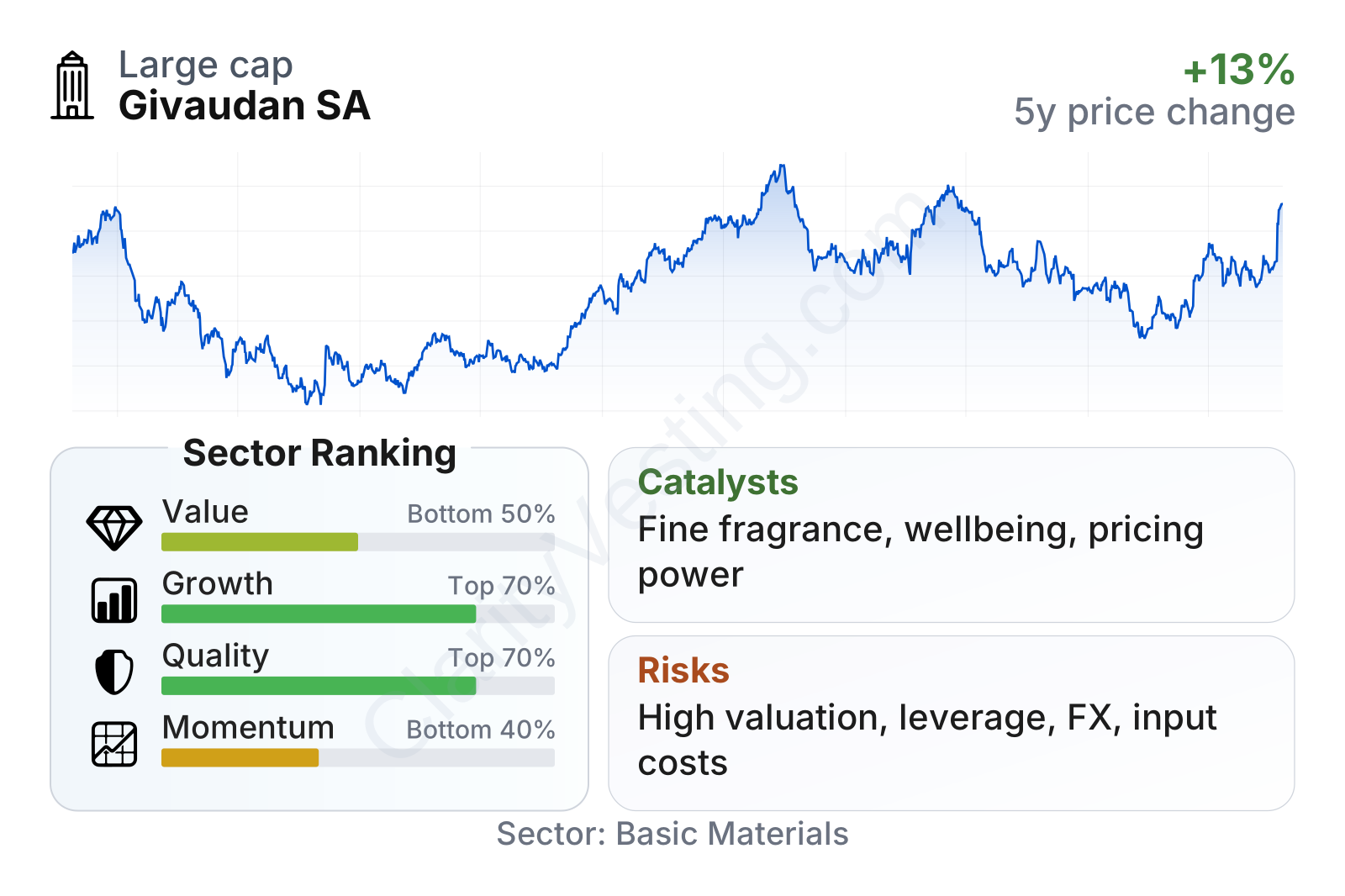
Givaudan combines a large global scale with relatively low share-price volatility, as reflected by a beta below 1. The overall financial picture is mixed in an intuitive way: quality is strong, growth is decent but not fast, momentum has been uneven, and valuation looks demanding. Profitability metrics stand well above the sector median, especially returns on capital, returns on assets, and operating margin. Free cash flow generation is also solid in absolute terms. On the other hand, the stock trades at a clear premium on earnings and book value, while recent revenue growth has been softer than the broader specialty chemicals sector.
The stock-price history also reflects this profile. After a steep decline in 2022, the shares recovered strongly through 2024, then became more volatile again before rebounding in mid-2026. That pattern often appears in high-quality businesses when the market is reassessing how much it is willing to pay for stability and pricing power.
Growth
Givaudan operates in markets supported by long-term structural demand rather than short-lived fashion. Global consumption of food, beverages, beauty, and household products tends to rise over time, while brands increasingly want more sophisticated flavor and fragrance formulations. On top of that, several industry themes favor specialized suppliers: premiumization, clean-label and natural ingredients, wellness-oriented products, and product differentiation through scent and taste.
The company’s strategy also makes sense for long-term expansion. Givaudan invests heavily in research, works closely with consumer-goods companies, and uses acquisitions to add technologies, ingredient capabilities, and access to faster-growing niches. This is important because many customer relationships are sticky: once a formulation is approved and scaled into a product line, changing suppliers can be inconvenient, time-consuming, and risky for the brand owner.
The near-term growth picture is not as strong as the long-term one. Reported year-over-year revenue recently slipped by about 2%, and the five-year revenue-per-share growth rate is below the sector median. However, earnings per share, free cash flow, and operating margin have improved at healthier rates than much of the sector. That suggests growth has recently come less from raw volume expansion and more from better mix, pricing discipline, and operating execution.
A meaningful catalyst is the company’s positioning in higher-value categories such as fine fragrance, active beauty ingredients, and health-and-wellbeing solutions in food. These areas generally offer stronger differentiation than basic chemical products. Another catalyst is the ongoing push by global consumer brands to refresh products more frequently and tailor them to regional tastes, which increases the value of formulation expertise and local application capabilities.
Recent company communications have continued to emphasize innovation, targeted acquisitions, and expansion in fast-growing customer segments. None of that points to a sudden step-change opportunity, but it does reinforce the idea of steady compounding driven by category mix and customer embeddedness rather than a single blockbuster event.
Risks
This article is for informational purposes only and does not constitute financial advice. Some content is AI-generated. See Disclaimer


