Stock Analysis · Getty Realty Corporation (GTY)
Overview
Getty Realty Corporation is a retail real estate investment trust, or REIT. In simple terms, it owns properties and leases them to tenants, then distributes a large share of its taxable income to shareholders through dividends. Getty Realty focuses mainly on convenience and automotive-related real estate, with a portfolio built around properties that people use regularly and that often benefit from high-traffic locations.
The company’s properties are primarily leased under long-term net leases. Under this structure, tenants usually pay rent as well as many property-level costs such as taxes, insurance, and maintenance. That can make rental income more predictable than in many other types of real estate.
Based on recent company disclosures, Getty Realty’s revenue comes overwhelmingly from rental income tied to single-tenant retail properties. A simplified breakdown is:
- Rental revenue from convenience and gas-related sites: approximately 70% to 80%. This includes convenience stores and fuel stations, historically the company’s core focus.
- Rental revenue from automotive and service-oriented properties: approximately 15% to 25%. This includes car washes, auto service, repair, and similar uses.
- Other real estate income: a small remainder, generally below 10%. This can include ground leases, portfolio transition income, and limited fee or reimbursement-related items.
That mix shows a landlord centered on necessity-driven roadside retail rather than discretionary shopping. Revenue has also trended upward over the past several years, while operating income has generally expanded as the portfolio has grown and rents have increased.
The long-term pattern points to a business that has been adding revenue steadily, although year-to-year accounting line items can be noisy in real estate because of property sales, impairments, and transaction-related effects. The key point is that Getty Realty remains a specialized REIT built around rent collection from everyday-use retail locations.
Key Figures
| Metric | Value | Sector ⓘ |
|---|---|---|
| Date | Oct 03, 2026 | |
| Context | ||
| Sector | Real Estate | |
| Industry | REIT - Retail | |
| Market Cap ⓘ | $1.75B | |
| Beta ⓘ | 0.75 | |
Value (Cheapness) | ||
| P/E Ratio ⓘ | 17.22 | 17.35 |
| P/B Ratio ⓘ | 1.50 | 0.86 |
| FCF Yield ⓘ | -0.70% | 7.47% |
| Dividend Yield ⓘ | 6.75% | 4.75% |
| EBIT / EV ⓘ | 7.47% | 3.81% |
| PEG ⓘ | 1.27 | |
Growth (Business expansion) | ||
| Revenue Growth ⓘ | 10.90% | 5.30% |
| RPS Growth (5Y CAGR) ⓘ | 3.16% | 5.96% |
| EPS Growth (5Y CAGR) ⓘ | -14.49% | -11.41% |
| BVPS Growth (5Y CAGR) ⓘ | 3.38% | 0.41% |
| Margin Growth (5Y Trend) ⓘ | 7.69% | 0.53% |
| FCF Growth (5Y CAGR) ⓘ | 10.07% | 5.40% |
| DPS Growth (5Y CAGR) ⓘ | 5.07% | 5.02% |
Quality (Business durability) | ||
| ROIC (Latest) ⓘ | 8.14% | 5.77% |
| ROE (Latest) ⓘ | 9.19% | 7.64% |
| ROA (Latest) ⓘ | 4.58% | 2.85% |
| ROIC (5Y Median) ⓘ | 4.81% | 4.20% |
| ROE (5Y Median) ⓘ | 7.48% | 6.03% |
| ROA (5Y Median) ⓘ | 3.82% | 2.45% |
| Net Debt / EBIT (Latest) ⓘ | 4.92 | 7.57 |
| Net Debt / EBIT (5Y Median) ⓘ | 8.24 | 8.41 |
| Net Debt / EBITDA (Latest) ⓘ | 3.80 | 5.12 |
| Net Debt / Assets ⓘ | 46.49% | 37.84% |
| EBITDA / Interest ⓘ | 2.40 | 4.11 |
| Operating Margin (Latest) ⓘ | 92.88% | 35.40% |
| Operating Margin (5Y Median) ⓘ | 54.25% | 36.59% |
| Debt to Equity (Latest) ⓘ | 95.33% | 89.06% |
| Profit Margin (Latest) ⓘ | 42.74% | 19.99% |
| Free Cash Flow (Latest) ⓘ | -$12.22M | |
Momentum (Price trend) | ||
| 3Y Return ⓘ | +24.76% | +30.60% |
| 12M Return (excl. last month) ⓘ | +20.81% | +7.55% |
| 6M Return ⓘ | -10.48% | +0.69% |
| Price vs. 200-Day MA ⓘ | -10.69% | -2.30% |
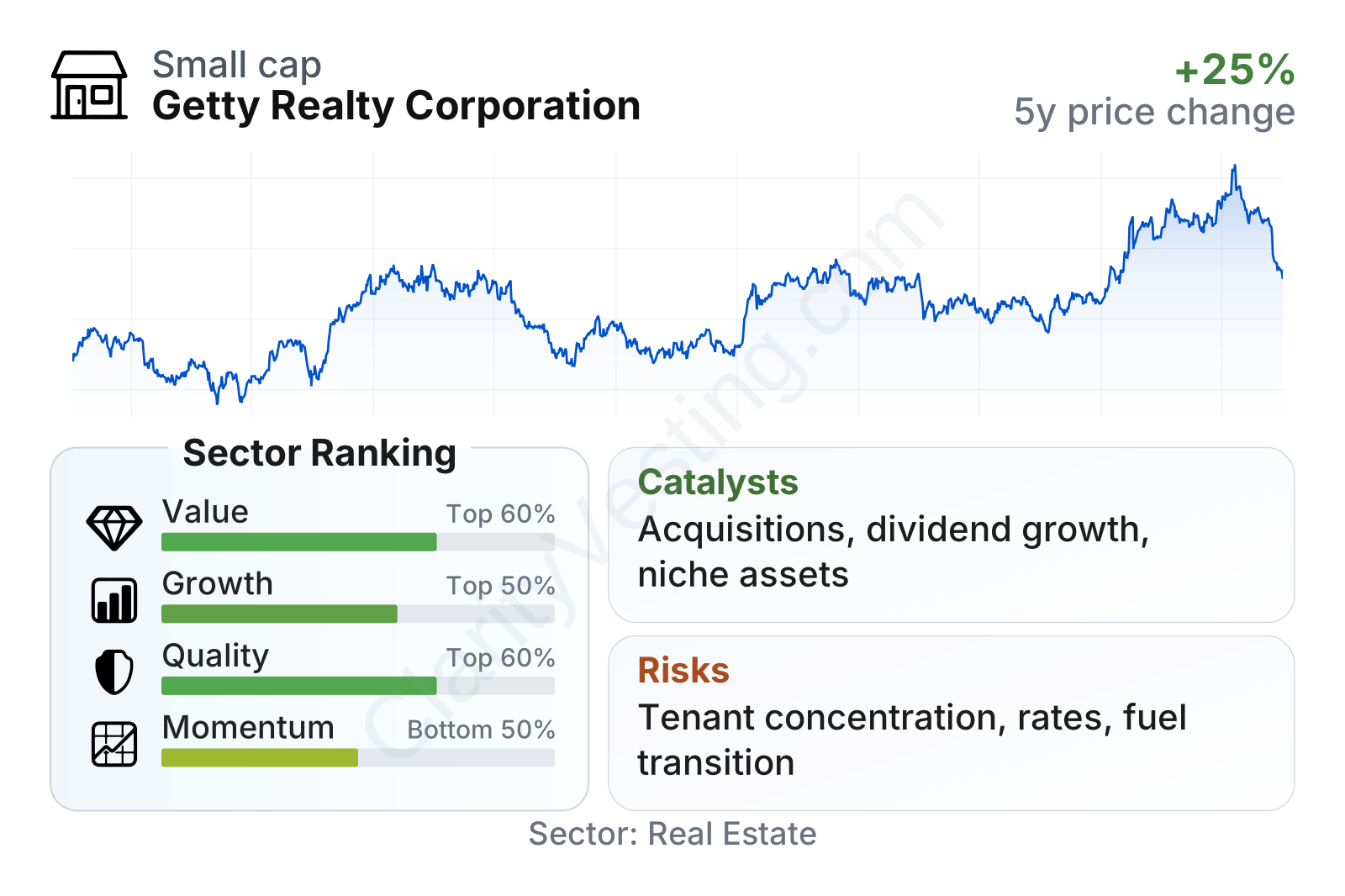
Getty Realty is a mid-sized REIT with a relatively low share-price volatility profile, reflected in a beta below 1. On valuation, its earnings multiple is close to the sector median, while its dividend yield is above the sector median. Quality indicators are generally solid for a REIT, with returns on capital, equity, and assets running above typical sector levels. Growth is more mixed: recent revenue growth has been stronger than the sector median, but longer-term revenue-per-share growth has been more modest. Momentum improved over the last year, although the stock has weakened over the more recent six-month period.
Growth
The company operates in a part of real estate that has held up relatively well because it serves everyday transportation and convenience needs. Convenience stores, fuel stations, car washes, and auto-service properties are not immune to economic slowdowns, but they are generally less dependent on discretionary mall traffic or office demand. That gives Getty Realty exposure to a steadier corner of retail real estate.
Its strategy also looks coherent for long-term expansion. Getty Realty has been broadening beyond traditional gas-station assets into adjacent property types such as convenience retail, car washes, and automotive service. That matters because it reduces reliance on one format while staying within a specialized category where the company already has underwriting experience and tenant relationships.
Revenue per share has moved upward over the last five years, though at a measured pace rather than a rapid one. For a REIT, that is still meaningful because per-share growth matters more than simple portfolio expansion. If a property landlord grows only by issuing more shares, existing owners may not benefit much. Getty Realty’s trend suggests it has been able to add assets while still moving the business forward on a per-share basis.
The dividend record also supports the growth case. Dividend per share has risen consistently over the last five years, with growth roughly in line with the broader sector. For a REIT, a rising dividend usually signals confidence in recurring rental cash flow, even if free cash flow can appear uneven because of acquisition spending and capital timing.
A notable catalyst is the company’s continued acquisition-driven expansion in convenience and automotive real estate. This segment remains fragmented, meaning many properties are still owned by smaller operators or private investors rather than large public REITs. That creates room for Getty Realty to keep consolidating selected assets. Another possible tailwind is that these properties often sit on well-located land, which can preserve relevance even as tenant formats evolve over time.
There is also a longer-term debate around electric vehicles. For some landlords, that is a threat. For Getty Realty, it can be both a challenge and an opportunity. Sites tied to convenience retail, food, and vehicle service may remain useful even if fueling patterns change. Over time, well-located roadside parcels could be adapted to new uses, including charging-related traffic, expanded food offerings, or service concepts that keep drivers on site longer.
Risks
This article is for informational purposes only and does not constitute financial advice. Some content is AI-generated. See Disclaimer