Stock Analysis · Gray Television Inc (GTN-A)
Overview
Gray Television is a U.S. media company focused mainly on local television broadcasting. It owns and operates television stations in many markets across the country and earns most of its money by selling advertising tied to local audiences. In addition to traditional TV broadcasting, the company also owns digital assets, local news operations, production businesses, and a growing group of sports-related media rights and video services.
Its business is built around local market positions. Gray typically seeks stations that are leaders or near-leaders in local news ratings, because strong local news tends to support better advertising pricing, steadier audience relationships, and retransmission negotiations with cable, satellite, and virtual pay-TV distributors.
Based on recent company reporting, Gray’s revenue mix is centered on a few major streams:
- Retransmission consent revenue: approximately 45% to 50% of total revenue in a typical non-election year. This is the money paid by cable, satellite, and streaming TV distributors to carry Gray’s local stations.
- Core advertising: approximately 25% to 30%. This includes local and national advertising sold outside of major political cycles.
- Political advertising: approximately 10% to 20% depending on the election calendar. This category can rise sharply in even-numbered federal election years and then fall back.
- Production and other revenue: approximately 10% to 15%. This includes production-related activities, digital services, and other media operations.
The revenue pattern is important for long-term analysis. Gray is no longer just an advertising company: retransmission fees now represent a very large share of the business and tend to be more recurring than political advertising, although they are still exposed to contract renewals and industry pressure from cord-cutting.
Over the last several years, revenue and operating profit have shown a highly cyclical pattern. Election years have produced very strong results, while non-election years have looked much weaker. At the same time, interest expense has remained heavy, which means that strong operating performance does not always flow cleanly into net profit.
Key Figures
| Metric | Value | Sector ⓘ |
|---|---|---|
| Date | Nov 21, 2026 | |
| Context | ||
| Sector | Communication Services | |
| Industry | Broadcasting | |
| Market Cap ⓘ | $726.04M | |
| Beta ⓘ | 1.02 | |
Value (Cheapness) | ||
| P/E Ratio ⓘ | N/A | 17.77 |
| FCF Yield ⓘ | 20.11% | 7.57% |
| Dividend Yield ⓘ | 3.20% | 2.85% |
| EBIT / EV ⓘ | 2.57% | 6.92% |
| PEG ⓘ | 0.21 | |
Growth (Business expansion) | ||
| Revenue Growth ⓘ | 8.70% | 6.30% |
| RPS Growth (5Y CAGR) ⓘ | 5.87% | 4.62% |
| EPS Growth (5Y CAGR) ⓘ | N/A | -14.44% |
| Margin Growth (5Y Trend) ⓘ | -3.79% | 1.03% |
| FCF Growth (5Y CAGR) ⓘ | 18.11% | 5.91% |
| DPS Growth (5Y CAGR) ⓘ | 0.07% | 5.03% |
Quality (Business durability) | ||
| ROIC (Latest) ⓘ | 1.67% | 8.39% |
| ROIC (5Y Median) ⓘ | 3.56% | 8.33% |
| Net Debt / EBIT (Latest) ⓘ | 32.45 | 1.88 |
| Net Debt / EBIT (5Y Median) ⓘ | 15.08 | 2.83 |
| Net Debt / EBITDA (Latest) ⓘ | 13.04 | 1.22 |
| Net Debt / Assets ⓘ | 54.72% | 20.70% |
| EBITDA / Interest ⓘ | 0.93 | 8.41 |
| Operating Margin (Latest) ⓘ | 5.59% | 15.44% |
| Operating Margin (5Y Median) ⓘ | 15.46% | 13.32% |
| Debt to Equity (Latest) ⓘ | 215.80% | 60.11% |
| Profit Margin (Latest) ⓘ | -0.83% | 8.06% |
| Free Cash Flow (Latest) ⓘ | $146.00M | |
Momentum (Price trend) | ||
| 3Y Return ⓘ | -10.20% | +35.91% |
| 12M Return (excl. last month) ⓘ | -24.81% | +2.79% |
| 6M Return ⓘ | -19.31% | 0.00% |
| Price vs. 200-Day MA ⓘ | -17.54% | +0.03% |
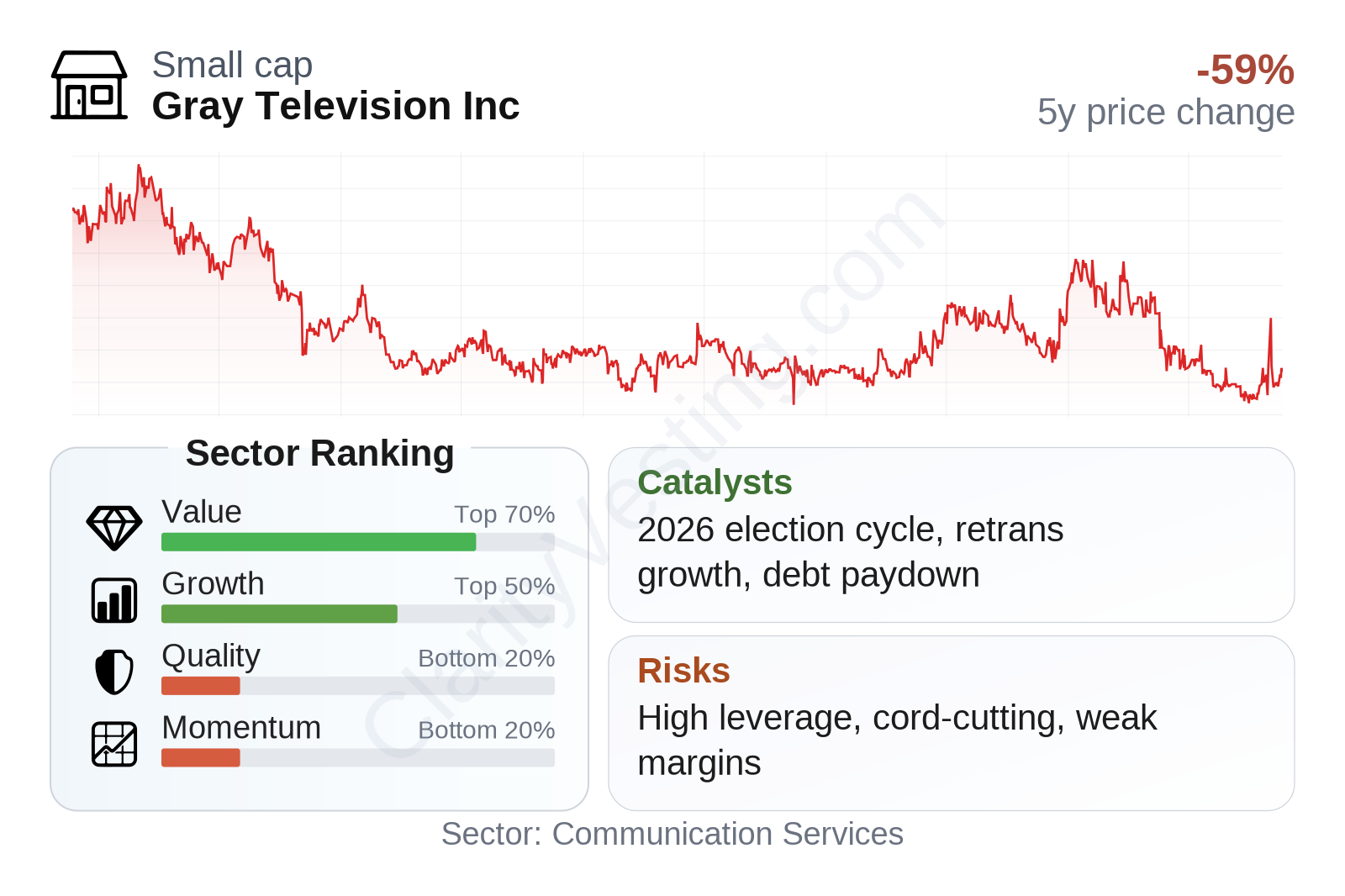
Gray is a small-cap broadcasting company with market volatility close to the broader market, but its operating profile is much more uneven than that headline suggests. On valuation, the company screens cheaply on free cash flow yield and appears acceptable on broad value measures versus the sector. Growth indicators are mixed-to-decent, helped by revenue and free cash flow trends over multi-year periods. The weak area is business quality: leverage is far above sector norms, interest coverage is thin, returns on invested capital are low, and profitability has recently slipped below the sector median. Price performance has also been much weaker than the broader Communication Services group.
The share price history shows how sensitive market sentiment has become. The stock moved down heavily from 2021 levels, recovered at times, and then weakened again in 2026. That pattern usually reflects a market that sees value in the assets but remains concerned about debt, earnings volatility, and the long-term outlook for traditional broadcasting.
Growth
Gray operates in a mature sector rather than a classic high-growth industry. Local TV broadcasting is not expanding rapidly in the way software, cloud infrastructure, or semiconductors might. However, that does not mean the business has no growth path. For Gray, growth depends on three practical levers: maintaining strong local audience positions, expanding and defending retransmission revenue, and using election cycles plus sports and local content to lift monetization.
A central part of the strategy still makes sense. Local news remains one of the few forms of media with strong community relevance and live viewing habits. That matters because live and local programming tends to retain advertising value better than general entertainment content. Gray has also emphasized premium local sports rights and media partnerships in selected markets, which can reinforce station relevance and create additional advertising inventory.
Revenue growth has been lumpy rather than smooth. The pattern shows the classic broadcasting cycle: very strong jumps in election-heavy periods, contractions afterward, and occasional rebounds from retransmission growth or acquisitions. The latest year-over-year reading is positive, but not strong enough on its own to erase the broader volatility of the business.
Free cash flow is one of the more important positives in Gray’s profile, but it also swings sharply. In stronger periods the company has produced substantial cash generation, which is critical because debt reduction is one of the main long-term questions. A trailing twelve-month free cash flow figure in the low hundreds of millions is meaningful relative to the company’s current equity value, but the inconsistency of that cash flow limits how much comfort it provides.
The clearest catalyst is the election cycle. Political advertising can materially change annual performance, and presidential election years are especially important for broadcasters with broad station footprints. Another potential growth support comes from retransmission renewals and local sports initiatives, which may help offset pressure in traditional advertising. Gray has also continued to focus on refinancing, deleveraging, and portfolio optimization, which could improve the earnings picture if interest burden eases over time.
Risks
This article is for informational purposes only and does not constitute financial advice. Some content is AI-generated. See Disclaimer