Stock Analysis · Gates Industrial Corporation plc (GTES)
Overview
Gates Industrial Corporation plc is a global manufacturer of engineered power transmission and fluid power products. In simple terms, it makes critical parts such as belts, hoses, hydraulic components, and related systems that help machines, vehicles, and industrial equipment move power or fluids reliably. Its products are used in a wide range of end markets including replacement parts for cars and trucks, industrial machinery, construction equipment, energy, agriculture, and many other applications where durability matters.
The business is organized into two main segments, and the company’s revenue mix is fairly balanced between them.
- Power Transmission — approximately 55% of revenue in recent years. This segment includes belts, tensioners, sprockets, and related products used in automotive aftermarket, industrial machines, and other equipment that transfer mechanical power.
- Fluid Power — approximately 45% of revenue in recent years. This includes hydraulic and industrial hoses, tubing, couplings, and assemblies that move fluids in mobile and industrial systems.
Another important lens is end-market exposure. Gates has a meaningful aftermarket business, which tends to be more stable than original equipment demand because replacement parts are needed throughout the life of machines and vehicles. The company also serves original equipment manufacturers, giving it access to new platforms and long product cycles. Geographically, Gates operates on a global scale, with revenue spread across the Americas, Europe, the Middle East, Africa, and Asia-Pacific, which helps diversify demand.
The long-term appeal of this business model is that many of its products are small in cost relative to the systems they support, but highly important in performance and reliability. That can support pricing power, repeat purchases, and customer loyalty when execution is strong.
The long-term financial profile shows a business that has kept revenue broadly steady in the low-to-mid $3 billion range while protecting gross profit and operating income through margin discipline. One notable improvement is that selling and administrative costs fell meaningfully in 2025, which helped lift operating earnings even without major top-line expansion.
Key Figures
| Metric | Value | Sector ⓘ |
|---|---|---|
| Date | Oct 17, 2026 | |
| Context | ||
| Sector | Industrials | |
| Industry | Specialty Industrial Machinery | |
| Market Cap ⓘ | $6.57B | |
| Beta ⓘ | 1.28 | |
Value (Cheapness) | ||
| P/E Ratio ⓘ | 18.41 | 22.10 |
| P/B Ratio ⓘ | 2.10 | 1.97 |
| FCF Yield ⓘ | 6.06% | 6.38% |
| Dividend Yield ⓘ | N/A | 1.94% |
| EBIT / EV ⓘ | 6.12% | 4.79% |
| PEG ⓘ | N/A | |
Growth (Business expansion) | ||
| Revenue Growth ⓘ | 6.60% | 9.30% |
| RPS Growth (5Y CAGR) ⓘ | 3.12% | 7.81% |
| EPS Growth (5Y CAGR) ⓘ | -10.25% | -13.06% |
| BVPS Growth (5Y CAGR) ⓘ | 5.75% | 6.14% |
| Margin Growth (5Y Trend) ⓘ | 0.30% | 0.88% |
| FCF Growth (5Y CAGR) ⓘ | 8.20% | 11.01% |
| DPS Growth (5Y CAGR) ⓘ | 38.44% | 9.48% |
Quality (Business durability) | ||
| ROIC (Latest) ⓘ | 10.12% | 10.84% |
| ROA (Latest) ⓘ | 5.00% | 5.41% |
| ROIC (5Y Median) ⓘ | 7.28% | 9.38% |
| ROA (5Y Median) ⓘ | 3.22% | 4.95% |
| Net Debt / EBIT (Latest) ⓘ | 3.06 | 2.08 |
| Net Debt / EBIT (5Y Median) ⓘ | 3.98 | 2.27 |
| Net Debt / EBITDA (Latest) ⓘ | 2.13 | 1.39 |
| Net Debt / Assets ⓘ | 20.82% | 19.28% |
| EBITDA / Interest ⓘ | 4.79 | 9.58 |
| Operating Margin (Latest) ⓘ | 14.35% | 10.50% |
| Operating Margin (5Y Median) ⓘ | 13.52% | 10.29% |
| Debt to Equity (Latest) ⓘ | 67.09% | 65.48% |
| Profit Margin (Latest) ⓘ | 10.37% | 6.67% |
| Free Cash Flow (Latest) ⓘ | $398.00M | |
Momentum (Price trend) | ||
| 3Y Return ⓘ | +132.46% | +61.68% |
| 12M Return (excl. last month) ⓘ | -0.78% | +12.58% |
| 6M Return ⓘ | -2.05% | 0.00% |
| Price vs. 200-Day MA ⓘ | +1.13% | +0.02% |
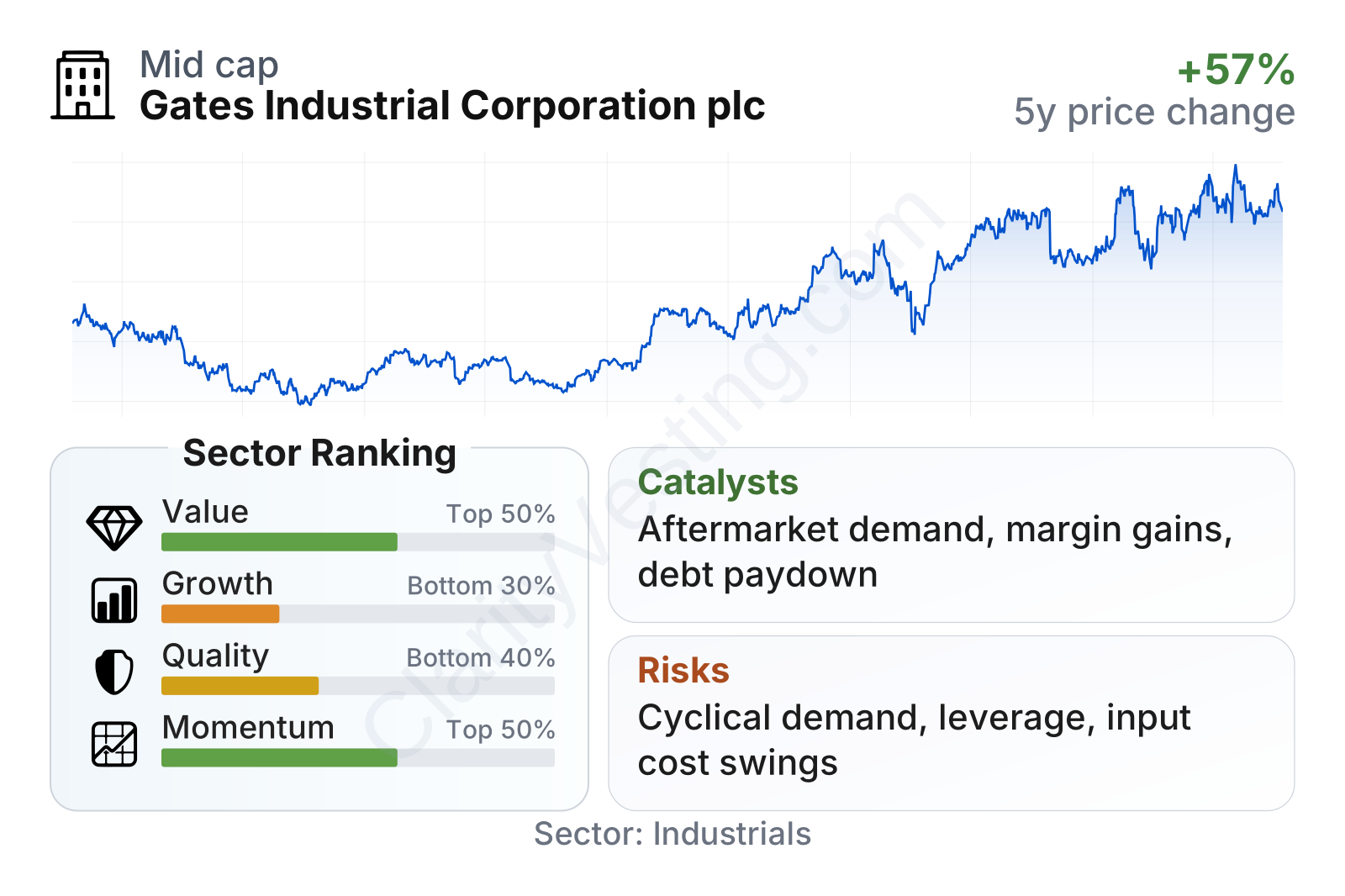
Gates is a mid-sized industrial company with a market value around the mid-single-digit billions of dollars and a share price history that has been volatile but generally strong over the past three years. On valuation, it screens somewhat cheaper than the sector on earnings, while free cash flow yield is close to the industry median. Profitability stands out more positively than growth: operating margin and profit margin are ahead of many peers, but leverage remains higher than average and return metrics are not as strong as the better industrial businesses in the group. Overall, the mix suggests a company with solid earnings quality and cash generation, but not one currently leading its sector on growth or balance-sheet strength.
Growth
Gates operates in markets that are not typically high-growth in the way software or semiconductors can be, but they are durable and broad. Demand is tied to vehicle maintenance, industrial activity, automation, infrastructure, energy systems, and replacement cycles. That makes the sector attractive for long-term compounding when a company can steadily gain share, improve margins, and convert earnings into cash.
The company’s strategy appears sensible for this type of industry. Gates focuses on engineered products where reliability matters, supports customers through a global manufacturing and distribution footprint, and benefits from recurring replacement demand. It also has exposure to several structural themes that can support growth over time: more complex vehicles, electrification-related thermal management and fluid handling needs, industrial automation, and continued demand for hydraulic systems in heavy equipment.
Recent revenue growth has been uneven. The business moved through a soft patch in 2024 with several quarters of contraction, then returned to modest growth, with a more noticeable acceleration by mid-2026. That pattern suggests Gates is not in a straight-line expansion phase, but it does show resilience and a capacity to recover as end-market conditions improve.
Cash generation is one of the more encouraging parts of the picture. Free cash flow has trended higher over time and recently moved above $400 million on a trailing basis. For a mature industrial company, this matters because strong cash conversion gives management room to reduce debt, reinvest in product development, pursue bolt-on acquisitions, and return capital to shareholders without relying heavily on outside financing.
A practical catalyst is the company’s ability to keep expanding margins through mix, pricing, sourcing, and productivity. Because Gates sells mission-critical components, even moderate revenue growth can translate into stronger earnings if operational execution remains disciplined. Continued penetration in higher-value applications, especially around advanced automotive systems and industrial uses where performance specifications are stricter, could also support better growth than the company’s traditional image might suggest.
Recent company communications have also pointed to ongoing portfolio and productivity actions rather than a dramatic one-time event. That is usually less exciting in the short term, but for long-term analysis it can be more credible because it relies on repeatable operating improvements instead of speculative bets.
Risks
This article is for informational purposes only and does not constitute financial advice. Some content is AI-generated. See Disclaimer


