Stock Analysis · Green Thumb Industries Inc (GTBIF)
Overview
Green Thumb Industries is a U.S. cannabis company that grows, manufactures, and sells marijuana products for both medical and adult-use markets where state law allows it. The company operates across cultivation facilities, branded consumer products, and retail dispensaries. In simple terms, it controls much of the value chain: it produces cannabis, turns it into packaged products, and sells those products through its own stores as well as through third-party dispensaries.
Its business is mainly driven by cannabis sales, with revenue split between retail sales in company-owned stores and wholesale sales of branded products to other dispensaries. Based on recent annual reporting, retail remains the larger contributor, while wholesale is still substantial and strategically important because it expands brand reach beyond Green Thumb’s own store base.
- Retail revenue: about 67% of total revenue. This comes from sales through Green Thumb’s Rise dispensaries and other company-operated stores.
- Wholesale revenue: about 33% of total revenue. This includes sales of packaged cannabis products to third-party dispensaries, including brands such as RYTHM, Dogwalkers, incredibles, Beboe, Good Green, Doctor Solomon’s, and &Shine.
The business mix matters because retail typically gives the company direct customer access and stronger control over pricing and merchandising, while wholesale can support broader distribution and brand visibility across more states. Over the last few years, revenue has continued to rise, gross profit has remained solid, and operating income has improved again after a softer 2023 period. That combination suggests a company that has managed to stay profitable in an industry where many peers still struggle to do so consistently.
The financial flow also shows a useful pattern: revenue has expanded from under $900 million in 2021 to roughly $1.2 billion in 2025, while operating income and net income have generally recovered after the 2022–2023 slowdown. Selling and administrative costs have grown too, but not enough to erase the company’s profitability, which is a key distinction in U.S. cannabis.
Key Figures
| Metric | Value | Sector ⓘ |
|---|---|---|
| Date | Oct 17, 2026 | |
| Context | ||
| Sector | Healthcare | |
| Industry | Drug Manufacturers - Specialty & Generic | |
| Market Cap ⓘ | $1.39B | |
| Beta ⓘ | 0.95 | |
Value (Cheapness) | ||
| P/E Ratio ⓘ | 11.78 | 24.79 |
| P/B Ratio ⓘ | 0.75 | 3.08 |
| FCF Yield ⓘ | 14.23% | 3.15% |
| Dividend Yield ⓘ | N/A | 1.94% |
| EBIT / EV ⓘ | 14.62% | 0.57% |
| PEG ⓘ | 1.79 | |
Growth (Business expansion) | ||
| Revenue Growth ⓘ | 4.60% | 7.45% |
| RPS Growth (5Y CAGR) ⓘ | 7.50% | 8.61% |
| EPS Growth (5Y CAGR) ⓘ | -28.19% | -17.81% |
| BVPS Growth (5Y CAGR) ⓘ | 4.45% | 3.72% |
| Margin Growth (5Y Trend) ⓘ | -1.29% | -0.62% |
| FCF Growth (5Y CAGR) ⓘ | N/A | 1.04% |
| DPS Growth (5Y CAGR) ⓘ | -89.63% | 6.77% |
Quality (Business durability) | ||
| ROIC (Latest) ⓘ | 11.01% | 3.24% |
| ROA (Latest) ⓘ | 4.65% | 3.01% |
| ROIC (5Y Median) ⓘ | 8.63% | 4.60% |
| ROA (5Y Median) ⓘ | 2.91% | 1.89% |
| Net Debt / EBIT (Latest) ⓘ | N/A | 1.34 |
| Net Debt / EBIT (5Y Median) ⓘ | 0.42 | 1.84 |
| Net Debt / EBITDA (Latest) ⓘ | N/A | 1.00 |
| Net Debt / Assets ⓘ | N/A | 5.45% |
| EBITDA / Interest ⓘ | 23.72 | 9.64 |
| Operating Margin (Latest) ⓘ | 24.95% | 9.27% |
| Operating Margin (5Y Median) ⓘ | 20.74% | 7.38% |
| Debt to Equity (Latest) ⓘ | N/A | 28.58% |
| Profit Margin (Latest) ⓘ | 10.48% | 3.59% |
| Free Cash Flow (Latest) ⓘ | $197.77M | |
Momentum (Price trend) | ||
| 3Y Return ⓘ | -34.77% | +42.80% |
| 12M Return (excl. last month) ⓘ | -1.35% | +18.50% |
| 6M Return ⓘ | -5.92% | +7.57% |
| Price vs. 200-Day MA ⓘ | -12.51% | +5.12% |
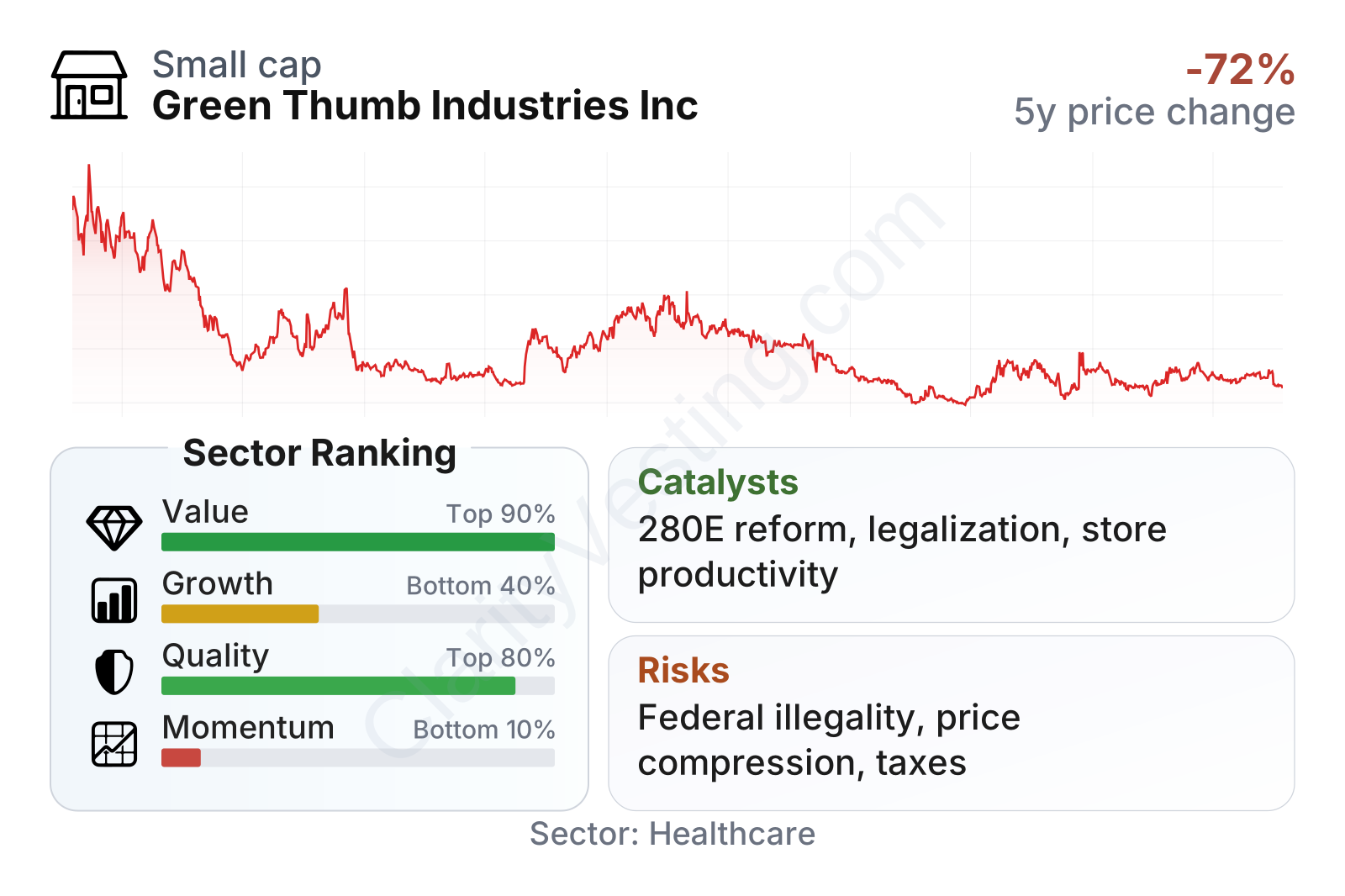
Green Thumb sits in the mid-cap range and has shown less share-price volatility than many cannabis names, but the stock’s multi-year path has still been rough. The share price remains far below 2021 levels despite a better underlying profit profile today. In the latest factor snapshot, value and quality rank well versus the broader healthcare sector, while growth and momentum rank weaker. That combination points to a business that looks operationally stronger than its recent market performance suggests, but with a slower top-line pace than many investors usually expect from an emerging industry.
Growth
Green Thumb operates in a sector that still has long-term expansion potential. The U.S. cannabis market continues to develop state by state as more jurisdictions allow medical or adult-use sales, and existing legal markets can deepen over time as stores mature and consumer adoption increases. That does not mean growth is smooth every year, but the overall direction of the industry is still tied to legalization, product innovation, and the shift from illicit to regulated channels.
The company’s strategy is straightforward and sensible for that environment: focus on limited-license states, build cultivation and manufacturing scale where regulations protect established operators, and support recognized consumer brands with a vertically integrated retail network. This approach can create a durable footprint because licenses are often difficult to obtain and because owning both production and distribution can help margins.
Growth has clearly slowed from the very high rates seen earlier in the company’s expansion phase. More recent year-over-year revenue increases have mostly been in the low- to mid-single digits, with a few better quarters around 7% to 11%. That is below the pace many people associate with cannabis, but it also reflects a maturing base, uneven state markets, and pricing pressure across the industry. In other words, Green Thumb looks more like a scaling consumer company now than a hypergrowth startup.
A more encouraging sign is cash generation. Free cash flow has improved sharply from negative territory in 2022 to strongly positive levels by 2026. That matters because long-term business quality is not only about revenue growth; it is also about whether expansion turns into cash after operating costs and capital spending. Green Thumb’s recent trajectory suggests much better internal funding capacity than many rivals.
One of the clearest catalysts remains U.S. regulatory change. Any easing of federal restrictions, tax reform tied to cannabis treatment under the tax code, banking access improvements, or movement toward exchange uplisting could materially improve profitability, access to capital, and investor attention across the sector. Company-specific expansion in existing markets and further store productivity gains also remain important near-term opportunities.
Recent company communications have also highlighted continued store development, brand distribution, and disciplined capital allocation rather than aggressive balance-sheet stretching. In this industry, that restraint can itself be a growth advantage because weaker competitors often overexpanded and then had to pull back.
Risks
This article is for informational purposes only and does not constitute financial advice. Some content is AI-generated. See Disclaimer


