Stock Analysis · Global Ship Lease Inc (GSL)
Overview
Global Ship Lease Inc is a container ship owner. It does not run a consumer shipping brand or manage end-customer cargo bookings. Instead, it buys and owns container vessels and leases them to liner companies under fixed-rate charter contracts. In simple terms, its business resembles renting out industrial assets: the company provides the ships, while its customers operate the transport services.
This matters for long-term analysis because GSL is less exposed to daily freight rate swings than spot-market operators. Its earnings depend mainly on the duration, pricing, and quality of its charter contracts, plus how efficiently it finances and maintains its fleet. The company’s fleet is focused on containerships, including many mid-sized and smaller vessels that remain important for regional and secondary trade lanes.
The main sources of revenue are concentrated and relatively straightforward.
- Time charter revenue from containership leasing — approximately 100%. This is the core of the business and comes from leasing vessels to container line operators for contracted periods at agreed daily rates.
- Other operating revenue — minimal. This can include small ancillary items, but it is not a meaningful driver compared with charter income.
Over the last several years, the business has shown a clear pattern: revenue rose from a little above $400 million in 2021 to roughly $766 million in 2025, while interest expense trended down materially as debt was reduced and refinanced. That combination helped turn revenue growth into even stronger bottom-line expansion, which is especially important in a capital-intensive shipping business.
Key Figures
| Metric | Value | Sector ⓘ |
|---|---|---|
| Date | Oct 17, 2026 | |
| Context | ||
| Sector | Industrials | |
| Industry | Marine Shipping | |
| Market Cap ⓘ | $1.63B | |
| Beta ⓘ | 0.95 | |
Value (Cheapness) | ||
| P/E Ratio ⓘ | 4.41 | 22.10 |
| P/B Ratio ⓘ | 0.80 | 1.97 |
| FCF Yield ⓘ | 17.85% | 6.38% |
| Dividend Yield ⓘ | 5.53% | 1.94% |
| EBIT / EV ⓘ | 23.65% | 4.79% |
| PEG ⓘ | 0.87 | |
Growth (Business expansion) | ||
| Revenue Growth ⓘ | 2.00% | 9.30% |
| RPS Growth (5Y CAGR) ⓘ | 17.30% | 7.81% |
| EPS Growth (5Y CAGR) ⓘ | -12.41% | -13.06% |
| BVPS Growth (5Y CAGR) ⓘ | 25.91% | 6.14% |
| Margin Growth (5Y Trend) ⓘ | -0.40% | 0.88% |
| FCF Growth (5Y CAGR) ⓘ | N/A | 11.01% |
| DPS Growth (5Y CAGR) ⓘ | 23.83% | 9.48% |
Quality (Business durability) | ||
| ROIC (Latest) ⓘ | 13.04% | 10.84% |
| ROA (Latest) ⓘ | 13.56% | 5.41% |
| ROIC (5Y Median) ⓘ | 17.92% | 9.38% |
| ROA (5Y Median) ⓘ | 14.29% | 4.95% |
| Net Debt / EBIT (Latest) ⓘ | 0.67 | 2.08 |
| Net Debt / EBIT (5Y Median) ⓘ | 1.93 | 2.27 |
| Net Debt / EBITDA (Latest) ⓘ | 0.52 | 1.39 |
| Net Debt / Assets ⓘ | 9.49% | 19.28% |
| EBITDA / Interest ⓘ | 14.49 | 9.58 |
| Operating Margin (Latest) ⓘ | 54.32% | 10.50% |
| Operating Margin (5Y Median) ⓘ | 59.42% | 10.29% |
| Debt to Equity (Latest) ⓘ | 34.51% | 65.48% |
| Profit Margin (Latest) ⓘ | 50.36% | 6.67% |
| Free Cash Flow (Latest) ⓘ | $290.82M | |
Momentum (Price trend) | ||
| 3Y Return ⓘ | +194.89% | +61.68% |
| 12M Return (excl. last month) ⓘ | +52.80% | +12.58% |
| 6M Return ⓘ | +14.59% | 0.00% |
| Price vs. 200-Day MA ⓘ | +9.71% | +0.02% |
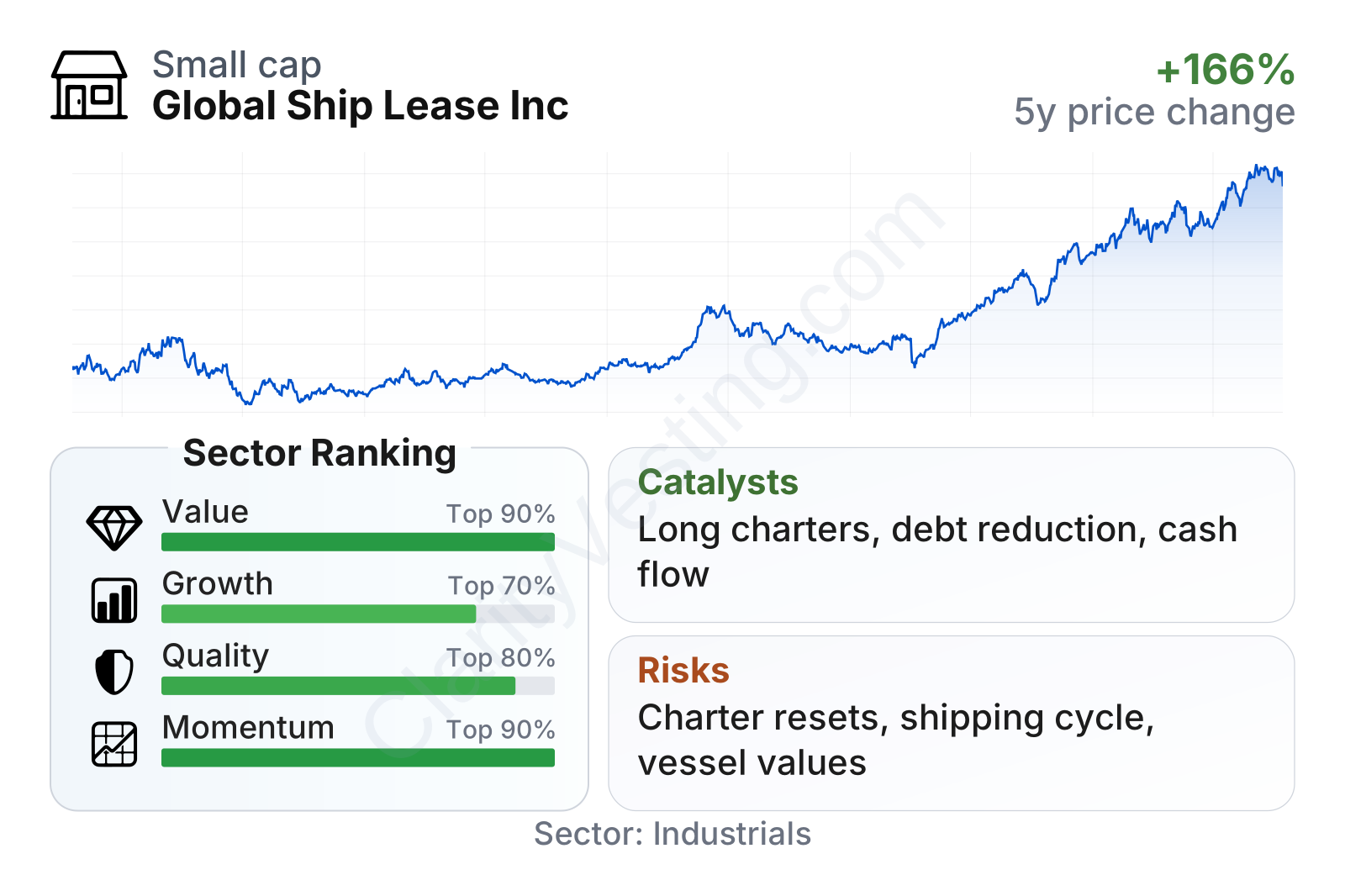
GSL stands out on value, quality, and market performance relative to much of the industrial sector. The company is still a mid-sized public company by market value, but its profitability and cash generation are unusually strong for shipping. Valuation multiples remain well below sector norms, while free cash flow yield and dividend yield are notably above typical levels. Growth is more mixed: long-term per-share progress has been strong, but recent year-over-year revenue growth has slowed compared with the broader sector.
Growth
Container shipping is a cyclical business, but vessel leasing can still offer durable growth when backed by long contracts and disciplined fleet management. GSL operates in a sector that remains essential to global trade. Even when freight markets cool, liner companies still need ships to serve established routes, and leasing remains an attractive option because it reduces the amount of capital customers need to commit to vessel ownership.
GSL’s strategy has generally been consistent with that logic. The company has focused on securing multi-year charters, preserving cash flow visibility, and using strong earnings to reduce debt while returning capital to shareholders. That approach is more conservative than chasing short-term spikes in shipping markets, and it is better suited to long-term business resilience.
Revenue growth has clearly decelerated from the exceptional surge seen in 2021 and 2022. More recently, growth has been positive but modest, with the latest annual pace around 2%. That slowdown is not surprising: the earlier jump reflected an unusually strong charter market. For long-term analysis, the more relevant point is that revenue has remained stable at a high base instead of collapsing, suggesting the charter backlog has continued to support the business.
Cash generation is one of the strongest parts of the case. Free cash flow has been volatile at times, which is normal in shipping because vessel purchases, drydocking, and financing moves can shift timing. Even so, the overall level remains high, and the latest trailing figure is very robust. This gives the company flexibility to pay dividends, deleverage, and potentially acquire vessels or refinance opportunistically.
A key catalyst is charter coverage. When a ship lessor has a large portion of future operating days already contracted, earnings become more predictable. GSL has emphasized this visibility in its public filings and investor materials. Another potential tailwind is the ongoing need for regional and mid-sized containership capacity, a segment where replacement supply is not unlimited and where older fleets across the industry may gradually tighten available tonnage. Recent company communications have also highlighted continued contract activity and balance sheet progress, both of which support the idea that GSL is trying to extend cash flow stability beyond the peak shipping cycle.
Risks
This article is for informational purposes only and does not constitute financial advice. Some content is AI-generated. See Disclaimer


