Stock Analysis · Goosehead Insurance Inc (GSHD)
Overview
Goosehead Insurance is an insurance distribution company focused mainly on personal lines coverage in the United States. In simple terms, it helps households shop for insurance by comparing policies from a large panel of carriers, then places the customer with the insurer that best fits price and coverage needs. The company operates through a hybrid model: a corporate sales force and a large franchise network of local agents. That structure allows Goosehead to expand nationally without carrying all of the cost of opening every office itself.
The business does not take underwriting risk like an insurance carrier. It acts as a broker and agency, which means its economics depend more on customer growth, policy retention, carrier relationships, and operating efficiency than on claims losses from storms, accidents, or disasters. This distinction matters for long-term analysis because brokers usually have lighter balance sheets and more recurring revenue than insurers, but they are still tied to the overall insurance cycle.
Based on company filings, Goosehead’s revenue comes primarily from commissions and related fees attached to insurance policies it sells and services. The mix can shift by period, but the business is broadly organized around these sources:
- Core commissions from written and renewed policies: approximately 75% to 85% of revenue. This includes initial commissions on new policies and recurring renewal commissions as customers keep their coverage in force.
- Franchise-related revenue: approximately 10% to 20% of revenue. This includes franchise fees, royalties, and other payments tied to the company’s franchised agency network.
- Ancillary and service-related income: generally a smaller portion, often below 10%. This can include fees connected to agency services and other support activities.
A notable feature of the model is the importance of renewals. Once a customer is acquired, the company can continue earning revenue as long as that household keeps the policy active. That creates a more recurring stream than a one-time sales model and helps explain why the company has emphasized customer service, agent productivity, and retention.
Revenue has expanded strongly over the last several years, and operating income has improved even faster, suggesting that scale is beginning to show through in margins. At the same time, interest expense has risen, which means debt and financing costs remain relevant when judging the quality of that growth.
Key Figures
| Metric | Value | Sector ⓘ |
|---|---|---|
| Date | Oct 24, 2026 | |
| Context | ||
| Sector | Financial Services | |
| Industry | Insurance Brokers | |
| Market Cap ⓘ | $1.62B | |
| Beta ⓘ | 1.45 | |
Value (Cheapness) | ||
| P/E Ratio ⓘ | 33.08 | 12.46 |
| P/B Ratio ⓘ | N/A | 1.25 |
| FCF Yield ⓘ | 5.09% | 9.82% |
| Dividend Yield ⓘ | N/A | 2.94% |
| EBIT / EV ⓘ | 7.44% | 8.11% |
| PEG ⓘ | N/A | |
Growth (Business expansion) | ||
| Revenue Growth ⓘ | 20.70% | 9.10% |
| RPS Growth (5Y CAGR) ⓘ | 7.16% | 12.31% |
| EPS Growth (5Y CAGR) ⓘ | 13.01% | -6.97% |
| BVPS Growth (5Y CAGR) ⓘ | N/A | 5.02% |
| Margin Growth (5Y Trend) ⓘ | 14.58% | -4.00% |
| FCF Growth (5Y CAGR) ⓘ | 43.97% | 4.71% |
| DPS Growth (5Y CAGR) ⓘ | 7.33% | 8.92% |
Quality (Business durability) | ||
| ROIC (Latest) ⓘ | 43.34% | 9.18% |
| ROE (Latest) ⓘ | N/A | 13.93% |
| ROA (Latest) ⓘ | 8.71% | 1.57% |
| ROIC (5Y Median) ⓘ | 24.90% | 7.80% |
| ROE (5Y Median) ⓘ | 23.05% | 12.15% |
| ROA (5Y Median) ⓘ | 4.18% | 1.28% |
| Net Debt / EBIT (Latest) ⓘ | 3.39 | 1.02 |
| Net Debt / EBIT (5Y Median) ⓘ | 4.26 | 0.72 |
| Net Debt / EBITDA (Latest) ⓘ | 3.02 | 0.88 |
| Operating Margin (Latest) ⓘ | 25.63% | 22.30% |
| Operating Margin (5Y Median) ⓘ | 12.61% | 24.50% |
| Debt to Equity (Latest) ⓘ | -331.70% | 59.34% |
| Profit Margin (Latest) ⓘ | 8.79% | 26.42% |
| Free Cash Flow (Latest) ⓘ | $82.45M | |
Momentum (Price trend) | ||
| 3Y Return ⓘ | -22.10% | +95.73% |
| 12M Return (excl. last month) ⓘ | -42.36% | +17.30% |
| 6M Return ⓘ | +11.06% | +6.07% |
| Price vs. 200-Day MA ⓘ | -1.75% | +5.36% |
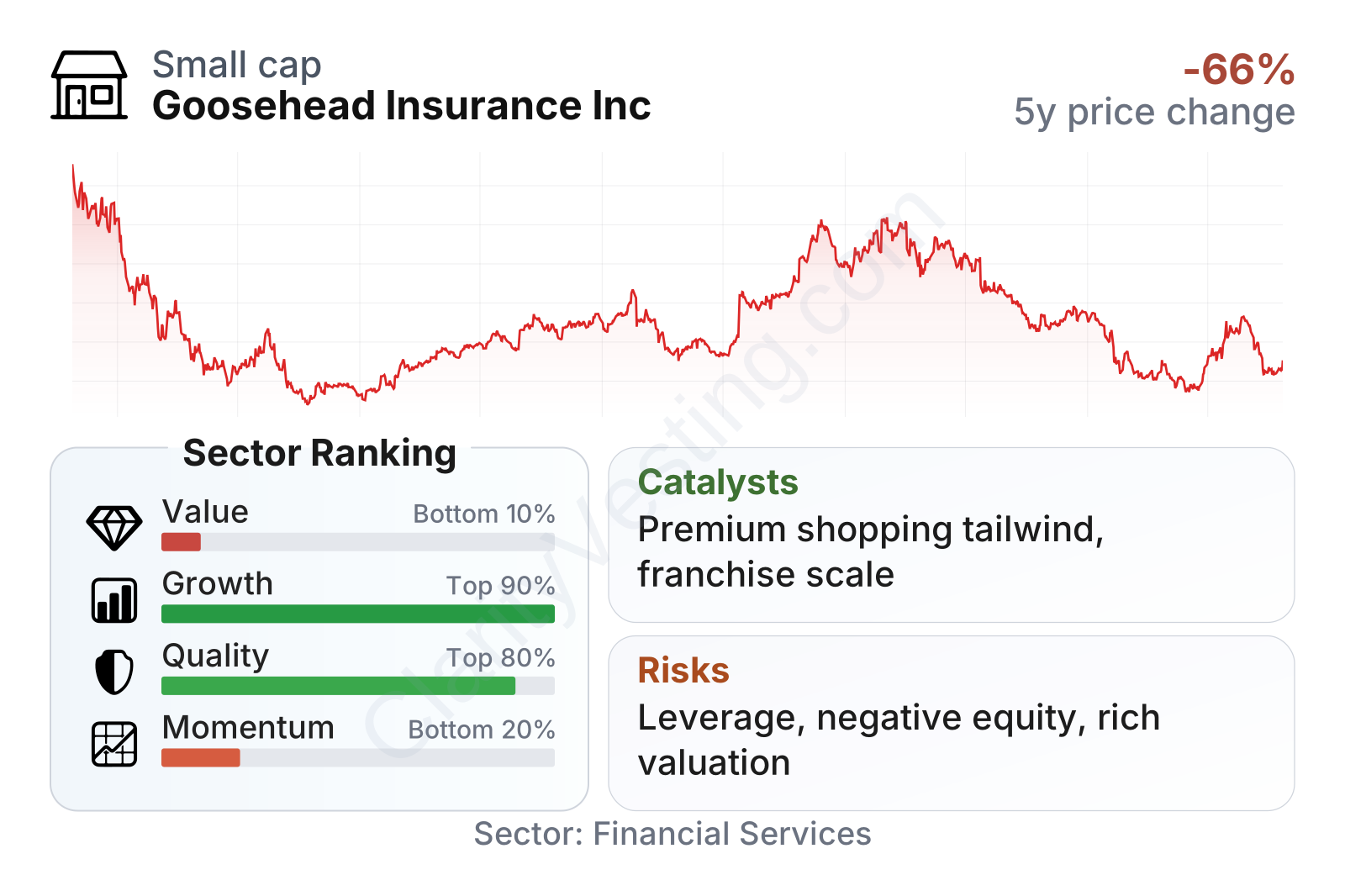
Goosehead is a small-cap insurance broker with a stock that has been much more volatile than the broader market. The share price has experienced a very sharp rise, collapse, recovery, and another steep setback, which helps explain why momentum measures currently rank near the bottom of its sector. On fundamentals, the picture is more mixed: growth and business quality rank well above sector averages, while value metrics look stretched. Revenue growth is running around 21% year over year, clearly ahead of the sector median, and profitability on capital remains strong. However, the earnings multiple is far above the sector norm, free cash flow yield is lower than average, and leverage is meaningfully higher than many peers.
Growth
The company operates in a part of financial services that has attractive long-term characteristics. Insurance is not an optional purchase for most households with cars, homes, or mortgages, and shopping behavior increasingly favors comparison, convenience, and digital service. That plays directly into Goosehead’s model as an independent broker with a technology-enabled platform and a broad carrier panel. As insurance premiums rise across the market, brokers can also benefit because commissions are often tied to premium volume.
Its strategy also makes sense for future expansion. The franchise approach lets Goosehead add local distribution with less capital than a fully company-owned branch buildout. Meanwhile, the centralized service model aims to handle quoting, onboarding, and renewals more efficiently than a traditional independent agency. If the company keeps attracting productive agents and maintaining customer retention, that combination can support growth in both written premium and recurring renewal revenue.
Earnings per share have grown materially from the low base seen a few years ago, even though the path has not been perfectly smooth. The broad trend still points to a business that has scaled profitably over time rather than merely adding revenue without improving economics.
There is, however, an important counterpoint in book value per share. The recent deterioration, including a move into negative territory, indicates that balance sheet strength has not improved in the same way that revenue and operating performance have. For a broker, book value is not the main driver of long-term value creation, but this trend shows that growth has been accompanied by a more aggressive capital structure.
A meaningful catalyst is the continuing dislocation in personal insurance pricing. As carriers reprice auto and home coverage after inflation, catastrophe losses, and underwriting pressure, more consumers need help comparing options. That environment can favor brokers that are not tied to a single insurer. Goosehead’s access to many carriers can become more valuable when households actively shop for savings or better coverage.
Recent company updates have also continued to emphasize expansion in producer count, franchise network development, and premium growth. Those are relevant because the model benefits from scale: more agents can bring more new business, and a larger installed base of customers can produce more renewal commissions over time. The company’s historical operating margin improvement reinforces the idea that future growth does not necessarily require expenses to rise at the same pace as revenue.
Risks
This article is for informational purposes only and does not constitute financial advice. Some content is AI-generated. See Disclaimer


