Stock Analysis · Covivio (GSEFF)
Overview
Covivio is a European real estate company focused on owning, developing, and managing income-producing properties. Its portfolio is centered on three main segments: offices, residential properties in Germany, and hotels. The group operates mainly in France, Germany, and Italy, with hotels spread more broadly across Europe through direct ownership and partnerships with operators.
For long-term analysis, Covivio is best understood as a landlord and asset manager whose earnings depend on rent collection, property occupancy, development gains, asset recycling, and periodic changes in property valuations. Unlike an industrial company, its reported profit can move sharply from one year to another because real estate values and disposal gains can materially affect net income.
Based on recent company reporting, the business mix is broadly organized as follows:
- Offices: approximately 40% to 45% of portfolio value. This includes office buildings in major urban business districts, especially in Paris, Milan, and other large European cities.
- Hotels: approximately 30% to 35% of portfolio value. This segment includes hotel real estate leased to operators or held through hotel partnerships, giving Covivio exposure to European travel and business activity.
- German residential: approximately 20% to 25% of portfolio value. This mainly consists of multifamily housing assets in Germany, which tend to provide more stable occupancy and recurring rental income.
- Other activities: a smaller share linked to development projects, asset sales, and support activities.
This mix matters because it gives Covivio a more diversified profile than a pure office landlord. Offices remain important, but hotels add cyclical recovery potential while German housing adds a more defensive stream of rent.
The cash generation profile has remained strong at the operating level even though reported earnings have been volatile. Over the last few years, operating profitability has generally stayed high, while interest expense has risen as financing costs moved up across Europe. That combination is typical for large property owners in the current rate environment: rents and asset management can remain solid, but debt costs weigh more heavily on bottom-line results.
Key Figures
| Metric | Value | Sector ⓘ |
|---|---|---|
| Date | Oct 31, 2026 | |
| Context | ||
| Sector | Real Estate | |
| Industry | REIT - Diversified | |
| Market Cap ⓘ | $6.18B | |
| Beta ⓘ | 1.12 | |
Value (Cheapness) | ||
| P/E Ratio ⓘ | 8.14 | 18.09 |
| P/B Ratio ⓘ | 1.65 | 0.87 |
| FCF Yield ⓘ | 8.24% | 7.20% |
| Dividend Yield ⓘ | 6.71% | 4.74% |
| EBIT / EV ⓘ | N/A | 3.79% |
| PEG ⓘ | N/A | |
Growth (Business expansion) | ||
| Revenue Growth ⓘ | 4.50% | 5.65% |
| RPS Growth (5Y CAGR) ⓘ | -1.48% | 6.02% |
| EPS Growth (5Y CAGR) ⓘ | -38.57% | -7.60% |
| BVPS Growth (5Y CAGR) ⓘ | -19.20% | 0.46% |
| Margin Growth (5Y Trend) ⓘ | 51.02% | -0.69% |
| FCF Growth (5Y CAGR) ⓘ | N/A | 5.40% |
| DPS Growth (5Y CAGR) ⓘ | -0.56% | 5.11% |
Quality (Business durability) | ||
| ROIC (Latest) ⓘ | 13.64% | 5.24% |
| ROE (Latest) ⓘ | 24.56% | 7.59% |
| ROA (Latest) ⓘ | 4.28% | 3.05% |
| ROIC (5Y Median) ⓘ | 3.53% | 4.22% |
| ROE (5Y Median) ⓘ | 8.87% | 6.04% |
| ROA (5Y Median) ⓘ | 2.22% | 2.45% |
| Net Debt / EBIT (Latest) ⓘ | 4.52 | 7.33 |
| Net Debt / EBIT (5Y Median) ⓘ | 13.21 | 8.34 |
| Net Debt / EBITDA (Latest) ⓘ | 4.00 | 5.15 |
| Net Debt / Assets ⓘ | 38.39% | 37.10% |
| EBITDA / Interest ⓘ | 4.06 | 4.18 |
| Operating Margin (Latest) ⓘ | 90.12% | 33.44% |
| Operating Margin (5Y Median) ⓘ | 76.63% | 37.79% |
| Debt to Equity (Latest) ⓘ | 122.47% | 88.65% |
| Profit Margin (Latest) ⓘ | 55.92% | 20.06% |
| Free Cash Flow (Latest) ⓘ | $509.14M | |
Momentum (Price trend) | ||
| 3Y Return ⓘ | +60.13% | +38.89% |
| 12M Return (excl. last month) ⓘ | -12.06% | +2.55% |
| 6M Return ⓘ | -12.06% | -1.76% |
| Price vs. 200-Day MA ⓘ | +3.74% | -0.99% |
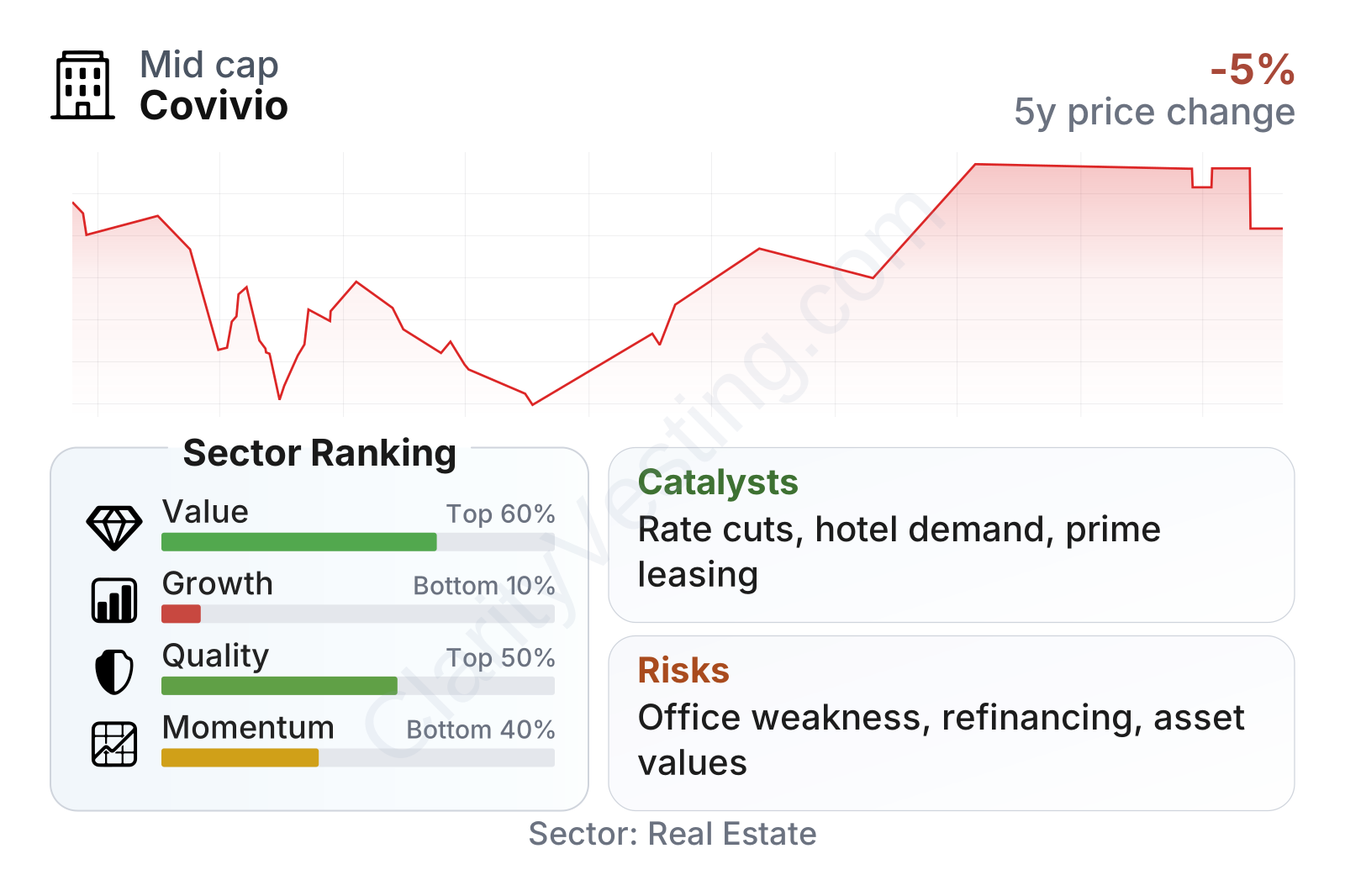
Covivio is a large listed real estate group with a market value around the mid-single-digit billions of dollars and share-price volatility that is close to the broader market. On valuation metrics, it screens as mixed: earnings and cash flow multiples look relatively undemanding, while book-based valuation looks less straightforward because European property companies can trade at large discounts or premiums depending on asset values, debt costs, and confidence in appraisals.
The quality profile is better than the growth profile. Profitability, returns on capital, and free cash flow generation look solid relative to many real estate peers, and leverage measured against EBITDA is not stretched versus the sector median. However, long-term growth metrics are weak, with five-year declines in revenue per share, book value per share, earnings per share, and dividend per share. In short, the business appears operationally resilient but not structurally fast-growing.
Growth
Covivio operates in parts of the real estate market that still have clear long-term demand, but the outlook differs by segment. Hotels and well-located urban residential assets generally benefit from favorable long-run drivers such as tourism, mobility, constrained supply in major cities, and inflation-linked rent structures in some leases. Offices are more complicated because demand has become more selective after the shift toward hybrid work, pushing tenants toward high-quality, energy-efficient buildings in prime locations while weaker assets face pressure.
That context makes Covivio’s strategy broadly coherent. The company has concentrated on large European cities and on assets that can remain relevant under stricter environmental standards and more demanding tenant expectations. In offices, that means focusing on central, modern, and adaptable buildings. In hotels, it means partnering with established operators and benefiting from the continued normalization of travel. In German residential, it means relying on a more stable rental base to offset the cyclicality of other segments.
The growth record has not been smooth. Revenue per share has moved up and down rather than following a steady upward line, which reflects the reality of a property group that actively rotates assets and operates through changing market conditions. Recent annual revenue growth has been modestly positive, but the five-year trend remains weak. That suggests Covivio’s near-term expansion depends less on rapid portfolio growth and more on rental indexation, occupancy, project deliveries, hotel recovery, and selective disposals or reinvestments.
The dividend path also shows uneven progression. This is not unusual for a real estate company exposed to property cycles, balance-sheet management, and changing profit recognition. Even so, the current trailing yield stands above the sector median, indicating that income distribution remains an important part of the company’s profile. For long-term observers, the more important question is not short-term dividend volatility by itself, but whether recurring cash flows and debt discipline can support distributions through the cycle.
Potential catalysts are visible. A lower interest-rate environment in Europe would help financing conditions, support property values, and typically improve sentiment toward listed landlords. The hotel business could continue to benefit from resilient travel demand. In offices, any evidence of stable leasing for prime buildings would be significant because it would reinforce the argument that high-quality assets can still perform well even if the broader office market remains under pressure. Covivio’s ability to recycle capital from mature assets into better-yielding or more future-proof properties is another meaningful lever.
Risks
This article is for informational purposes only and does not constitute financial advice. Some content is AI-generated. See Disclaimer


