Stock Analysis · Goldman Sachs Group Inc (GS)
Overview
Goldman Sachs is a global financial institution best known for advising large companies, governments, and wealthy clients. In simple terms, it helps clients raise money, manage money, trade financial assets, finance transactions, and complete major corporate deals such as mergers, acquisitions, and stock listings. The company is much less like a traditional consumer bank and much more like a high-end financial services platform centered on markets, corporate advice, and asset management.
Since its recent reporting structure update, Goldman Sachs presents its business in three main segments. Based on the latest full-year results, the revenue mix is approximately:
- Global Banking & Markets: about 77% of net revenues. This is the core business and includes investment banking fees, advisory work on mergers and acquisitions, equity and debt underwriting, fixed income trading, equities trading, financing, and risk intermediation for institutional clients.
- Asset & Wealth Management: about 18%. This includes managing money for institutions and high-net-worth clients, wealth advisory services, private banking and lending, alternatives, and management fees tied to client assets.
- Platform Solutions: about 5%. This segment has included transaction banking, consumer-related activities, and embedded financial services partnerships. It has been strategically reduced and reshaped after weaker economics in parts of the consumer push.
That revenue mix matters for long-term analysis because Goldman Sachs still depends heavily on capital markets activity and trading conditions. At the same time, management has spent several years trying to increase the share of steadier, fee-based businesses such as wealth and asset management. The result is a firm that remains cyclical, but with a broader earnings base than in prior decades.
The multi-year financial flow also shows a business that can produce very large revenue and profit rebounds after weaker periods. Revenue and net income fell sharply from the 2021 peak into 2023, then recovered strongly in 2024 and 2025, which is typical for a firm exposed to deal activity, market volatility, and client trading demand.
Key Figures
| Metric | Value | Sector ⓘ |
|---|---|---|
| Date | Oct 19, 2026 | |
| Context | ||
| Sector | Financial Services | |
| Industry | Capital Markets | |
| Market Cap ⓘ | $256.60B | |
| Beta ⓘ | 1.28 | |
Value (Cheapness) | ||
| P/E Ratio ⓘ | 12.67 | 12.26 |
| P/B Ratio ⓘ | 2.12 | 1.23 |
| FCF Yield ⓘ | -16.18% | 10.40% |
| Dividend Yield ⓘ | 2.02% | 3.02% |
| EBIT / EV ⓘ | 29.27% | 8.14% |
| PEG ⓘ | 1.17 | |
Growth (Business expansion) | ||
| Revenue Growth ⓘ | 23.30% | 9.25% |
| RPS Growth (5Y CAGR) ⓘ | 21.18% | 12.19% |
| EPS Growth (5Y CAGR) ⓘ | 17.80% | -9.36% |
| BVPS Growth (5Y CAGR) ⓘ | 8.99% | 4.99% |
| Margin Growth (5Y Trend) ⓘ | -24.15% | -3.86% |
| FCF Growth (5Y CAGR) ⓘ | N/A | 4.81% |
| DPS Growth (5Y CAGR) ⓘ | 21.36% | 8.79% |
Quality (Business durability) | ||
| ROIC (Latest) ⓘ | 4.44% | 9.49% |
| ROE (Latest) ⓘ | 17.37% | 13.87% |
| ROA (Latest) ⓘ | 1.11% | 1.54% |
| ROIC (5Y Median) ⓘ | 3.64% | 7.86% |
| ROE (5Y Median) ⓘ | 11.32% | 12.17% |
| ROA (5Y Median) ⓘ | 0.86% | 1.30% |
| Net Debt / EBIT (Latest) ⓘ | 27.11 | 0.99 |
| Net Debt / EBIT (5Y Median) ⓘ | 20.38 | 0.73 |
| Net Debt / EBITDA (Latest) ⓘ | 25.41 | 0.91 |
| Operating Margin (Latest) ⓘ | 25.06% | 22.30% |
| Operating Margin (5Y Median) ⓘ | 17.47% | 24.63% |
| Debt to Equity (Latest) ⓘ | 671.20% | 58.04% |
| Profit Margin (Latest) ⓘ | 31.21% | 26.57% |
| Free Cash Flow (Latest) ⓘ | -$41.52B | |
Momentum (Price trend) | ||
| 3Y Return ⓘ | +204.56% | +88.26% |
| 12M Return (excl. last month) ⓘ | +21.76% | +19.24% |
| 6M Return ⓘ | -1.17% | +4.70% |
| Price vs. 200-Day MA ⓘ | -7.50% | +3.66% |
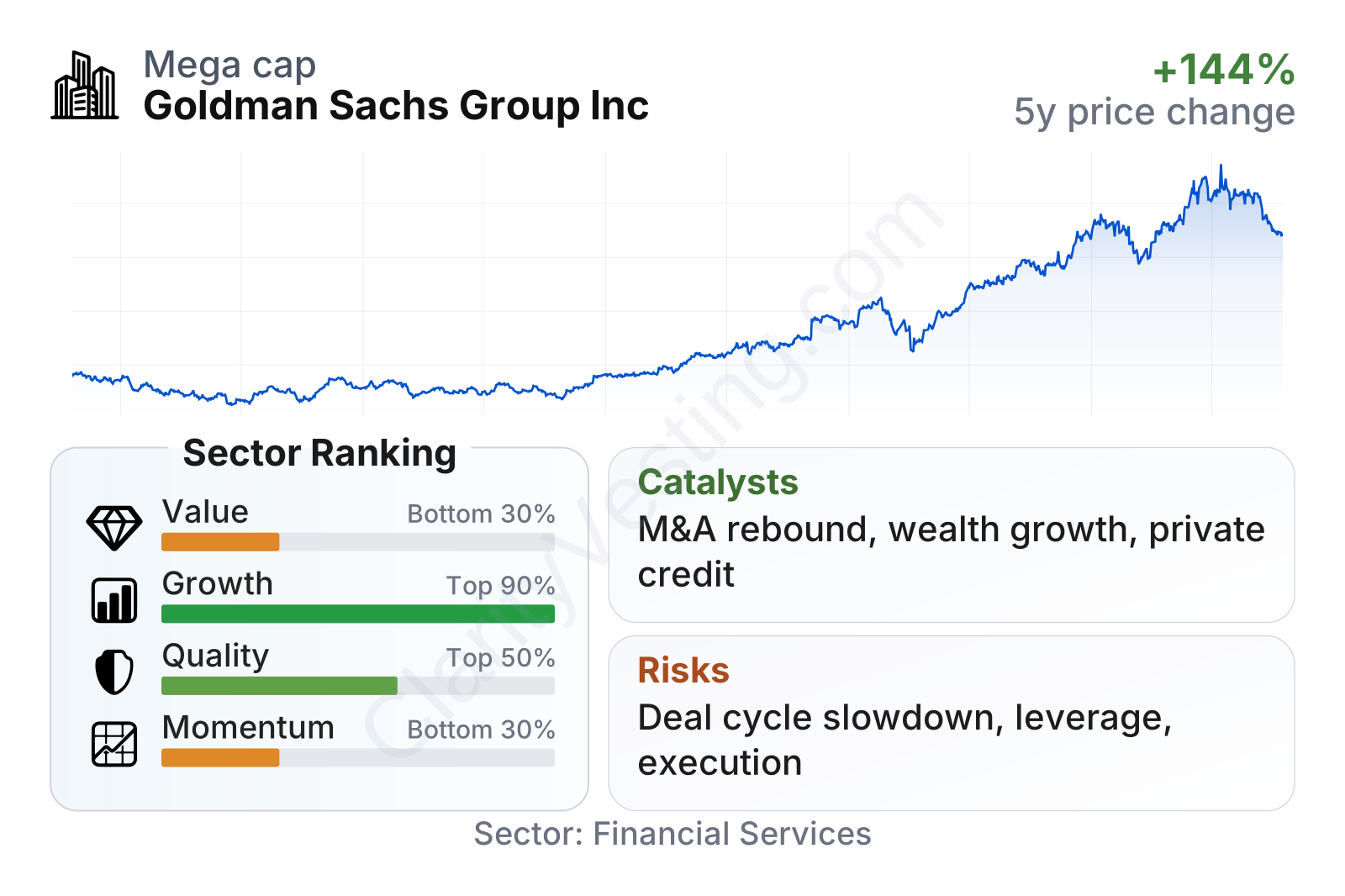
Goldman Sachs is one of the largest firms in global capital markets, with a stock that has been more volatile than the average financial company, as reflected by a beta above 1. The metrics table points to a mixed profile: growth ranks very high within the sector, quality is solid but not dominant across all measures, while value and recent momentum look less favorable. The strong long-term share price rise has been supported by a recovery in earnings and book value, but the latest valuation multiples are no longer near the discounted levels seen in 2022 and 2023.
Growth
Goldman Sachs operates in parts of finance that should remain structurally important: capital raising, mergers and acquisitions, private markets, wealth management, and institutional trading. These are not fast-growing in a straight line every year, but they benefit from long-term expansion in global assets, corporate financing needs, and demand from wealthy clients for more sophisticated investment products. Growth in this industry tends to come in waves rather than smooth annual increases.
The company’s current strategy is more coherent than it was during its consumer banking expansion. Management has stepped back from lower-return mass-market lending and refocused on its historic strengths: advising corporations, serving institutions, and expanding private wealth and alternatives. That makes strategic sense because Goldman’s brand, client relationships, and talent base are strongest in premium segments where pricing power and cross-selling are better.
A major catalyst is the operating leverage embedded in the model. When dealmaking, underwriting, and client activity recover, earnings can rise quickly because the franchise already has the platform, relationships, and global reach in place. Another catalyst is the continued build-out of wealth and asset management, which can add more recurring fee income and reduce dependence on volatile trading and investment banking cycles.
Recent company updates have also highlighted continued emphasis on private credit, alternatives, financing, and serving ultra-high-net-worth clients. These areas matter because they tie Goldman to pockets of finance where asset growth, complexity, and fee pools remain attractive. In addition, a more active environment for IPOs, debt issuance, and mergers would directly support its largest business line.
The earnings pattern shows why Goldman Sachs is both appealing and challenging to assess. Earnings per share dropped sharply after the unusually strong 2021 environment, bottomed in 2023, and then recovered strongly through 2024, 2025, and into 2026. That rebound supports the view that the franchise remains highly profitable when market conditions normalize. Over five years, earnings growth has still outpaced much of the sector despite the swings.
Book value per share has moved steadily higher over time, which is important for a bank-like financial institution. Rising book value suggests the company has continued to build shareholder capital even through uneven market conditions. Combined with improved earnings momentum, that trend supports the case that the firm has emerged from its weaker period with stronger underlying economics.
Risks
This article is for informational purposes only and does not constitute financial advice. Some content is AI-generated. See Disclaimer


