Stock Analysis · Grainger plc (GRGTF)
Overview
Grainger plc is a U.K. residential real estate company focused on rental housing. Its core activity is owning, developing, and operating homes that are rented out over long periods. The business is best known for its exposure to the private rented sector and, increasingly, purpose-built rental communities often described in the U.K. as build-to-rent. In practical terms, Grainger earns income from tenants, grows by adding newly developed homes, and also benefits from changes in the value of its property portfolio.
The company’s revenue mix is more property-based than service-based, so the largest contributors are recurring rental income and gains or fees linked to residential assets. Based on recent annual reporting, the mix is centered on the following sources:
- Rental income: approximately 65% to 75% of revenue in recent years. This includes rents from the company’s private rented homes and build-to-rent communities, which form the recurring engine of the business.
- Sales of development units and other property disposals: approximately 10% to 20%. This can vary materially from year to year depending on completion timing, asset recycling, and market conditions.
- Fees, services, and other property-related income: approximately 10% to 15%. This can include management-related income, ancillary charges, and other operating items connected to the residential portfolio.
That revenue structure matters because it makes Grainger different from many office, retail, or mixed-use landlords. The company is closely tied to residential occupancy, rent growth, and the speed at which new rental developments are completed and leased.
The broad financial flow shows a business with consistently high operating margins for its sector, but also one where reported profit can swing sharply because property valuation movements, taxes, and financing costs can have a large effect on bottom-line earnings. Revenue has stayed in a fairly stable range over the last four fiscal years, while operating income and net income have been more volatile.
Key Figures
| Metric | Value | Sector ⓘ |
|---|---|---|
| Date | Oct 17, 2026 | |
| Context | ||
| Sector | Real Estate | |
| Industry | Real Estate Services | |
| Market Cap ⓘ | $1.63B | |
| Beta ⓘ | 0.77 | |
Value (Cheapness) | ||
| P/E Ratio ⓘ | 9.17 | 17.38 |
| P/B Ratio ⓘ | 1.08 | 0.85 |
| FCF Yield ⓘ | 15.66% | 7.38% |
| Dividend Yield ⓘ | 3.82% | 4.85% |
| EBIT / EV ⓘ | N/A | 3.78% |
| PEG ⓘ | N/A | |
Growth (Business expansion) | ||
| Revenue Growth ⓘ | -16.60% | 5.30% |
| RPS Growth (5Y CAGR) ⓘ | -0.94% | 6.02% |
| EPS Growth (5Y CAGR) ⓘ | -2.93% | -11.37% |
| BVPS Growth (5Y CAGR) ⓘ | 1.83% | 0.45% |
| Margin Growth (5Y Trend) ⓘ | -19.01% | -0.22% |
| FCF Growth (5Y CAGR) ⓘ | -4.86% | 5.40% |
| DPS Growth (5Y CAGR) ⓘ | 9.68% | 5.02% |
Quality (Business durability) | ||
| ROIC (Latest) ⓘ | 9.51% | 5.69% |
| ROE (Latest) ⓘ | 12.34% | 7.56% |
| ROA (Latest) ⓘ | 6.38% | 2.85% |
| ROIC (5Y Median) ⓘ | 6.18% | 4.22% |
| ROE (5Y Median) ⓘ | 6.84% | 6.03% |
| ROA (5Y Median) ⓘ | 3.50% | 2.44% |
| Net Debt / EBIT (Latest) ⓘ | 15.31 | 7.59 |
| Net Debt / EBIT (5Y Median) ⓘ | 8.06 | 8.40 |
| Net Debt / EBITDA (Latest) ⓘ | 14.79 | 5.27 |
| Net Debt / Assets ⓘ | 40.20% | 37.76% |
| EBITDA / Interest ⓘ | 1.11 | 4.10 |
| Operating Margin (Latest) ⓘ | 17.94% | 35.29% |
| Operating Margin (5Y Median) ⓘ | 55.54% | 37.31% |
| Debt to Equity (Latest) ⓘ | 83.71% | 88.87% |
| Profit Margin (Latest) ⓘ | 54.75% | 19.61% |
| Free Cash Flow (Latest) ⓘ | $255.54M | |
Momentum (Price trend) | ||
| 3Y Return ⓘ | -11.66% | +30.75% |
| 12M Return (excl. last month) ⓘ | +4.36% | +4.36% |
| 6M Return ⓘ | +2.67% | -2.52% |
| Price vs. 200-Day MA ⓘ | -4.11% | -2.34% |
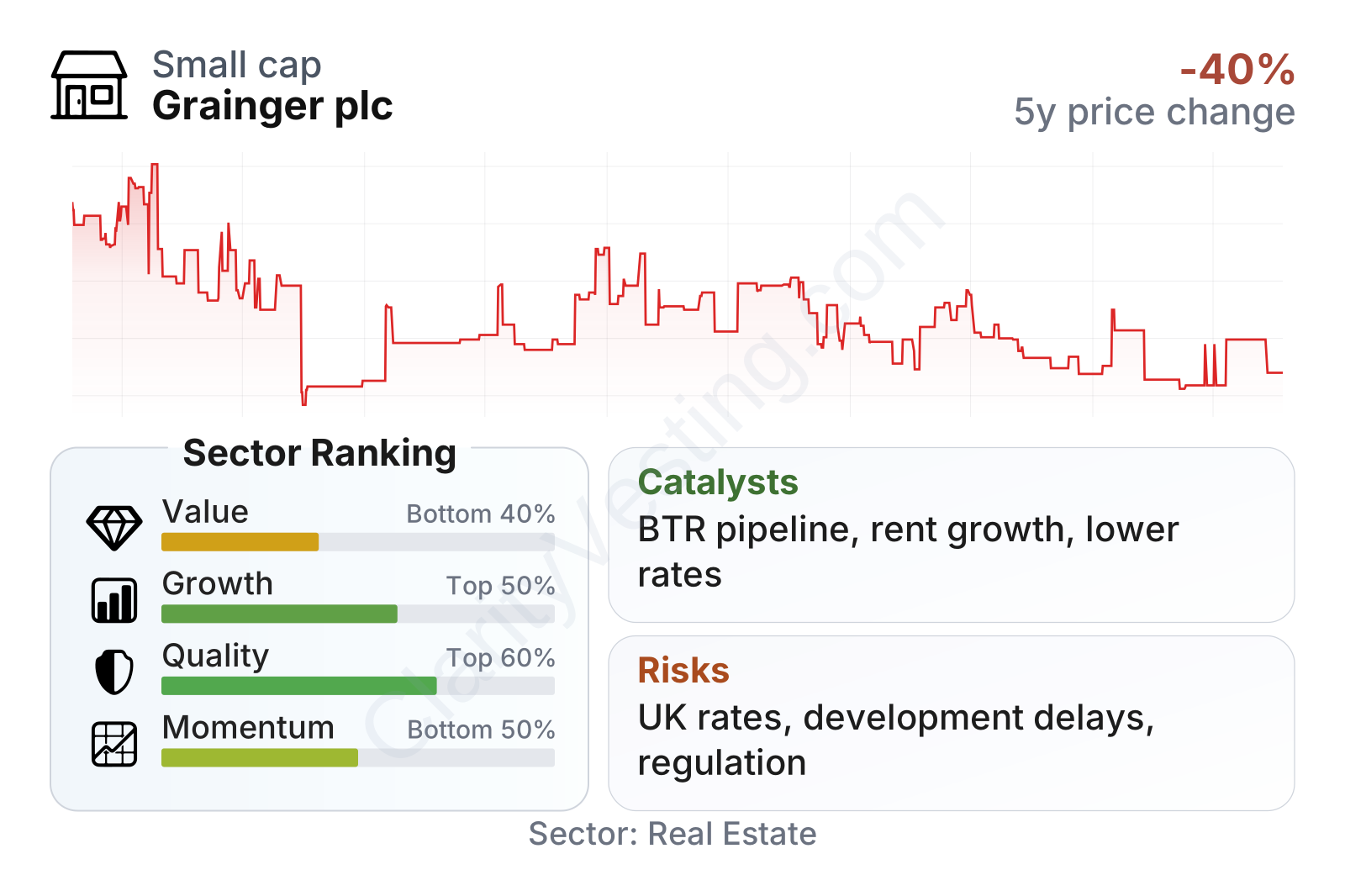
Grainger is a mid-sized real estate company with relatively low share-price volatility, as reflected by a beta below 1. In the factor breakdown, quality stands out more positively than growth or momentum. Profitability metrics are comfortably above sector medians, with returns on capital, equity, and assets all ahead of typical peers. Leverage is meaningful, which is normal for property companies, but debt relative to earnings is somewhat better than the sector median rather than stretched versus peers.
On valuation measures, the picture is mixed. The earnings multiple is below the sector median, which can look undemanding, while price-to-book is slightly above the sector median at the latest reading. Free cash flow yield is notably strong. At the same time, recent revenue growth and multi-year revenue-per-share trends have lagged much of the sector, and share-price momentum has also been weaker than average.
Growth
Grainger operates in a part of real estate that has a credible long-term demand backdrop. The U.K. continues to face a structural housing shortage, and renting has become a longer-term reality for many households because home affordability remains difficult in many cities. That supports demand for professionally managed rental housing, especially newer buildings with consistent service standards and amenities.
The company’s strategy is aligned with that trend. Grainger has spent years shifting toward a more recurring-income model built around large-scale rental assets rather than depending mainly on transactional gains. That makes strategic sense for long-duration growth because each newly completed rental development can add income capacity for many years, provided occupancy remains high and rents continue to adjust upward over time.
The recent revenue-per-share pattern has been uneven rather than clearly compounding. There was some recovery in 2024, followed by a softer 2025 reading. That suggests the long-term thesis currently depends more on portfolio expansion, leasing progress, and embedded rental growth than on a smooth reported revenue trend.
One encouraging sign is the dividend record. Dividend per share has risen steadily over the last four fiscal years, and the five-year growth rate is stronger than the sector median. For a residential landlord, that can indicate confidence in cash generation and asset quality, even if accounting earnings remain affected by property revaluations and timing effects.
Potential catalysts are tied to delivery and leasing. As more build-to-rent units complete and stabilize, Grainger can increase rental income without relying on a broad rebound in commercial real estate. A lower interest-rate environment in the U.K. would also help in two ways: it could reduce financing pressure and support residential asset values. In addition, institutional interest in rental housing remains an important backdrop for this niche, since it reinforces the idea that professionally managed residential portfolios are a durable asset class rather than a temporary theme.
Risks
This article is for informational purposes only and does not constitute financial advice. Some content is AI-generated. See Disclaimer


