Stock Analysis · Guardian Pharmacy Services Inc (GRDN)
Overview
Guardian Pharmacy Services Inc is a specialized pharmacy company serving residents in long-term care and other assisted living settings. In practical terms, it fills and delivers prescription medications, helps facilities manage medication regimens, supports packaging and dispensing, and provides pharmacy-related clinical and consulting services. Its customers are generally senior housing, skilled nursing, behavioral health, and similar care providers that need recurring pharmacy support rather than one-time retail transactions.
The business model is built around high-volume, recurring medication needs for patients who often require multiple prescriptions and ongoing coordination with caregivers, nurses, and physicians. That makes the company more service-intensive than a traditional neighborhood pharmacy and ties performance to occupancy, resident acuity, and the number of beds or communities it serves.
Based on company disclosures, revenue is overwhelmingly generated from pharmacy services and medication dispensing, while smaller amounts come from related service activities. A simple way to think about the revenue mix is:
- Prescription drug dispensing and related pharmacy sales: about 90% to 95% of revenue. This includes branded drugs, generics, specialty medications where applicable, and the reimbursement tied to filling prescriptions for long-term care residents.
- Ancillary pharmacy and service revenue: about 5% to 10% of revenue. This can include medication packaging, delivery, consulting, and other support services provided to care facilities.
The broad financial picture is that revenue has expanded materially over the last several years, gross profit has risen with scale, and profitability rebounded after a weak 2024. One notable point is that 2024 included a sharp rise in operating expenses and a reported loss, followed by a recovery in 2025 as operating income and net income turned positive again. That pattern matters for long-term analysis because it suggests the current investment case depends not only on growth, but also on execution and margin discipline.
The business has clearly become larger, with revenue rising from below $800 million in 2021 to roughly $1.45 billion in 2025. At the same time, the recent recovery shows that scale alone is not enough; cost control remains central to the company’s long-term economics.
Key Figures
| Metric | Value | Sector ⓘ |
|---|---|---|
| Date | Oct 24, 2026 | |
| Context | ||
| Sector | Healthcare | |
| Industry | Medical Care Facilities | |
| Market Cap ⓘ | $2.47B | |
| Beta ⓘ | 0.02 | |
Value (Cheapness) | ||
| P/E Ratio ⓘ | 37.84 | 25.42 |
| P/B Ratio ⓘ | 10.82 | 3.08 |
| FCF Yield ⓘ | 3.23% | 3.12% |
| Dividend Yield ⓘ | N/A | 1.85% |
| EBIT / EV ⓘ | 3.59% | 0.56% |
| PEG ⓘ | N/A | |
Growth (Business expansion) | ||
| Revenue Growth ⓘ | 2.20% | 7.50% |
| RPS Growth (5Y CAGR) ⓘ | 15.15% | 8.60% |
| EPS Growth (5Y CAGR) ⓘ | -18.83% | -17.73% |
| BVPS Growth (5Y CAGR) ⓘ | 67.00% | 3.72% |
| Margin Growth (5Y Trend) ⓘ | 1.33% | -0.57% |
| FCF Growth (5Y CAGR) ⓘ | 13.16% | 0.96% |
| DPS Growth (5Y CAGR) ⓘ | N/A | 6.69% |
Quality (Business durability) | ||
| ROIC (Latest) ⓘ | 31.29% | 3.17% |
| ROA (Latest) ⓘ | 15.81% | 2.98% |
| ROIC (5Y Median) ⓘ | N/A | 4.56% |
| ROA (5Y Median) ⓘ | 9.07% | 1.87% |
| Net Debt / EBIT (Latest) ⓘ | -0.57 | 1.34 |
| Net Debt / EBIT (5Y Median) ⓘ | 1.27 | 1.86 |
| Net Debt / EBITDA (Latest) ⓘ | -0.46 | 1.00 |
| Net Debt / Assets ⓘ | -12.30% | 5.06% |
| EBITDA / Interest ⓘ | 189.87 | 9.55 |
| Operating Margin (Latest) ⓘ | 6.59% | 9.25% |
| Operating Margin (5Y Median) ⓘ | 3.88% | 7.33% |
| Debt to Equity (Latest) ⓘ | 14.35% | 26.68% |
| Profit Margin (Latest) ⓘ | 4.50% | 3.34% |
| Free Cash Flow (Latest) ⓘ | $79.78M | |
Momentum (Price trend) | ||
| 3Y Return ⓘ | N/A | +51.61% |
| 12M Return (excl. last month) ⓘ | +76.21% | +19.90% |
| 6M Return ⓘ | +9.18% | +10.10% |
| Price vs. 200-Day MA ⓘ | +4.71% | +6.44% |
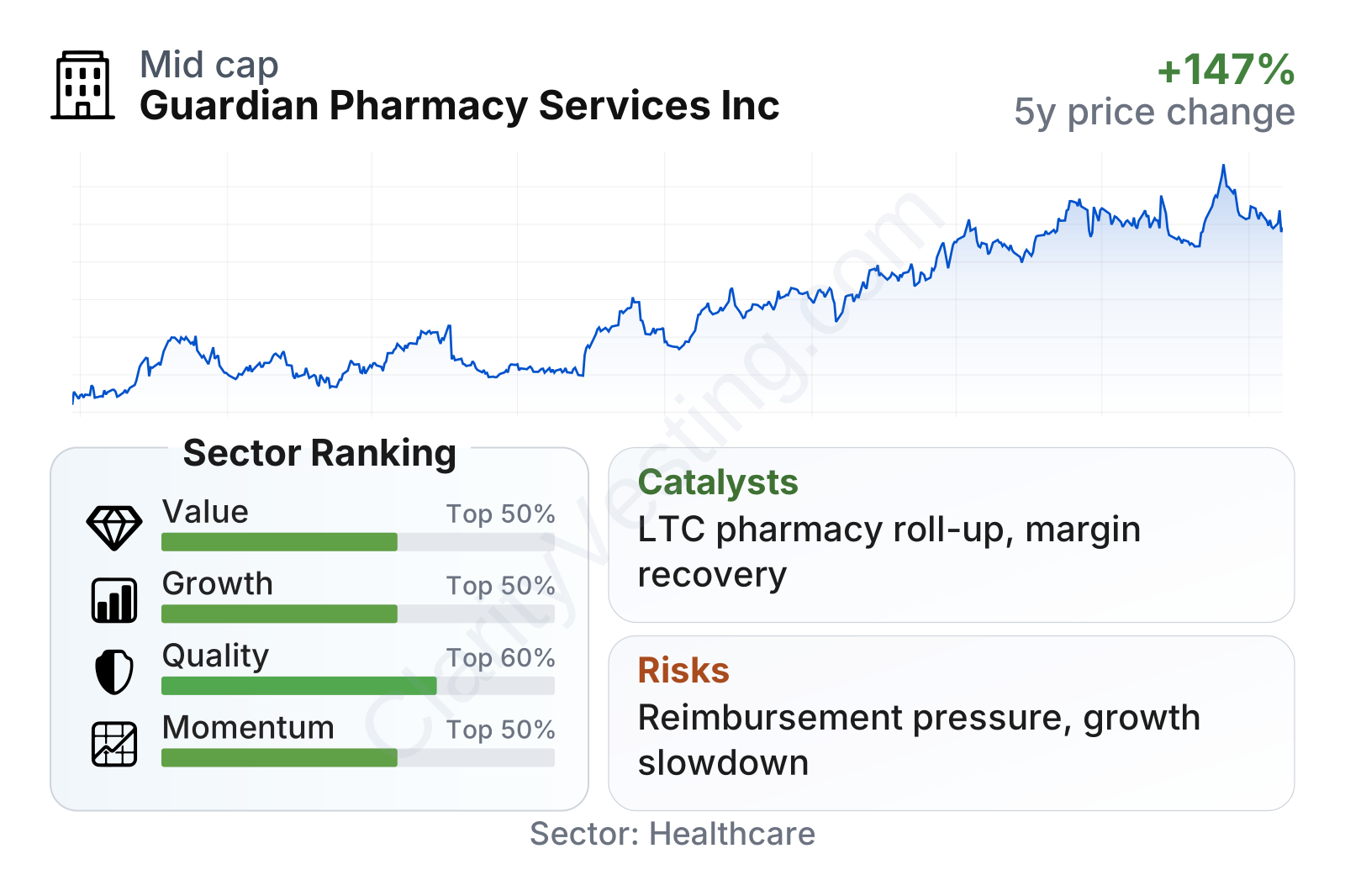
Guardian is a mid-cap healthcare company with unusually low share-price volatility, as shown by a very low beta. The table points to a mixed but interesting profile: valuation metrics look richer than the healthcare median on earnings and book value, quality measures are stronger than they first appear, and growth is solid over a multi-year period even though recent year-over-year revenue expansion has cooled sharply. Profitability and returns on capital stand out positively, while momentum is less convincing over shorter stretches despite a strong move over the past year.
The market’s pricing appears to reflect a company that has moved beyond a temporary earnings disruption and regained profitability, but not one that is being treated as a bargain. In other words, the current setup looks more like a business being credited for resilience and operational improvement than for rapid near-term acceleration.
Growth
Guardian operates in an area of healthcare that benefits from durable demographic support. An aging U.S. population, greater medication complexity among older adults, and the ongoing need for outsourced pharmacy support in senior care and long-term care settings all create a favorable background. This is not a fast-changing technology market, but it is a segment where patient needs are recurring and where scale, local relationships, and service reliability matter.
The company’s strategy also makes sense in that context. Long-term care pharmacy is often a local or regional service business, so building density, adding facilities, and integrating acquisitions can improve route efficiency, labor utilization, purchasing leverage, and pharmacy workflow. Guardian has historically expanded through a combination of organic growth and acquisitions, which is common in this niche because many independent operators remain in the market.
The recent growth pattern is worth reading carefully. Through 2025, revenue growth was strong, generally in the mid-to-high teens and at times around 20%. In 2026, that pace slowed to roughly 2%. That deceleration does not automatically mean the growth case is broken, but it does suggest that the company is moving from a high-comparison period into a more normal rate of expansion. For long-term analysis, that raises an important question: can Guardian continue compounding through new facility wins, acquisitions, and deeper penetration of existing customers even if headline growth becomes less dramatic?
Cash generation has moved in the right direction. Free cash flow rose meaningfully over the last year, which matters because it gives the company more flexibility to fund acquisitions, invest in operations, or simply strengthen its financial position. That is especially relevant in a roll-up style business, where the ability to turn accounting profit into real cash can shape how sustainably growth is financed.
A meaningful catalyst is the company’s ability to keep consolidating a fragmented long-term care pharmacy market. Another is the operating recovery already visible after 2024’s loss. If Guardian can show that margins remain positive while adding revenue, the market may continue treating it as a maturing consolidator rather than a volatile turnaround. Recent company reporting also indicates continued expansion in beds served and customer relationships, which supports the idea that demand for its services remains healthy even as growth normalizes.
Risks
This article is for informational purposes only and does not constitute financial advice. Some content is AI-generated. See Disclaimer


