Stock Analysis · GrainCorp Limited (GRCLF)
Overview
GrainCorp Limited is an Australian agribusiness company focused on storing, handling, processing, and exporting grain and edible oils. In simple terms, it sits in the middle of the food supply chain: farmers deliver crops, GrainCorp stores and moves them through its network, processors and overseas customers buy them, and the company also crushes oilseeds and supplies ingredients used in food production.
Its business is mainly tied to eastern Australia, where it operates a large grain storage and logistics network linked to rail, road, and export terminals. That infrastructure matters because grain is bulky, seasonal, and expensive to move without scale. GrainCorp also has a smaller but still meaningful oils and processing operation that serves food manufacturers and other industrial customers.
Based on recent company reporting, revenue is primarily generated from the following activities:
- Agribusiness: approximately 85% to 90% of group revenue. This includes grain receivals, storage, marketing, transport, export terminal services, and related supply-chain activities.
- Processing: approximately 10% to 15% of group revenue. This includes crush and refining activities, edible oils, animal feed by-products, and ingredients supplied to food and industrial customers.
The broad earnings picture is more balanced than revenue alone suggests. Agribusiness usually drives the larger sales base, but profits can swing sharply depending on crop size, export flows, and trading conditions. Processing tends to be smaller in revenue terms, yet it can add diversification because demand for oils and ingredients is not perfectly tied to grain harvest volumes.
The flow of the business over the last few years shows how cyclical GrainCorp is. Revenue remained large, but margins narrowed materially after the unusually strong 2022 and 2023 period. Gross profit and operating income dropped much faster than sales, which highlights how sensitive results are to crop conditions, commodity spreads, and financing costs rather than just top-line volume.
Key Figures
| Metric | Value | Sector ⓘ |
|---|---|---|
| Date | Oct 17, 2026 | |
| Context | ||
| Sector | Consumer Defensive | |
| Industry | Farm Products | |
| Market Cap ⓘ | $1.05B | |
| Beta ⓘ | -0.09 | |
Value (Cheapness) | ||
| P/E Ratio ⓘ | N/A | 17.88 |
| P/B Ratio ⓘ | 0.72 | 1.29 |
| FCF Yield ⓘ | 4.23% | 12.39% |
| Dividend Yield ⓘ | 5.94% | 2.85% |
| EBIT / EV ⓘ | N/A | 6.43% |
| PEG ⓘ | N/A | |
Growth (Business expansion) | ||
| Revenue Growth ⓘ | -5.10% | 4.10% |
| RPS Growth (5Y CAGR) ⓘ | 8.33% | 6.18% |
| EPS Growth (5Y CAGR) ⓘ | 1.23% | -13.59% |
| BVPS Growth (5Y CAGR) ⓘ | 4.75% | 3.20% |
| Margin Growth (5Y Trend) ⓘ | -2.03% | -0.15% |
| FCF Growth (5Y CAGR) ⓘ | N/A | 4.10% |
| DPS Growth (5Y CAGR) ⓘ | 33.64% | 6.79% |
Quality (Business durability) | ||
| ROIC (Latest) ⓘ | N/A | 12.34% |
| ROA (Latest) ⓘ | 1.65% | 6.30% |
| ROIC (5Y Median) ⓘ | 9.30% | 10.49% |
| ROA (5Y Median) ⓘ | 5.93% | 5.44% |
| Net Debt / EBIT (Latest) ⓘ | 7.68 | 1.96 |
| Net Debt / EBIT (5Y Median) ⓘ | 2.15 | 2.35 |
| Net Debt / EBITDA (Latest) ⓘ | 3.60 | 1.38 |
| Net Debt / Assets ⓘ | 40.60% | 21.51% |
| EBITDA / Interest ⓘ | 3.24 | 9.46 |
| Operating Margin (Latest) ⓘ | 1.47% | 8.87% |
| Operating Margin (5Y Median) ⓘ | 4.09% | 9.53% |
| Debt to Equity (Latest) ⓘ | 140.97% | 72.35% |
| Profit Margin (Latest) ⓘ | -0.19% | 5.40% |
| Free Cash Flow (Latest) ⓘ | $44.27M | |
Momentum (Price trend) | ||
| 3Y Return ⓘ | +36.95% | +20.92% |
| 12M Return (excl. last month) ⓘ | -15.54% | +2.13% |
| 6M Return ⓘ | +3.34% | +1.26% |
| Price vs. 200-Day MA ⓘ | +5.01% | +1.39% |
GrainCorp is a mid-sized company in market value terms, and the operating profile looks mixed. On valuation, the shares screen cheaply on book value, with a price-to-book ratio below the sector median, and the trailing dividend yield is notably above the sector norm. On the other hand, cash generation relative to market value is weaker than many peers, which helps explain why overall value metrics do not stand out more strongly.
Growth indicators are uneven. Short-term revenue recently moved backward, but the longer five-year record for revenue per share and book value per share is better than the sector median. Dividend growth has also been strong over that period, although that came off a cyclical upswing and may not represent a steady run rate.
Quality metrics are the clearest weak point. Profitability is thin, return on assets is below sector norms, leverage is elevated, and interest coverage is much tighter than the typical company in this industry group. That combination means the balance sheet deserves close attention, especially when earnings normalize after stronger crop years.
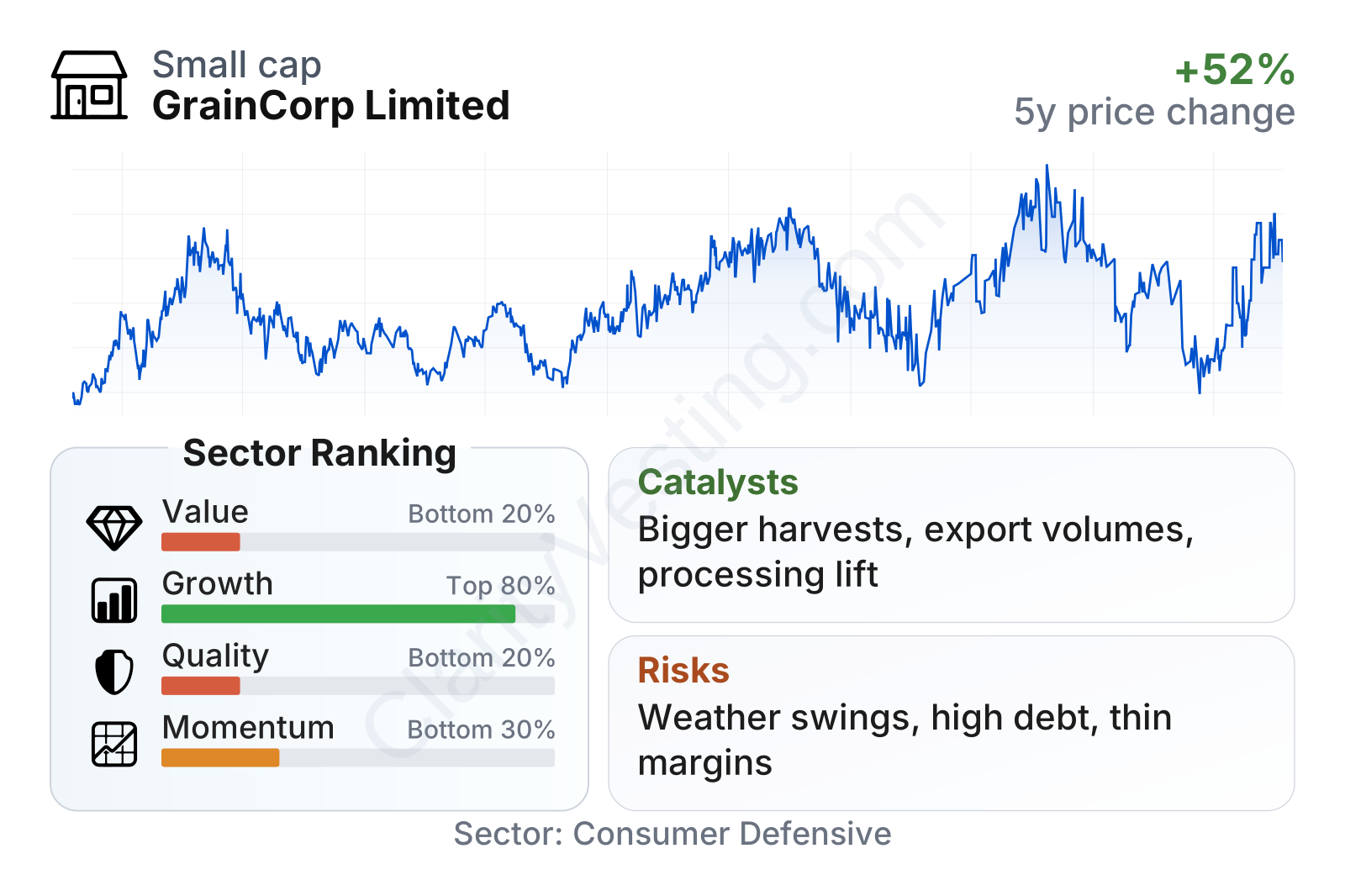
The share price trend has been better over three years than much of the sector, although shorter-term momentum is only moderate. The chart shows a stock that advanced strongly from 2021 levels, then moved through periods of volatility rather than a straight line upward, which fits the cyclical nature of the business.
Growth
GrainCorp operates in a sector that is mature rather than fast-growing, but it remains strategically important. Global demand for grain, edible oils, and agricultural supply-chain services is supported by population growth, food consumption, and trade flows. That does not create a classic high-growth profile, yet it does provide durable long-term demand for efficient storage, transport, and export infrastructure.
The company’s strategy makes sense within that context. GrainCorp is not trying to invent a new market; it is trying to deepen its role in essential agricultural logistics and processing. Its network of up-country storage sites, rail and road connections, and export terminals creates a practical advantage in eastern Australia. Replicating that footprint would take time, capital, and regulatory approvals, which gives existing infrastructure owners a meaningful position.
A key catalyst is crop normalization and export throughput. GrainCorp’s earnings can improve significantly when east coast harvests are strong and grain volumes move efficiently through its network. Another catalyst is better performance in processing, where edible oils and ingredients can smooth results compared with purely harvest-driven grain handling. Operational upgrades, supply-chain efficiency projects, and disciplined capital allocation can also lift returns even if the broader industry grows slowly.
Recent company updates have emphasized capital projects, network reliability, and the continued importance of Australian grain exports into Asia and other markets. In practical terms, the biggest opportunity is not explosive market expansion but stronger utilization of assets that are already in place. When volumes rise, these fixed assets can support a meaningful recovery in earnings.
Risks
This article is for informational purposes only and does not constitute financial advice. Some content is AI-generated. See Disclaimer


