Stock Analysis · Gorman-Rupp Company (GRC)
Overview
Gorman-Rupp is an industrial equipment manufacturer focused on pumps and pump systems. Its products are used to move water, wastewater, sewage, chemicals, petroleum products, and other fluids in municipal, construction, industrial, fire protection, and transportation applications. In simple terms, the company sells equipment that keeps water and other liquids flowing in essential infrastructure and industrial processes.
The business is organized around pump-related product lines rather than a large number of unrelated activities, which makes the company easier to understand than many industrial groups. Based on recent annual reporting, revenue is heavily concentrated in pump systems and related equipment, with the largest end markets tied to water and wastewater infrastructure, construction and dewatering, fire suppression, industrial applications, and original equipment for vehicles and transport.
Approximate revenue exposure by end market, using company disclosures and segment descriptions, can be summarized as follows:
- Water, wastewater, sewer, and municipal infrastructure: the largest source of demand, roughly 30% to 40% of revenue. This includes pumps used by cities, utilities, and public systems.
- Construction, dewatering, and general industrial applications: roughly 25% to 35%. These products help remove water from job sites and support industrial fluid handling.
- Fire suppression and public safety systems: roughly 10% to 20%. This includes pumps used in fire protection applications.
- Transportation and OEM markets: roughly 10% to 20%. This includes pumps and systems used in trucks, agricultural equipment, and other manufactured vehicles or machinery.
- Repair parts, accessories, and other: a smaller but recurring source, generally under 10%.
Recent financial flow trends show a business that expanded meaningfully after the acquisition of Fill-Rite, then spent the next few years improving profitability and reducing financing pressure. Revenue climbed from about $378 million in 2021 to more than $680 million in 2025, while net income recovered strongly after a weak 2022 period.
Key Figures
| Metric | Value | Sector ⓘ |
|---|---|---|
| Date | Oct 03, 2026 | |
| Context | ||
| Sector | Industrials | |
| Industry | Specialty Industrial Machinery | |
| Market Cap ⓘ | $1.98B | |
| Beta ⓘ | 1.28 | |
Value (Cheapness) | ||
| P/E Ratio ⓘ | 32.08 | 22.45 |
| P/B Ratio ⓘ | 4.45 | 1.98 |
| FCF Yield ⓘ | 5.47% | 6.31% |
| Dividend Yield ⓘ | 0.99% | 1.96% |
| EBIT / EV ⓘ | 4.64% | 4.81% |
| PEG ⓘ | 1.84 | |
Growth (Business expansion) | ||
| Revenue Growth ⓘ | 3.90% | 9.10% |
| RPS Growth (5Y CAGR) ⓘ | 15.70% | 7.75% |
| EPS Growth (5Y CAGR) ⓘ | 10.70% | -13.59% |
| BVPS Growth (5Y CAGR) ⓘ | 5.71% | 6.22% |
| Margin Growth (5Y Trend) ⓘ | 3.72% | 0.72% |
| FCF Growth (5Y CAGR) ⓘ | 25.61% | 10.98% |
| DPS Growth (5Y CAGR) ⓘ | 4.08% | 9.48% |
Quality (Business durability) | ||
| ROIC (Latest) ⓘ | 10.92% | 10.92% |
| ROA (Latest) ⓘ | 7.18% | 5.41% |
| ROIC (5Y Median) ⓘ | 9.25% | 9.21% |
| ROA (5Y Median) ⓘ | 4.59% | 4.94% |
| Net Debt / EBIT (Latest) ⓘ | 2.26 | 2.07 |
| Net Debt / EBIT (5Y Median) ⓘ | 4.41 | 2.28 |
| Net Debt / EBITDA (Latest) ⓘ | 1.78 | 1.43 |
| Net Debt / Assets ⓘ | 26.71% | 19.27% |
| EBITDA / Interest ⓘ | 6.24 | 9.53 |
| Operating Margin (Latest) ⓘ | 14.56% | 10.50% |
| Operating Margin (5Y Median) ⓘ | 12.48% | 10.27% |
| Debt to Equity (Latest) ⓘ | 62.30% | 65.48% |
| Profit Margin (Latest) ⓘ | 8.88% | 6.62% |
| Free Cash Flow (Latest) ⓘ | $108.40M | |
Momentum (Price trend) | ||
| 3Y Return ⓘ | +138.42% | +58.56% |
| 12M Return (excl. last month) ⓘ | +78.40% | +15.63% |
| 6M Return ⓘ | +20.46% | +4.19% |
| Price vs. 200-Day MA ⓘ | +6.99% | +0.93% |
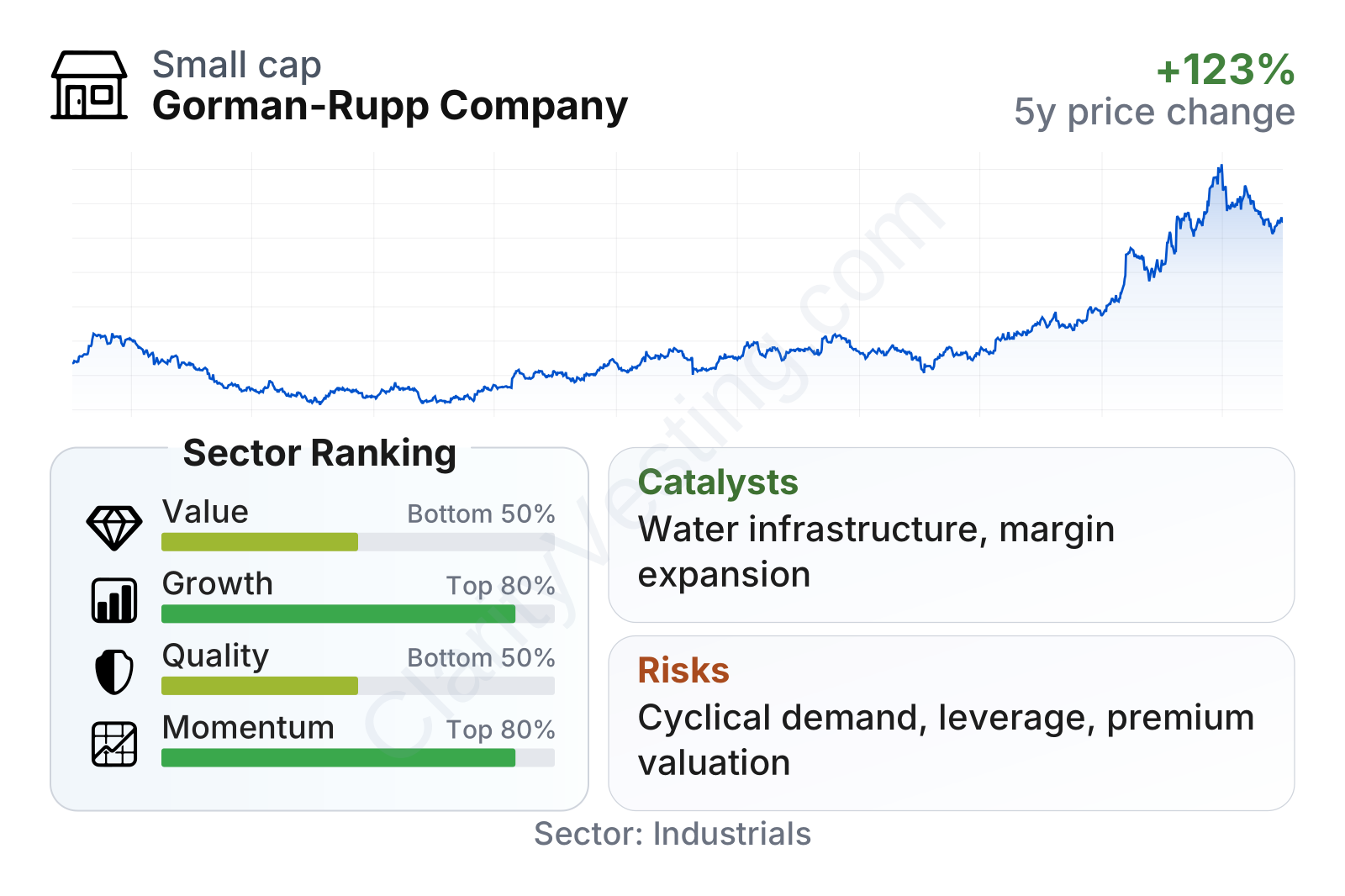
Gorman-Rupp is a small-to-mid-sized industrial company with a market value near $2 billion, so it is far smaller than diversified machinery giants but still large enough to have established manufacturing, distribution, and public market access. The table suggests a mixed profile: long-term growth and share price momentum have been strong relative to much of the industrial sector, while valuation looks less favorable and balance-sheet quality remains only average.
The market has clearly rewarded the company over the last three years, with the share price rising far more than the sector median. That performance appears to reflect improving earnings, better margins, and continued debt reduction rather than a dramatic acceleration in near-term sales growth.
Growth
Gorman-Rupp operates in a part of the industrial market that benefits from durable long-term demand. Water and wastewater systems require ongoing replacement and maintenance, municipalities need resilient pumping infrastructure, and construction and industrial customers continue to need dewatering and fluid-handling equipment. These are not speculative markets; they are tied to basic infrastructure and essential operations.
The company’s strategy also fits that backdrop. Management has combined an established niche pump franchise with targeted acquisitions, then focused on integration, cost discipline, and margin improvement. The Fill-Rite acquisition expanded the product mix and scale, and the more recent results suggest the company has moved from acquisition digestion toward operational improvement.
Revenue growth has normalized after the very large acquisition-driven jump in 2022 and 2023. More recently, sales growth has been positive but modest, running in the low- to mid-single digits. That is slower than the sector median right now, but the longer view is more favorable: five-year revenue per share growth has been notably stronger than the sector, which suggests that the business has genuinely increased its scale rather than just treading water.
Cash generation is another constructive point. Free cash flow has improved sharply from the low levels seen during the post-acquisition adjustment period and now sits at a much stronger level. That matters because it gives the company more room to reduce debt, fund capital spending, support dividends, and handle cyclical swings without relying too heavily on outside financing.
A meaningful catalyst is the continued need for U.S. water and wastewater infrastructure upgrades. Public funding programs and long replacement cycles can support demand for pumps over many years. Another catalyst is margin expansion: if Gorman-Rupp continues improving manufacturing efficiency and product mix, earnings can grow faster than revenue. The company’s exposure to repair parts and installed equipment also creates some recurring demand beyond new system sales.
Recent company updates have also pointed to continued profitability improvement and stronger order trends in parts of the business, which supports the view that growth going forward may rely more on execution and end-market resilience than on another large acquisition.
Risks
This article is for informational purposes only and does not constitute financial advice. Some content is AI-generated. See Disclaimer