Stock Analysis · GRAIL LLC (GRAL)
Overview
GRAIL is a healthcare diagnostics company focused on blood-based cancer screening. Its main product is Galleri, a multi-cancer early detection test designed to identify signals associated with many cancers from a single blood draw, often before symptoms appear. The company’s broader goal is to make cancer screening more routine and to shift detection toward earlier stages, when treatment can be more effective.
The business is still in a commercial build-out phase, so revenue remains concentrated in testing rather than spread across several mature divisions. Based on recent company reporting, revenue is primarily generated from laboratory testing services and related development activities.
- Product revenue from Galleri and other testing services: approximately 85% to 95%. This includes blood-based screening tests ordered through healthcare channels and processed by GRAIL’s laboratory operations.
- Service and other revenue: approximately 5% to 15%. This can include development-related arrangements, support activities, and smaller non-core sources.
That concentration makes the company easy to understand: its future largely depends on whether Galleri expands from an early commercial product into a broader standard-of-care screening platform. The operating profile also shows a business still investing heavily ahead of scale. Revenue has risen strongly over the last several years, while losses have narrowed meaningfully in the most recent annual period as operating expenses came down. Even so, cost of revenue still exceeds total revenue, which means the company has not yet reached gross profitability.
The long-term trend is encouraging on one specific point: sales have climbed from a very small base into a much larger commercial figure, while annual net losses have improved sharply from prior extremes. At the same time, the path to a self-sustaining business is incomplete because the company still spends heavily on research, clinical evidence, and commercialization.
Key Figures
| Metric | Value | Sector ⓘ |
|---|---|---|
| Date | Oct 10, 2026 | |
| Context | ||
| Sector | Healthcare | |
| Industry | Diagnostics & Research | |
| Market Cap ⓘ | $5.94B | |
| Beta ⓘ | 2.84 | |
Value (Cheapness) | ||
| P/E Ratio ⓘ | N/A | 24.79 |
| P/B Ratio ⓘ | 2.25 | 2.97 |
| FCF Yield ⓘ | -4.97% | 3.11% |
| Dividend Yield ⓘ | N/A | 2.04% |
| EBIT / EV ⓘ | -12.99% | 0.57% |
| PEG ⓘ | N/A | |
Growth (Business expansion) | ||
| Revenue Growth ⓘ | 25.70% | 7.35% |
| RPS Growth (5Y CAGR) ⓘ | 70.80% | 8.61% |
| EPS Growth (5Y CAGR) ⓘ | -78.47% | -18.43% |
| BVPS Growth (5Y CAGR) ⓘ | -30.68% | 3.94% |
| Margin Growth (5Y Trend) ⓘ | N/A | -0.61% |
| FCF Growth (5Y CAGR) ⓘ | -20.75% | 0.88% |
| DPS Growth (5Y CAGR) ⓘ | N/A | 6.74% |
Quality (Business durability) | ||
| ROIC (Latest) ⓘ | -16.75% | 3.34% |
| ROA (Latest) ⓘ | -14.38% | 2.95% |
| ROIC (5Y Median) ⓘ | N/A | 4.60% |
| ROA (5Y Median) ⓘ | -28.85% | 1.89% |
| Net Debt / EBIT (Latest) ⓘ | N/A | 1.36 |
| Net Debt / EBIT (5Y Median) ⓘ | N/A | 1.86 |
| Net Debt / EBITDA (Latest) ⓘ | N/A | 1.02 |
| Net Debt / Assets ⓘ | 1.25% | 5.85% |
| EBITDA / Interest ⓘ | N/A | 9.60 |
| Operating Margin (Latest) ⓘ | -320.38% | 9.19% |
| Operating Margin (5Y Median) ⓘ | -855.93% | 7.53% |
| Debt to Equity (Latest) ⓘ | 3.59% | 29.44% |
| Profit Margin (Latest) ⓘ | -236.95% | 3.52% |
| Free Cash Flow (Latest) ⓘ | -$295.25M | |
Momentum (Price trend) | ||
| 3Y Return ⓘ | N/A | +34.80% |
| 12M Return (excl. last month) ⓘ | +106.91% | +19.33% |
| 6M Return ⓘ | +161.15% | +7.18% |
| Price vs. 200-Day MA ⓘ | +77.50% | +3.20% |
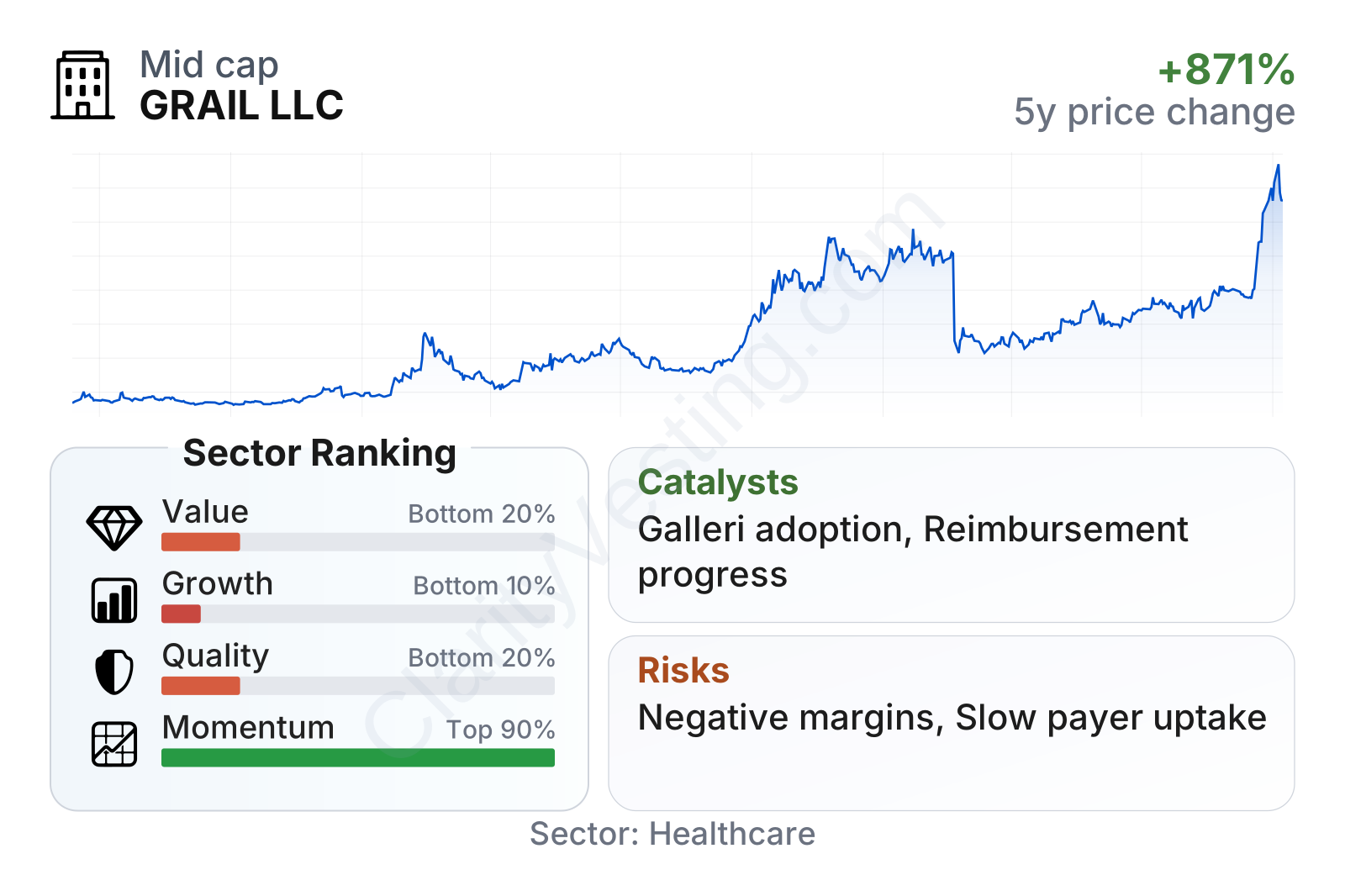
GRAIL is now a mid-sized public healthcare company by market value, but its financial profile still looks more like an early-stage growth business than an established diagnostics leader. On valuation factors, it ranks in the lower end of the healthcare peer group because profits and free cash flow remain negative. On quality metrics, returns on capital and assets are deeply below sector norms, which is typical of a company still funding commercialization and clinical expansion before achieving scale.
Growth metrics are mixed. Recent year-over-year revenue expansion is clearly above the sector median, and the multi-year rise in revenue per share is very strong. However, earnings, book value per share, and free cash flow trends remain weak, showing that sales growth has not yet translated into durable economics. Price momentum is the standout area: the stock has significantly outperformed much of the healthcare sector over the last 6 to 12 months, which suggests the market is increasingly focused on future adoption potential rather than current profitability.
Growth
GRAIL operates in a part of healthcare that attracts long-term interest: early cancer detection. This is a large potential market because cancer screening today is mostly organized one cancer at a time, while a multi-cancer blood test could eventually expand the number of people screened and help detect cancers that currently lack standard screening methods. If the approach gains wider clinical acceptance, the addressable market could be substantial.
The company’s strategy makes sense for that opportunity. It is building clinical evidence, expanding commercial access, and working to embed Galleri more deeply into healthcare systems and employer channels. For a test like this, evidence generation matters as much as sales execution. Physicians, health systems, guideline bodies, and payers usually want large-scale data before changing screening practices. That means progress may be slower than in a typical consumer health rollout, but success can become more durable if adoption is supported by strong outcomes data.
Recent revenue growth supports the idea that adoption is moving forward. Year-over-year growth has recently remained around the mid-20% range, with some quarters higher. That is well above the sector median and indicates that commercial demand is still building rather than flattening. Revenue is still modest relative to the company’s valuation, but the growth rate suggests the product is gaining traction.
Cash generation remains negative, yet the direction has improved. Trailing free cash flow has become less negative over the last year, which points to tighter spending discipline or improving operating leverage. That matters because the key question for a company like GRAIL is not only whether revenue rises, but whether each new dollar of revenue starts to absorb fixed costs and reduce the need for outside capital over time.
A major catalyst is the continued build-out of evidence around Galleri’s clinical utility and real-world adoption. New data, additional partnerships with health systems or employers, broader physician acceptance, and steps toward reimbursement can all materially expand the business opportunity. In diagnostics, reimbursement and guideline inclusion often matter more than pure scientific interest, so progress on those fronts would be especially important.
Recent company updates have also highlighted ongoing commercialization efforts, continued enrollment and follow-up in clinical programs, and broader work to support the case for multi-cancer early detection. Those developments do not remove uncertainty, but they reinforce that GRAIL is still actively pushing toward a much larger market position rather than simply maintaining a niche testing business.
Risks
This article is for informational purposes only and does not constitute financial advice. Some content is AI-generated. See Disclaimer