Stock Analysis · GPT Group (GPTGF)
Overview
GPT Group is an Australian real estate owner, manager, and developer focused on large commercial properties. Its portfolio is centered on office buildings, logistics and industrial facilities, and a smaller retail exposure. The group earns recurring income mainly from rents paid by tenants, while also generating revenue from funds management, property services, development activities, and periodic gains or losses linked to property valuations and asset sales.
Based on the company’s recent annual reporting and portfolio mix, the main economic drivers can be summarized as follows:
- Office properties: approximately 45% to 50% of portfolio exposure. This includes premium and A-grade office assets, largely in major Australian cities.
- Logistics and industrial properties: approximately 35% to 40%. This includes warehouses, distribution centers, and supply-chain related real estate.
- Retail properties: approximately 10% to 15%. This is the smallest major segment and includes shopping center interests.
- Funds management and other activities: a small share of revenue, including asset management fees, development management, and related services.
This mix matters because GPT is no longer mainly a traditional mall landlord. Over time, it has shifted toward logistics and kept a meaningful office platform, which changes both its growth profile and its risk profile. The latest operating flow also suggests that revenue has been moving upward over the last several years, while interest costs have also climbed, reflecting the heavier financing burden seen across property markets.
Key Figures
| Metric | Value | Sector ⓘ |
|---|---|---|
| Date | Oct 17, 2026 | |
| Context | ||
| Sector | Real Estate | |
| Industry | REIT - Diversified | |
| Market Cap ⓘ | $6.01B | |
| Beta ⓘ | 0.96 | |
Value (Cheapness) | ||
| P/E Ratio ⓘ | 8.49 | 17.38 |
| P/B Ratio ⓘ | 0.39 | 0.85 |
| FCF Yield ⓘ | 16.29% | 7.38% |
| Dividend Yield ⓘ | 7.74% | 4.85% |
| EBIT / EV ⓘ | N/A | 3.78% |
| PEG ⓘ | 1.93 | |
Growth (Business expansion) | ||
| Revenue Growth ⓘ | -8.20% | 5.30% |
| RPS Growth (5Y CAGR) ⓘ | 17.77% | 6.02% |
| EPS Growth (5Y CAGR) ⓘ | -32.93% | -11.37% |
| BVPS Growth (5Y CAGR) ⓘ | 8.14% | 0.45% |
| Margin Growth (5Y Trend) ⓘ | 68.93% | -0.22% |
| FCF Growth (5Y CAGR) ⓘ | 18.20% | 5.40% |
| DPS Growth (5Y CAGR) ⓘ | 7.79% | 5.02% |
Quality (Business durability) | ||
| ROIC (Latest) ⓘ | N/A | 5.69% |
| ROE (Latest) ⓘ | 13.69% | 7.56% |
| ROA (Latest) ⓘ | 8.73% | 2.85% |
| ROIC (5Y Median) ⓘ | N/A | 4.22% |
| ROE (5Y Median) ⓘ | 4.05% | 6.03% |
| ROA (5Y Median) ⓘ | 2.72% | 2.44% |
| Net Debt / EBIT (Latest) ⓘ | 2.72 | 7.59 |
| Net Debt / EBIT (5Y Median) ⓘ | N/A | 8.40 |
| Net Debt / EBITDA (Latest) ⓘ | 2.71 | 5.27 |
| Net Debt / Assets ⓘ | 31.93% | 37.76% |
| EBITDA / Interest ⓘ | 4.88 | 4.10 |
| Operating Margin (Latest) ⓘ | 97.90% | 35.29% |
| Operating Margin (5Y Median) ⓘ | 50.99% | 37.31% |
| Debt to Equity (Latest) ⓘ | 51.85% | 88.87% |
| Profit Margin (Latest) ⓘ | 106.00% | 19.61% |
| Free Cash Flow (Latest) ⓘ | $979.57M | |
Momentum (Price trend) | ||
| 3Y Return ⓘ | +48.24% | +30.75% |
| 12M Return (excl. last month) ⓘ | -0.70% | +4.36% |
| 6M Return ⓘ | +10.56% | -2.52% |
| Price vs. 200-Day MA ⓘ | +0.82% | -2.34% |
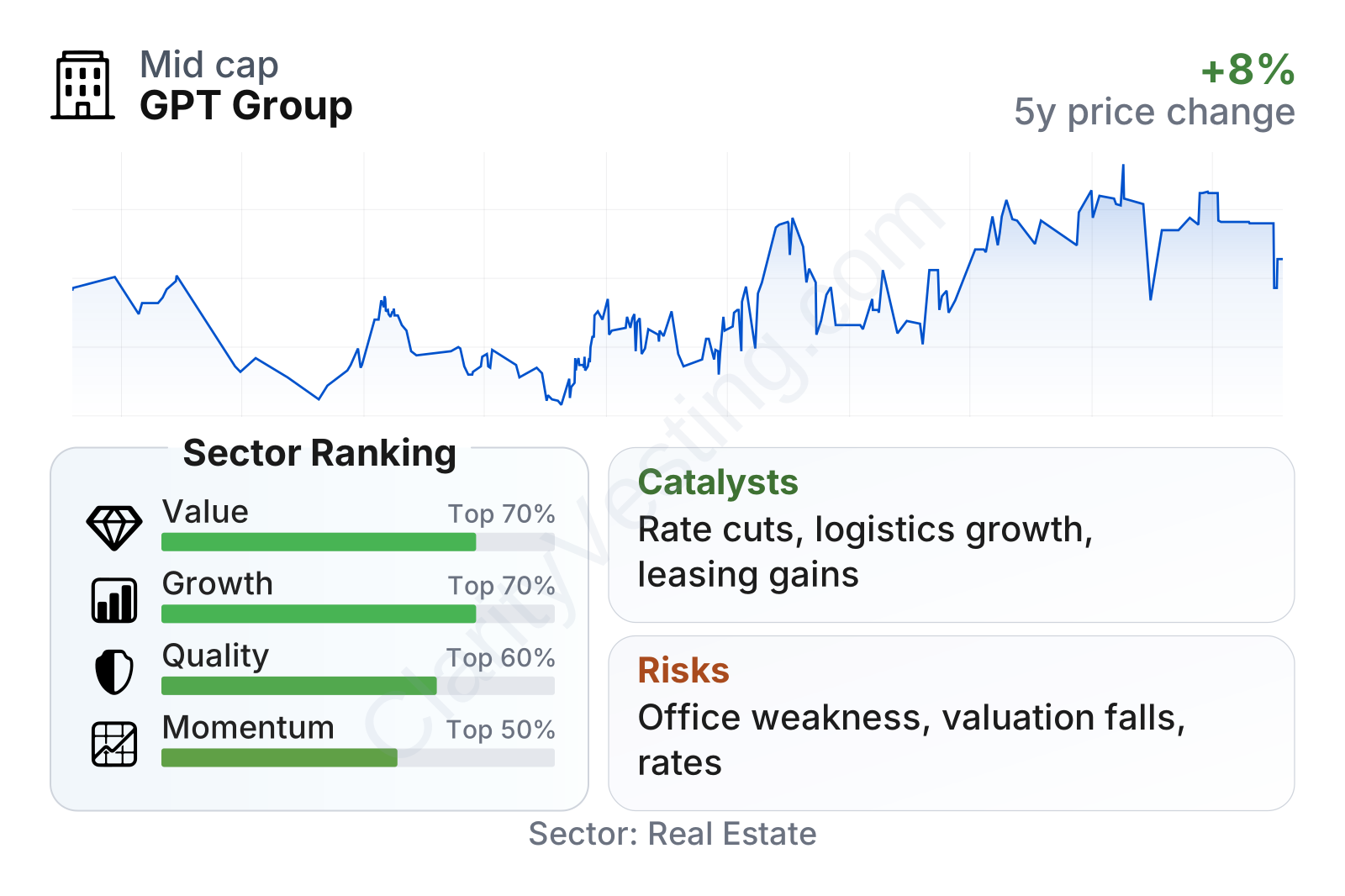
GPT Group is a mid-to-large size real estate company with a stock-market value around the mid-single-digit billions of dollars and a beta close to 1, meaning its share-price behavior has broadly moved in line with the wider market. The recent share-price pattern shows a recovery from the 2023 lows, although it remains influenced by the same interest-rate pressure that has affected many listed property companies.
The metrics table points to an unusual combination: valuation multiples are below sector norms, while balance-sheet leverage looks more conservative than many peers. Price-to-earnings and price-to-book ratios both sit well under the sector median, and the cash flow yield and dividend yield are both above typical levels in the group. On the quality side, debt metrics appear relatively contained for a REIT, with net debt to EBITDA and debt to equity below sector medians, and interest coverage slightly stronger than average.
At the same time, the growth picture is mixed. Longer-term revenue per share, free cash flow, and dividends have improved at a good pace, but the latest year-over-year revenue change is negative and earnings have been volatile. That combination is common in property businesses because profits can swing sharply with asset revaluations, financing costs, and transaction timing.
Growth
GPT operates in parts of real estate with very different prospects. Logistics is generally the most attractive segment because demand is supported by e-commerce, supply-chain modernization, and the need for well-located distribution space near major cities. Office is more complicated: prime assets in strong locations can still perform reasonably well, but the sector faces structural pressure from hybrid work, tenant downsizing, and higher incentives needed to secure leases. Retail is the most mature part of the portfolio and is no longer the central growth engine.
The company’s strategy makes the most sense where it leans into logistics development, active asset management, and capital recycling. In simple terms, capital recycling means selling lower-priority properties and redeploying money into segments with stronger long-term demand or better returns. For a real estate owner, that can be an effective way to reshape the portfolio without relying only on fresh borrowing or equity issuance.
Revenue per share has increased strongly over the last five years, which suggests GPT has been improving the economic output generated for each share over time. That is a more helpful sign than headline revenue alone because it reduces the distortion from capital raises and changing asset values. The company’s free cash flow trend also looks favorable over the same period, reinforcing the idea that operating performance has not been purely accounting-driven.
The dividend path has not been perfectly smooth, but the longer-term direction has been upward. For a property company, that matters because recurring distributions are a core part of the business model. The recent rebound in dividend per share indicates improving distributable capacity after a more difficult period for listed real estate.
A key catalyst is the possibility that lower or stabilizing interest rates ease pressure on property valuations and financing costs. Real estate companies are highly sensitive to the cost of debt and to market capitalization rates used to value buildings. If the rate backdrop becomes friendlier, logistics-led growth and a stronger transaction market could support both earnings quality and asset values. In addition, GPT’s concentration in institutional-grade Australian assets gives it access to tenants and investment partners that smaller landlords may struggle to attract.
Risks
This article is for informational purposes only and does not constitute financial advice. Some content is AI-generated. See Disclaimer


