Stock Analysis · Global Payments Inc (GPN)
Overview
Global Payments Inc is a payments technology company. In simple terms, it helps businesses accept card and digital payments, provides software for running day-to-day operations, and offers payment processing services to banks, fintechs, and other large institutions. Its products are used by merchants in stores, online, and through integrated software platforms in sectors such as restaurants, retail, education, healthcare, and business services.
The company has historically organized its business around merchant solutions, software and integrated payments, and issuer or business-to-business payment technology. Based on recent annual reporting and the business mix described by management, revenue is primarily generated from transaction-based fees and software-related income. A practical breakdown is:
- Merchant Solutions: approximately 55% to 65% of revenue. This includes payment processing for businesses, point-of-sale enablement, omnichannel commerce, fraud tools, and related services tied to card volumes.
- Software and Integrated Solutions: approximately 20% to 30% of revenue. This includes vertical-market software, embedded payments, business management tools, and recurring subscription or service revenue connected to sectors like restaurants, schools, and healthcare.
- Issuer Solutions and B2B / account services: approximately 10% to 20% of revenue. This includes services for financial institutions, card program support, and payment technology used beyond the traditional merchant checkout flow.
This is a large-scale business with global reach, but it is still best understood as a company sitting in the middle of commerce: every time a customer pays, Global Payments aims to earn a small fee, while also deepening relationships through software and integrated tools.
An important recent change is the announced plan to separate the Issuer Solutions business and acquire Worldpay. That transaction would materially reshape Global Payments, making the company more focused on merchant commerce and software while adding much larger processing scale. For long-term analysis, this means the current company is in transition rather than standing still.
The long-term operating picture shows a business that expanded revenue and gross profit through 2024, but with pressure appearing in 2025 as the portfolio changed and reported sales declined. Even so, the model remains strongly cash-generative before financing costs, with selling and administrative expense and interest expense being key items to watch.
Key Figures
| Metric | Value | Sector ⓘ |
|---|---|---|
| Date | Oct 24, 2026 | |
| Context | ||
| Sector | Industrials | |
| Industry | Specialty Business Services | |
| Market Cap ⓘ | $22.44B | |
| Beta ⓘ | 0.81 | |
Value (Cheapness) | ||
| P/E Ratio ⓘ | 39.82 | 22.29 |
| P/B Ratio ⓘ | 0.97 | 1.98 |
| FCF Yield ⓘ | 3.67% | 6.26% |
| Dividend Yield ⓘ | 1.18% | 1.92% |
| EBIT / EV ⓘ | 3.77% | 4.83% |
| PEG ⓘ | 0.21 | |
Growth (Business expansion) | ||
| Revenue Growth ⓘ | 68.60% | 9.30% |
| RPS Growth (5Y CAGR) ⓘ | 2.54% | 7.76% |
| EPS Growth (5Y CAGR) ⓘ | -9.49% | -13.17% |
| BVPS Growth (5Y CAGR) ⓘ | 1.46% | 6.13% |
| Margin Growth (5Y Trend) ⓘ | 10.64% | 0.74% |
| FCF Growth (5Y CAGR) ⓘ | -2.84% | 10.79% |
| DPS Growth (5Y CAGR) ⓘ | 2.94% | 9.41% |
Quality (Business durability) | ||
| ROIC (Latest) ⓘ | 3.13% | 10.75% |
| ROA (Latest) ⓘ | -1.71% | 5.41% |
| ROIC (5Y Median) ⓘ | 3.97% | 9.37% |
| ROA (5Y Median) ⓘ | 2.16% | 4.95% |
| Net Debt / EBIT (Latest) ⓘ | 11.12 | 2.04 |
| Net Debt / EBIT (5Y Median) ⓘ | 7.55 | 2.27 |
| Net Debt / EBITDA (Latest) ⓘ | 5.57 | 1.39 |
| Net Debt / Assets ⓘ | 26.76% | 19.27% |
| EBITDA / Interest ⓘ | 3.52 | 9.58 |
| Operating Margin (Latest) ⓘ | 15.00% | 10.49% |
| Operating Margin (5Y Median) ⓘ | 19.00% | 10.30% |
| Debt to Equity (Latest) ⓘ | 97.00% | 64.82% |
| Profit Margin (Latest) ⓘ | -9.15% | 6.67% |
| Free Cash Flow (Latest) ⓘ | $822.72M | |
Momentum (Price trend) | ||
| 3Y Return ⓘ | -22.34% | +67.77% |
| 12M Return (excl. last month) ⓘ | -0.17% | +12.05% |
| 6M Return ⓘ | +17.46% | 0.00% |
| Price vs. 200-Day MA ⓘ | +9.50% | +0.67% |
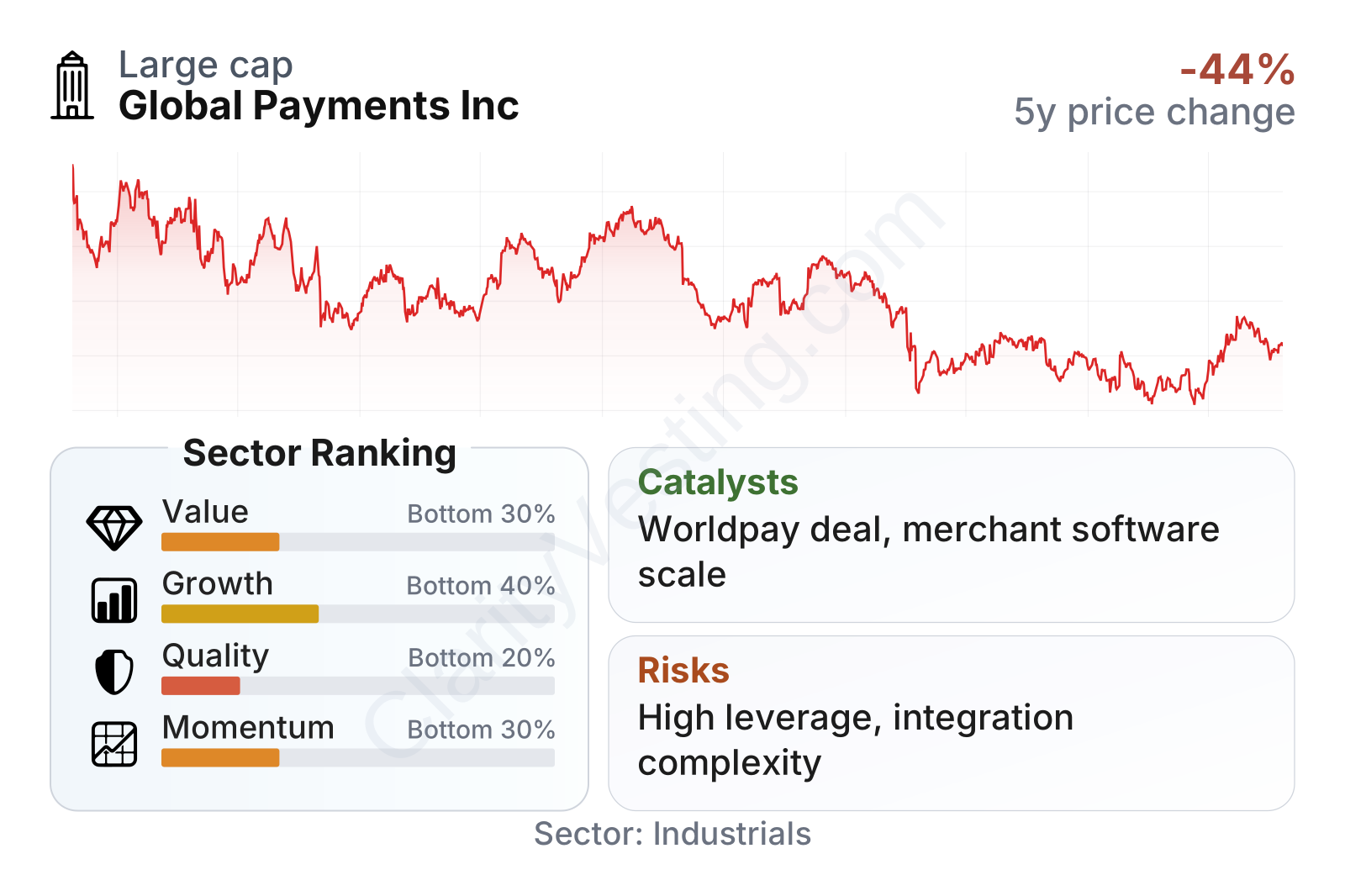
Global Payments is a large-cap company with a below-market beta, meaning its share price has historically moved somewhat less sharply than the broader market. The overall factor picture is mixed. Growth and momentum are weaker than many sector peers over longer periods, while value also screens poorly on earnings-based measures because the current P/E is elevated. At the same time, the PEG ratio is low and the price-to-book ratio sits below the sector median, which suggests the market is assigning limited value to the balance sheet and is still debating the earnings outlook. Quality metrics are the softest area, mainly because leverage is high and recent profitability has turned negative on a trailing basis.
The share price history also shows why the stock attracts debate. It traded far higher a few years ago, fell meaningfully, and has only partially recovered. More recently, momentum has improved over six months, but the longer three-year record still trails the broader sector by a wide margin.
Growth
Global Payments operates in a sector with durable long-term tailwinds. Electronic payments continue to take share from cash, commerce is becoming more digital and more integrated into software, and businesses increasingly want one provider that can combine payments, data, and workflow tools. Those trends support demand for exactly the kind of services Global Payments provides.
The company’s strategy also broadly fits where the industry is going. Payments processing on its own can become commoditized, so scale, software integration, and vertical specialization matter. Global Payments has spent years building software-led capabilities for specific end markets, which can improve customer retention and raise switching costs. The planned acquisition of Worldpay would reinforce that strategy by increasing merchant scale and broadening ecommerce and enterprise reach, while the separation of Issuer Solutions would simplify the company around merchant-focused operations.
Revenue growth has been uneven. The business delivered healthy expansion in 2021 through 2023, slowed in 2024, and then became distorted by portfolio changes and transaction timing. The latest year-over-year growth readings are unusually strong, but those numbers should be read carefully because they are influenced by comparison effects rather than purely by a clean acceleration in the core business. The more important takeaway is that Global Payments remains exposed to attractive structural growth markets, but its reported growth path has not been consistently smooth.
Cash generation is one of the more constructive parts of the profile. Free cash flow has remained meaningful, although it has fluctuated sharply from year to year. That matters because payment companies often rely on cash flow to reduce debt, repurchase shares, invest in software, and absorb integration costs after acquisitions. In Global Payments’ case, future cash deployment will be especially important because the company is entering another major portfolio reshaping phase.
A major catalyst is the expected business transformation tied to Worldpay. If integration is executed well, Global Payments could emerge with greater merchant scale, a stronger ecommerce footprint, more software cross-selling opportunities, and a simpler strategic identity. Another favorable point is that its vertical software assets give it exposure to sticky customer niches where payment acceptance is embedded into daily business workflows rather than chosen purely on price.
Risks
This article is for informational purposes only and does not constitute financial advice. Some content is AI-generated. See Disclaimer