Stock Analysis · Grupo Financiero Inbursa S.A.B. de C.V (GPFOF)
Overview
Grupo Financiero Inbursa is a Mexican financial group controlled by the Carlos Slim family. The company operates mainly through banking, insurance, pensions, brokerage, and asset management activities. In practical terms, it gathers deposits, makes loans, invests part of its balance sheet, sells insurance policies, manages retirement savings, and offers investment and brokerage services to individuals and businesses in Mexico.
Its business model is more diversified than that of a traditional regional bank because it combines lending and deposit-taking with insurance and wealth-related operations. That matters for long-term analysis because different financial activities do not always move in the same direction at the same time. Insurance income, investment returns, and banking spreads can offset each other to some extent, although they also make the group more complex to follow.
Public disclosures show that Inbursa’s revenue mix is driven mostly by financial income from banking and investment activity, with insurance-related revenue as the second major pillar and fee-based services as a smaller contribution. Exact segment percentages can vary meaningfully from year to year because financial groups recognize revenue in ways that depend on interest rates, investment gains, claims, and accounting presentation. A reasonable simplified breakdown is:
- Banking and lending-related income: approximately 55% to 70%. This includes net interest income from loans and deposits, plus returns linked to the bank’s investment portfolio.
- Insurance operations: approximately 20% to 35%. This includes premiums and investment income supporting life, auto, health, and property-related products.
- Brokerage, asset management, pensions, and other fees: approximately 5% to 15%. This includes commissions, custody, advisory, retirement savings administration, and related financial services.
One notable feature of Inbursa is that it has historically kept a conservative balance sheet compared with many peers, with relatively low leverage and strong profitability on assets. That can make the company more resilient during difficult credit periods, even if it may also limit upside when loan demand is booming.
The long-term picture shows a company that has materially expanded revenue and net income since 2021, though with some unevenness in operating line items caused by the nature of financial reporting. Administrative costs have remained controlled relative to scale, while net profit has stayed substantial, which supports the view that Inbursa is operating from a position of balance-sheet strength rather than aggressive expansion.
Key Figures
| Metric | Value | Sector ⓘ |
|---|---|---|
| Date | Nov 21, 2026 | |
| Context | ||
| Sector | Financial Services | |
| Industry | Banks - Regional | |
| Market Cap ⓘ | $14.04B | |
| Beta ⓘ | 0.07 | |
Value (Cheapness) | ||
| P/E Ratio ⓘ | 11.75 | 12.01 |
| P/B Ratio ⓘ | N/A | 1.48 |
| FCF Yield ⓘ | 6.63% | 8.77% |
| Dividend Yield ⓘ | N/A | 3.01% |
| EBIT / EV ⓘ | N/A | 8.31% |
| PEG ⓘ | N/A | |
Growth (Business expansion) | ||
| Revenue Growth ⓘ | -22.50% | 6.70% |
| RPS Growth (5Y CAGR) ⓘ | 178.50% | 12.35% |
| EPS Growth (5Y CAGR) ⓘ | -55.61% | -0.27% |
| BVPS Growth (5Y CAGR) ⓘ | 135.36% | 4.83% |
| Margin Growth (5Y Trend) ⓘ | -23.49% | -4.16% |
| FCF Growth (5Y CAGR) ⓘ | -12.80% | 4.69% |
| DPS Growth (5Y CAGR) ⓘ | 51.30% | 8.82% |
Quality (Business durability) | ||
| ROIC (Latest) ⓘ | N/A | 9.49% |
| ROE (Latest) ⓘ | 9.07% | 14.02% |
| ROA (Latest) ⓘ | 2.96% | 1.53% |
| ROIC (5Y Median) ⓘ | 9.39% | 7.80% |
| ROE (5Y Median) ⓘ | 13.27% | 12.09% |
| ROA (5Y Median) ⓘ | 4.20% | 1.28% |
| Net Debt / EBIT (Latest) ⓘ | N/A | 0.88 |
| Net Debt / EBIT (5Y Median) ⓘ | 1.54 | 0.73 |
| Net Debt / EBITDA (Latest) ⓘ | 0.30 | 0.71 |
| Operating Margin (Latest) ⓘ | N/A | 23.37% |
| Operating Margin (5Y Median) ⓘ | 33.61% | 24.29% |
| Debt to Equity (Latest) ⓘ | 15.53% | 59.34% |
| Profit Margin (Latest) ⓘ | 52.87% | 26.65% |
| Free Cash Flow (Latest) ⓘ | $930.41M | |
Momentum (Price trend) | ||
| 3Y Return ⓘ | +8.55% | +73.29% |
| 12M Return (excl. last month) ⓘ | -8.12% | +18.35% |
| 6M Return ⓘ | -7.81% | +3.24% |
| Price vs. 200-Day MA ⓘ | -2.87% | +2.17% |
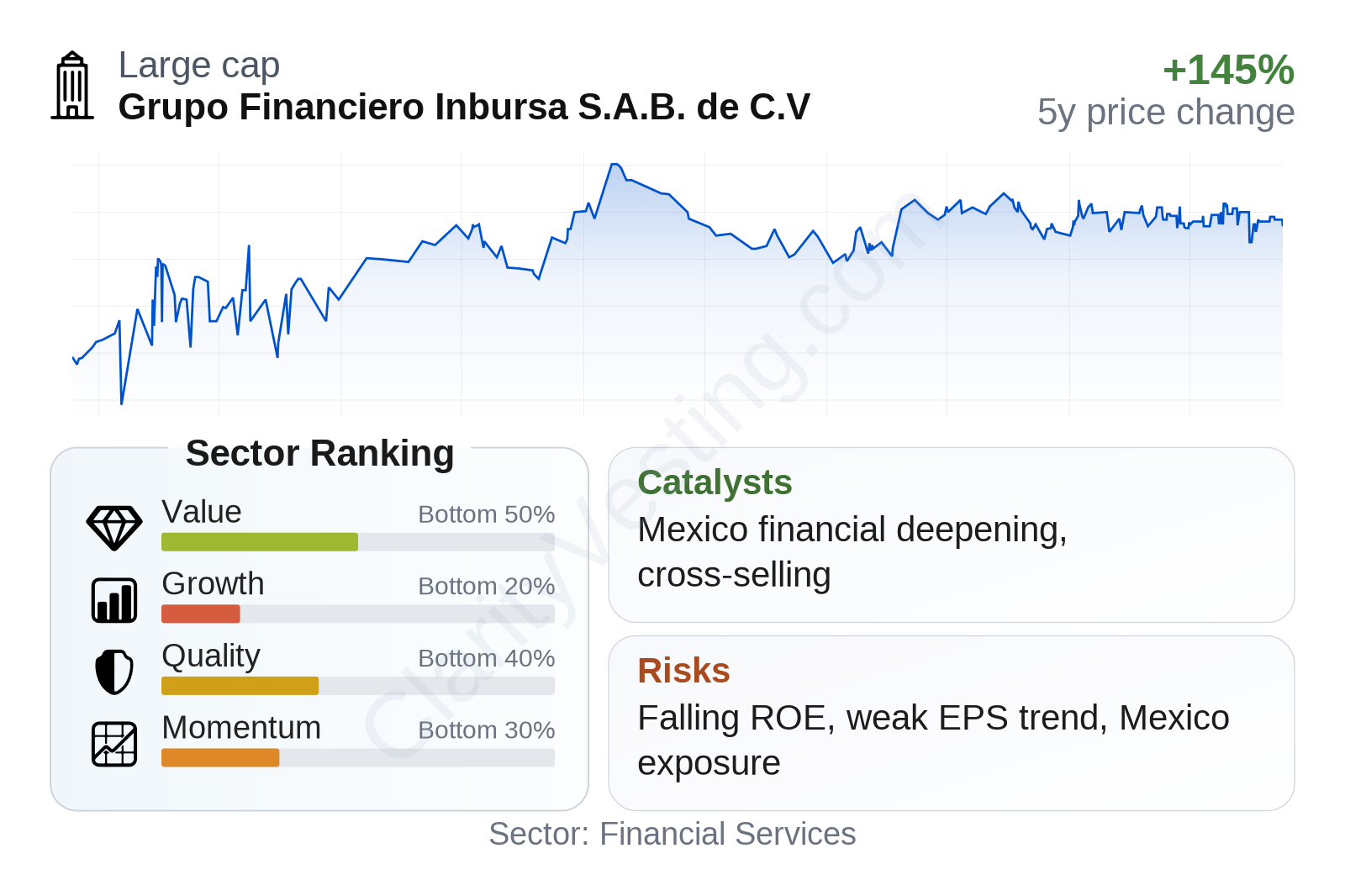
Inbursa is a large Mexican financial institution with unusually low share-price volatility, reflected in a beta close to zero. Valuation looks roughly in line with the broader banking universe on earnings, but the overall factor profile is weaker than average because recent growth and market performance have lagged. Profitability is mixed: return on equity is below the sector median, but return on assets and profit margin are clearly stronger, helped by a conservative capital structure with debt-to-equity around 16%. The absence of a current dividend yield also makes the shares stand out less on income than many financial peers.
Growth
Inbursa operates in a sector with long-term structural room for expansion. Mexico still has meaningful growth potential in banking penetration, insurance adoption, retirement savings, and formal financial services. That creates a supportive backdrop: over time, more households and businesses entering the formal financial system can enlarge the addressable market for deposits, loans, insurance, and investment products.
The company’s strategy also makes sense on paper. Its combination of banking, insurance, pensions, and brokerage allows cross-selling across a broad customer base and gives it several channels for asset gathering. The connection to large business networks associated with the Slim ecosystem can also help distribution, branding, and corporate relationships. In a country where trust and reach matter in finance, those links can be valuable.
That said, the recent growth profile is not straightforward. Revenue has been volatile, and the latest year-over-year revenue change is negative, placing the company near the bottom of the sector on that measure. At the same time, longer-term book value growth has been very strong, which is important for a financial institution because book value often reflects the accumulation of capital and earning power over time.
Earnings per share show a sharp break after 2022 and remain at a much lower level than earlier readings. That weak trend suggests either a major change in share count, accounting presentation, or profitability per share. For long-term readers, this is an area that deserves caution: a company can still grow its balance sheet and total earnings while per-share economics become less attractive.
Book value per share has risen strongly over time, although the latest jump is so large that it likely reflects a structural or accounting shift rather than ordinary year-to-year compounding alone. Even with that caveat, the broader direction points to meaningful capital accumulation. For a bank-insurance group, sustained book value growth can matter more than short-term market momentum because it helps support future lending, underwriting capacity, and investment income.
As for catalysts, an environment of stable or healthy Mexican economic activity could support loan demand, insurance sales, and fee generation. If management continues to compound book value while preserving a low-risk balance sheet, the market may eventually place more weight on asset quality and stability than on recent weak momentum. The group’s diversified model is also a potential catalyst if one business line softens while another improves.
Recent company reporting has continued to show profitability and sizable free cash generation, which supports the idea that Inbursa still has internal resources to fund growth. The more meaningful opportunity would come from converting that financial strength into better per-share earnings progression and steadier top-line expansion.
Risks
This article is for informational purposes only and does not constitute financial advice. Some content is AI-generated. See Disclaimer