Stock Analysis · Danone S.A (GPDNF)
Overview
Danone is a global food and beverage company focused on products linked to everyday nutrition and health. Its portfolio is centered on dairy and plant-based products, specialized nutrition, and bottled water. Well-known brands include Activia, Alpro, Oikos, Aptamil, Nutricia, Evian, and Volvic. Compared with many large packaged-food groups, Danone is more concentrated in health-oriented categories such as infant formula, medical nutrition, probiotics, high-protein dairy, and premium water.
The company’s revenue base is spread across three main activities. Based on recent annual reporting, the mix is approximately as follows:
- Essential Dairy and Plant-Based: about 50% of revenue. This includes yogurt, fermented dairy, creamers, coffee enhancers, plant-based drinks and foods, and protein-rich products sold under brands such as Activia, Actimel, Oikos, Alpro, and Silk.
- Specialized Nutrition: about 30% of revenue. This division includes infant formula, early life nutrition, adult medical nutrition, and products for people with specific dietary needs, mainly through Aptamil, Nutrilon, Neocate, and Nutricia.
- Waters: about 20% of revenue. This business includes bottled water and related hydration products, notably Evian, Volvic, Bonafont, and Aqua.
Geographically, Danone is broadly diversified across Europe, North America, China, and other international markets, which helps reduce dependence on a single country but also exposes the group to currency swings and uneven consumer trends.
The broader financial picture over the last several years shows a business with fairly stable sales, improving gross margin, and still-heavy spending on selling and distribution. Revenue has remained close to the high-20-billion-euro range, while profitability has been more uneven, reflecting inflation, brand investment, and changing category conditions.
One notable trend is that revenue has been relatively flat since 2022, but gross profit has held up better as input costs eased from prior peaks. That points to a business with resilient pricing power, although operating profit has not advanced as smoothly because marketing and overhead remain substantial.
Key Figures
| Metric | Value | Sector ⓘ |
|---|---|---|
| Date | Oct 17, 2026 | |
| Context | ||
| Sector | Consumer Defensive | |
| Industry | Packaged Foods | |
| Market Cap ⓘ | $42.83B | |
| Beta ⓘ | 0.20 | |
Value (Cheapness) | ||
| P/E Ratio ⓘ | 18.94 | 17.88 |
| P/B Ratio ⓘ | 2.38 | 1.29 |
| FCF Yield ⓘ | N/A | 12.39% |
| Dividend Yield ⓘ | 3.40% | 2.85% |
| EBIT / EV ⓘ | 6.26% | 6.43% |
| PEG ⓘ | 1.69 | |
Growth (Business expansion) | ||
| Revenue Growth ⓘ | 1.40% | 4.10% |
| RPS Growth (5Y CAGR) ⓘ | 2.87% | 6.18% |
| EPS Growth (5Y CAGR) ⓘ | -39.01% | -13.59% |
| BVPS Growth (5Y CAGR) ⓘ | -0.75% | 3.20% |
| Margin Growth (5Y Trend) ⓘ | -2.61% | -0.15% |
| FCF Growth (5Y CAGR) ⓘ | 2.89% | 4.10% |
| DPS Growth (5Y CAGR) ⓘ | 2.18% | 6.79% |
Quality (Business durability) | ||
| ROIC (Latest) ⓘ | N/A | 12.34% |
| ROA (Latest) ⓘ | N/A | 6.30% |
| ROIC (5Y Median) ⓘ | 7.69% | 10.49% |
| ROA (5Y Median) ⓘ | 4.04% | 5.44% |
| Net Debt / EBIT (Latest) ⓘ | N/A | 1.96 |
| Net Debt / EBIT (5Y Median) ⓘ | 3.79 | 2.35 |
| Net Debt / EBITDA (Latest) ⓘ | N/A | 1.38 |
| Net Debt / Assets ⓘ | 28.69% | 21.51% |
| EBITDA / Interest ⓘ | N/A | 9.46 |
| Operating Margin (Latest) ⓘ | N/A | 8.87% |
| Operating Margin (5Y Median) ⓘ | 12.23% | 9.53% |
| Debt to Equity (Latest) ⓘ | N/A | 72.35% |
| Profit Margin (Latest) ⓘ | 7.13% | 5.40% |
| Free Cash Flow (Latest) ⓘ | N/A | |
Momentum (Price trend) | ||
| 3Y Return ⓘ | +26.31% | +20.92% |
| 12M Return (excl. last month) ⓘ | -15.37% | +2.13% |
| 6M Return ⓘ | -14.17% | +1.26% |
| Price vs. 200-Day MA ⓘ | -17.39% | +1.39% |
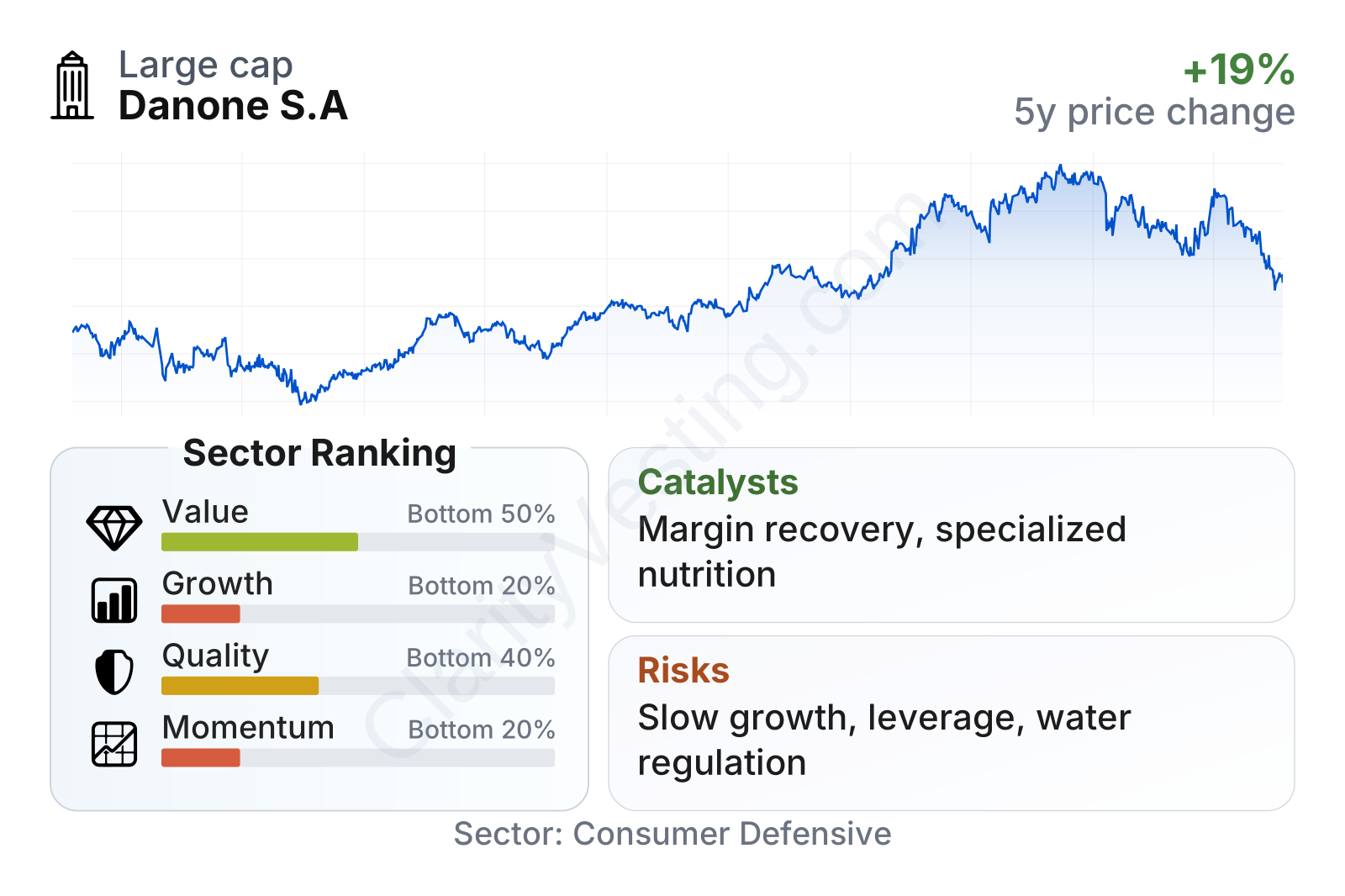
Danone is a large consumer staples company with a very low beta, which usually means its stock has moved less violently than the broader market. The valuation picture looks mixed: earnings multiples are close to the sector range, while the price-to-book ratio is clearly higher than the sector median. Income generation stands out more positively, with a dividend yield above the sector median and operating profitability that has historically been solid for a defensive food business.
The weaker area is growth. Revenue growth is modest, long-term earnings growth has been under pressure, and several multi-year growth measures rank in the lower part of the sector. Momentum has also softened recently: the share price had a strong multi-year recovery, but more recent performance has lagged the sector and sits below its longer-term trend line.
Growth
Danone operates in categories that should remain relevant over the long run. Infant nutrition, medical nutrition, protein-rich dairy, plant-based products, and healthier hydration all sit within parts of the food market supported by aging populations, health awareness, urbanization, and demand for convenience. These are not hyper-growth segments across the board, but they are generally more attractive than traditional mass-market packaged foods with limited differentiation.
The company’s strategy also has a clear logic. Danone has been pushing a mix of volume discipline, selective price increases, premiumization, product renovation, and category focus rather than trying to chase growth everywhere. That approach is especially important in specialized nutrition, where brand trust, regulatory know-how, and clinical credibility matter, and in premium water, where brand positioning can support margins.
A meaningful catalyst is the continued recovery in margins after the cost inflation shock seen across the food sector. Danone’s cost of goods sold has eased from 2022 levels, helping gross profit remain firm even with sales that have not expanded much. If that translates into steadier operating leverage, earnings could improve faster than revenue.
Another catalyst is portfolio quality. Specialized nutrition remains one of Danone’s most valuable businesses because it tends to have higher barriers to entry than standard packaged foods. The company also has room to expand premium and functional offerings in dairy and plant-based products, where consumers increasingly look for protein, digestive health, and clean-label positioning.
Recent company updates have also emphasized execution around science-based nutrition, medical nutrition, and product innovation, which fits long-term industry demand. Danone does not need explosive top-line growth to create progress; incremental gains in mix, pricing, and efficiency can still materially change earnings quality.
Risks
This article is for informational purposes only and does not constitute financial advice. Some content is AI-generated. See Disclaimer


