Stock Analysis · Structure Therapeutics Inc (GPCR)
Overview
Structure Therapeutics is a clinical-stage biotechnology company focused on developing oral, small-molecule medicines that target G protein-coupled receptors, a large class of biological targets involved in many diseases. In simple terms, the company is trying to build pill-based treatments in areas where many current drugs are injectable. Its main focus is obesity and related conditions, with additional work in other chronic diseases.
Because Structure Therapeutics is still in the clinical stage, it does not yet generate product sales from approved medicines. That has an important consequence for long-term analysis: the company’s value depends much more on research progress, clinical trial results, and future commercialization potential than on current operating revenue.
The revenue mix is therefore unusually simple at this stage.
- Product revenue: 0% — the company has no approved products on the market, so there are no recurring drug sales yet.
- Collaboration and other operating revenue: limited and not currently a meaningful recurring source — recent financial statements indicate the business is still primarily funded by cash on hand and capital raised rather than by a broad stream of commercial or licensing income.
- Interest and other non-operating income: variable, not a core business source — this can appear because biotechnology companies often hold sizable cash balances while funding development programs.
The operating structure also shows what matters most: research and development is by far the largest use of money, and it has risen sharply over the last several years as the pipeline has advanced. Selling and administrative costs are much smaller than research spending, which is typical for a company that has not yet launched a product. In other words, this is still a pipeline-driven business rather than a revenue-driven one.
The cost structure highlights a classic biotech profile: no meaningful revenue yet, rising research spending, and widening losses as clinical programs expand. That is not unusual for this type of company, but it means the investment case depends on whether the pipeline can eventually turn today’s spending into future commercial products.
Key Figures
| Metric | Value | Sector ⓘ |
|---|---|---|
| Date | Oct 24, 2026 | |
| Context | ||
| Sector | Healthcare | |
| Industry | Biotechnology | |
| Market Cap ⓘ | $1.57B | |
| Beta ⓘ | -1.37 | |
Value (Cheapness) | ||
| P/E Ratio ⓘ | N/A | 25.42 |
| P/B Ratio ⓘ | 1.18 | 3.08 |
| FCF Yield ⓘ | -14.30% | 3.12% |
| Dividend Yield ⓘ | N/A | 1.85% |
| EBIT / EV ⓘ | -17.47% | 0.56% |
| PEG ⓘ | N/A | |
Growth (Business expansion) | ||
| Revenue Growth ⓘ | N/A | 7.50% |
| RPS Growth (5Y CAGR) ⓘ | N/A | 8.60% |
| EPS Growth (5Y CAGR) ⓘ | -7.82% | -17.73% |
| BVPS Growth (5Y CAGR) ⓘ | N/A | 3.72% |
| Margin Growth (5Y Trend) ⓘ | N/A | -0.57% |
| FCF Growth (5Y CAGR) ⓘ | N/A | 0.96% |
| DPS Growth (5Y CAGR) ⓘ | N/A | 6.69% |
Quality (Business durability) | ||
| ROIC (Latest) ⓘ | -12.58% | 3.17% |
| ROA (Latest) ⓘ | -19.05% | 2.98% |
| ROIC (5Y Median) ⓘ | -14.47% | 4.56% |
| ROA (5Y Median) ⓘ | -30.91% | 1.87% |
| Net Debt / EBIT (Latest) ⓘ | N/A | 1.34 |
| Net Debt / EBIT (5Y Median) ⓘ | N/A | 1.86 |
| Net Debt / EBITDA (Latest) ⓘ | N/A | 1.00 |
| Net Debt / Assets ⓘ | -18.69% | 5.06% |
| EBITDA / Interest ⓘ | N/A | 9.55 |
| Operating Margin (Latest) ⓘ | N/A | 9.25% |
| Operating Margin (5Y Median) ⓘ | N/A | 7.33% |
| Debt to Equity (Latest) ⓘ | 0.46% | 26.68% |
| Profit Margin (Latest) ⓘ | N/A | 3.34% |
| Free Cash Flow (Latest) ⓘ | -$224.46M | |
Momentum (Price trend) | ||
| 3Y Return ⓘ | -67.52% | +51.61% |
| 12M Return (excl. last month) ⓘ | +50.96% | +19.90% |
| 6M Return ⓘ | -52.84% | +10.10% |
| Price vs. 200-Day MA ⓘ | -56.64% | +6.44% |
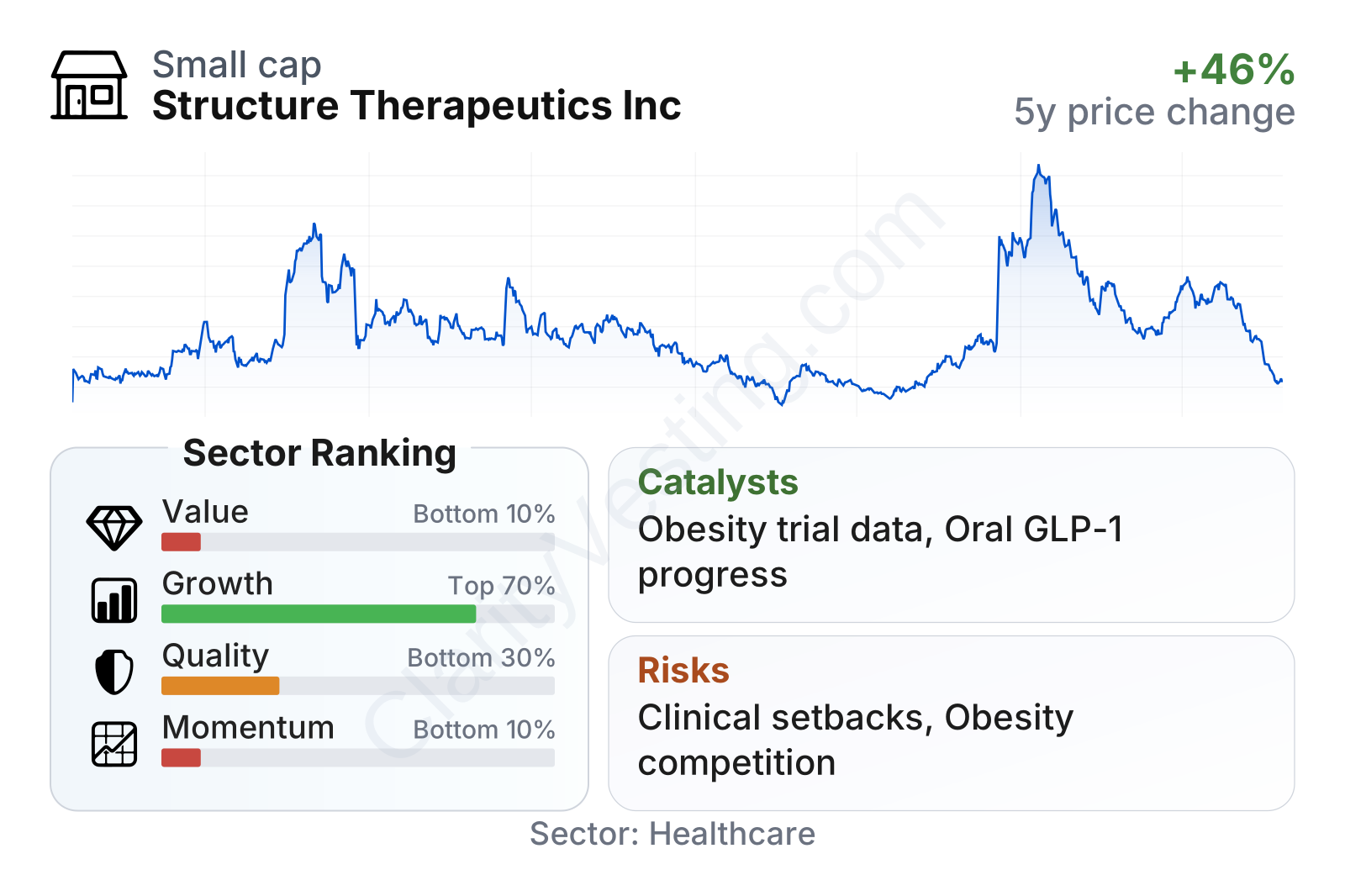
Structure Therapeutics is a mid-sized biotech by market value, with a share price history that has been very volatile. The stock has experienced large upward and downward moves in relatively short periods, which is common when valuation is tied to trial milestones rather than stable earnings. On broad factor measures, the company ranks weakly on value, quality, and momentum versus much of the healthcare sector, while its growth profile appears better than many peers mainly because the market is still looking ahead to pipeline potential rather than current profits.
The table also reflects the company’s stage of development. Profitability measures are weak, free cash flow is negative, and returns on capital are below sector norms. At the same time, the balance sheet is unusually light on debt, which gives the company more flexibility than many early-stage biotech peers.
Growth
Structure Therapeutics operates in one of the most watched areas in biotech: obesity and metabolic disease. This is a growing sector because demand is large, treatment rates remain relatively low compared with the size of the patient population, and current successful drugs have validated the market. A company attempting to bring an effective oral option into that market is addressing a very large commercial opportunity if the science works.
Its strategy is straightforward and makes sense for future growth. The company is focusing on oral GPCR-targeted medicines, especially in obesity, where a pill could be easier to distribute, store, and use than injectable therapies. If an oral medicine can deliver strong efficacy with acceptable safety, it could appeal to a broad group of patients and prescribers. That strategic positioning is the core reason the company receives attention despite having no approved products today.
A major catalyst is the clinical progress of its lead obesity program and related metabolic pipeline. In biotechnology, important milestones often come from dose-escalation updates, mid-stage efficacy results, safety readouts, and decisions about how quickly a program can move toward later-stage development. Positive signals in obesity tend to matter disproportionately because the addressable market is so large and because larger pharmaceutical companies are actively watching this category.
Cash generation is still moving in the opposite direction of maturity. Free cash flow has remained deeply negative and has worsened as development activity increased. That is consistent with a company investing aggressively in trials, but it also underlines that growth here is scientific and strategic rather than financial at this stage.
Recent company communications have continued to emphasize advancement of obesity programs and the broader oral GPCR platform. For long-term analysis, the most significant opportunity is not current income but the possibility that the company establishes clinically meaningful differentiation in a market already proven to be commercially attractive.
Risks
This article is for informational purposes only and does not constitute financial advice. Some content is AI-generated. See Disclaimer


