Stock Analysis · Gruma SAB de CV (GPAGF)
Overview
Gruma S.A.B. de C.V. is one of the world’s largest producers of corn flour, tortillas, wraps, flatbreads, and related packaged foods. The company sells both branded consumer products and ingredients used by foodservice operators, retailers, and industrial customers. Its best-known brands include Mission and Maseca. In simple terms, Gruma sits in a very basic part of the food chain: staple foods that are consumed frequently and are often inexpensive relative to household budgets.
The business is geographically diversified, with its largest presence in the United States and Mexico, and additional operations in Europe, Central America, Asia, and Oceania. That matters because demand for tortillas and flatbreads is no longer limited to traditional Mexican food consumption. Wraps, taco kits, and related products have become part of mainstream grocery demand in many countries.
Based on recent annual reporting, Gruma’s revenue mix is led by its U.S. operations, followed by Mexico, then a smaller international segment. A practical breakdown is:
- United States: about 60% of revenue. This includes tortillas, wraps, chips, and other value-added packaged products sold mainly under Mission, plus foodservice and retail distribution.
- Mexico: about 25% to 30% of revenue. This business includes corn flour under Maseca and tortilla products sold through retail and traditional channels.
- Europe, Central America, Asia, and Oceania: about 10% to 15% of revenue combined. These operations are smaller but help extend the Mission brand and the company’s manufacturing footprint.
There is also an important product mix distinction inside the company. Finished products such as tortillas and wraps usually carry higher value per unit than commodity-like flour sales, while corn flour remains strategically important because it anchors Gruma’s position in staple foods and gives it scale in raw material purchasing and processing.
Over the last few years, the business has shown a favorable earnings structure: gross profit has expanded faster than revenue in some periods, operating income has remained solid, and net income has trended upward despite currency and input-cost swings. Interest expense remains manageable relative to operating profit, which supports the view that Gruma is still fundamentally a cash-generative food manufacturer rather than a heavily financialized business.
The profit flow suggests a resilient packaged-food model. Revenue has been broadly stable recently, while margins improved compared with earlier years, indicating that pricing, product mix, and operating discipline have helped offset cost pressure.
Key Figures
| Metric | Value | Sector ⓘ |
|---|---|---|
| Date | Oct 17, 2026 | |
| Context | ||
| Sector | Consumer Defensive | |
| Industry | Packaged Foods | |
| Market Cap ⓘ | $4.70B | |
| Beta ⓘ | 0.00 | |
Value (Cheapness) | ||
| P/E Ratio ⓘ | 10.07 | 17.88 |
| P/B Ratio ⓘ | 2.12 | 1.29 |
| FCF Yield ⓘ | 8.56% | 12.39% |
| Dividend Yield ⓘ | 2.29% | 2.85% |
| EBIT / EV ⓘ | 13.71% | 6.43% |
| PEG ⓘ | 1.01 | |
Growth (Business expansion) | ||
| Revenue Growth ⓘ | 3.10% | 4.10% |
| RPS Growth (5Y CAGR) ⓘ | -47.73% | 6.18% |
| EPS Growth (5Y CAGR) ⓘ | -42.83% | -13.59% |
| BVPS Growth (5Y CAGR) ⓘ | -46.34% | 3.20% |
| Margin Growth (5Y Trend) ⓘ | 3.96% | -0.15% |
| FCF Growth (5Y CAGR) ⓘ | -45.62% | 4.10% |
| DPS Growth (5Y CAGR) ⓘ | -51.88% | 6.79% |
Quality (Business durability) | ||
| ROIC (Latest) ⓘ | N/A | 12.34% |
| ROA (Latest) ⓘ | 9.25% | 6.30% |
| ROIC (5Y Median) ⓘ | 18.18% | 10.49% |
| ROA (5Y Median) ⓘ | 11.57% | 5.44% |
| Net Debt / EBIT (Latest) ⓘ | 1.92 | 1.96 |
| Net Debt / EBIT (5Y Median) ⓘ | 1.88 | 2.35 |
| Net Debt / EBITDA (Latest) ⓘ | 1.48 | 1.38 |
| Net Debt / Assets ⓘ | 30.10% | 21.51% |
| EBITDA / Interest ⓘ | 8.30 | 9.46 |
| Operating Margin (Latest) ⓘ | 12.94% | 8.87% |
| Operating Margin (5Y Median) ⓘ | 12.46% | 9.53% |
| Debt to Equity (Latest) ⓘ | 93.88% | 72.35% |
| Profit Margin (Latest) ⓘ | 7.36% | 5.40% |
| Free Cash Flow (Latest) ⓘ | $402.04M | |
Momentum (Price trend) | ||
| 3Y Return ⓘ | -2.75% | +20.92% |
| 12M Return (excl. last month) ⓘ | -19.47% | +2.13% |
| 6M Return ⓘ | -24.46% | +1.26% |
| Price vs. 200-Day MA ⓘ | +1.92% | +1.39% |
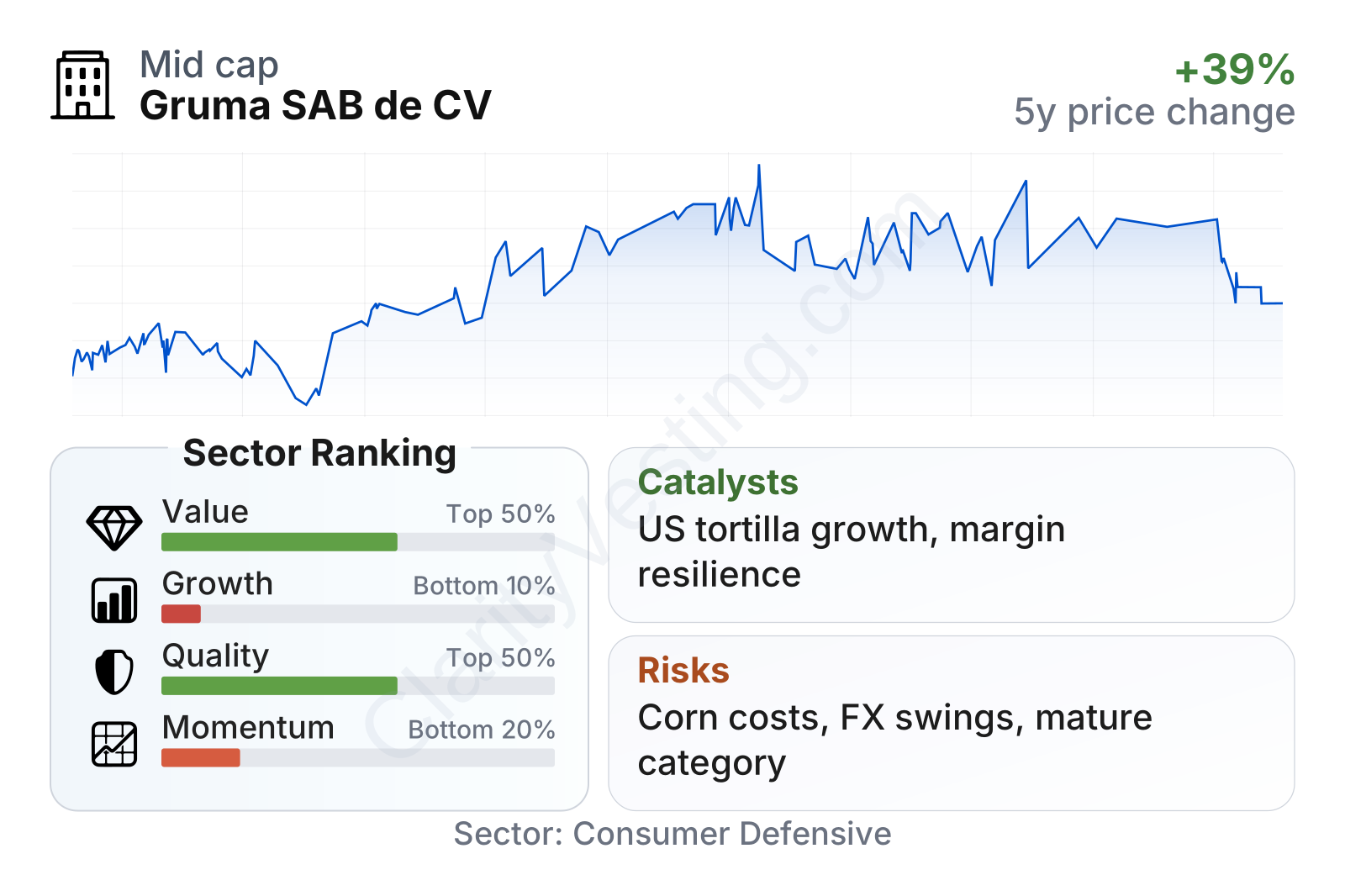
Gruma is a mid-sized defensive food company with unusually low share-price volatility in the available metrics. On valuation, it screens cheaper than the sector on earnings, while its asset multiple is somewhat richer, reflecting stronger profitability than many peers. Quality looks solid: operating margin and return on assets are above sector medians, and leverage is not excessive, although debt remains somewhat higher than the typical packaged-food company. The weak area is growth, especially on longer-term per-share trends, and recent market momentum has also lagged the sector.
Growth
Gruma operates in a sector that is mature but still capable of steady expansion. Packaged foods as a category usually does not deliver the same growth rates as technology or healthcare, but staple products can benefit from population growth, urbanization, convenience eating, and consumers shifting toward easy-to-prepare meal formats. Tortillas and wraps fit well into that pattern because they are versatile, relatively affordable, and used across many cuisines, not only Mexican food.
Its strategy for future expansion appears logical. In developed markets, especially the United States and Europe, the company can keep increasing penetration of tortillas, wraps, and related products through supermarkets and foodservice. In Mexico and other traditional markets, corn flour remains a staple category with consistent demand. This combination of staple ingredients and branded finished products gives Gruma a balanced model: stability from flour and added value from packaged foods.
Recent sales growth has clearly slowed after stronger periods earlier in the cycle. The company moved from double-digit growth phases to low single-digit change more recently, including some negative quarters before returning to modest growth. That pattern suggests Gruma is now in a normalization phase rather than a rapid expansion phase. For a long-term view, the key question is less about headline growth speed and more about whether the company can keep defending price, mix, and volumes in its core markets.
Cash generation remains one of the more important positive signals. Free cash flow has been volatile from year to year, but the latest trailing level remains meaningful for a business of this size. That supports capital spending, debt service, and dividends without requiring an aggressive financial structure. In a consumer defensive business, steady cash conversion often matters more than spectacular revenue growth.
A credible catalyst is the continued international adoption of tortilla and wrap consumption beyond traditional Hispanic markets. Another is manufacturing and distribution scale in the United States, where Mission is already a strong brand and where private-label competition has not erased Gruma’s positioning. Product innovation in healthier, high-fiber, flavored, or convenience-oriented formats can also lift mix over time. In addition, if grain-cost pressure stays under control, margins could remain stronger than the company’s historical average.
Recent company communications have also pointed to ongoing capital investments in capacity, efficiency, and distribution. For Gruma, these projects matter because they can support both cost control and shelf availability, two important drivers in a high-volume food category.
Risks
This article is for informational purposes only and does not constitute financial advice. Some content is AI-generated. See Disclaimer


