Stock Analysis · Gruma S.A.B. de C.V (GMKKY)
Overview
Gruma is a packaged foods company focused on corn flour, tortillas, flatbreads, wraps, and related staples. It is best known through brands such as Mission and Maseca. The business sells both branded consumer products through retailers and food-service channels, and industrial products such as corn flour to food manufacturers, tortilla makers, and other commercial customers. Its footprint is concentrated in Mexico and the United States, with additional operations in Europe, Central America, Asia, and Oceania.
The company’s revenue mix is mostly geographic in its public reporting. Based on recent annual reporting, the largest contributors are:
- United States operations: about 60% to 65% of consolidated revenue. This includes tortillas, wraps, flatbreads, chips, and related branded products sold mainly under Mission, plus food-service and retail distribution.
- Mexico operations: about 25% to 30% of revenue. This business is centered on corn flour under Maseca and packaged tortillas and related products for retail and commercial customers.
- Europe, Central America, Asia and Oceania: about 8% to 12% combined. These units are smaller but give Gruma an international growth platform beyond its two core markets.
By product category, tortillas and wraps are the most important growth engine in the United States, while corn flour remains a foundational earnings contributor in Mexico. That combination gives Gruma exposure to both branded convenience foods and basic staple demand. Over the last several years, revenue expanded meaningfully, and profitability improved as gross profit and net income rose faster than sales, even though 2025 showed a modest pullback from 2024’s peak.
The profit structure shows a business that has become more efficient since 2021: revenue is much higher than it was a few years ago, gross profit has expanded strongly, and net income remains well above pre-2024 levels. The slight softening in 2025 appears more like normalization after a strong 2024 than a collapse in the underlying model.
Key Figures
| Metric | Value | Sector ⓘ |
|---|---|---|
| Date | Oct 10, 2026 | |
| Context | ||
| Sector | Consumer Defensive | |
| Industry | Packaged Foods | |
| Market Cap ⓘ | $5.14B | |
| Beta ⓘ | 0.00 | |
Value (Cheapness) | ||
| P/E Ratio ⓘ | 9.51 | 17.64 |
| P/B Ratio ⓘ | 2.29 | 1.27 |
| FCF Yield ⓘ | 6.15% | 12.68% |
| Dividend Yield ⓘ | 2.45% | 2.85% |
| EBIT / EV ⓘ | 13.43% | 6.32% |
| PEG ⓘ | 1.09 | |
Growth (Business expansion) | ||
| Revenue Growth ⓘ | 3.10% | 3.85% |
| RPS Growth (5Y CAGR) ⓘ | 11.12% | 6.20% |
| EPS Growth (5Y CAGR) ⓘ | -18.52% | -14.31% |
| BVPS Growth (5Y CAGR) ⓘ | 14.53% | 3.33% |
| Margin Growth (5Y Trend) ⓘ | -231.73% | -0.17% |
| FCF Growth (5Y CAGR) ⓘ | 20.32% | 4.37% |
| DPS Growth (5Y CAGR) ⓘ | -52.38% | 6.68% |
Quality (Business durability) | ||
| ROIC (Latest) ⓘ | 17.33% | 12.58% |
| ROA (Latest) ⓘ | 9.28% | 6.32% |
| ROIC (5Y Median) ⓘ | N/A | 10.38% |
| ROA (5Y Median) ⓘ | 10.16% | 5.44% |
| Net Debt / EBIT (Latest) ⓘ | 1.47 | 1.92 |
| Net Debt / EBIT (5Y Median) ⓘ | 1.33 | 2.32 |
| Net Debt / EBITDA (Latest) ⓘ | 1.13 | 1.36 |
| Net Debt / Assets ⓘ | 22.56% | 21.29% |
| EBITDA / Interest ⓘ | 9.04 | 9.52 |
| Operating Margin (Latest) ⓘ | 12.82% | 8.88% |
| Operating Margin (5Y Median) ⓘ | 12.31% | 9.53% |
| Debt to Equity (Latest) ⓘ | N/A | 71.95% |
| Profit Margin (Latest) ⓘ | 7.36% | 5.37% |
| Free Cash Flow (Latest) ⓘ | $315.73M | |
Momentum (Price trend) | ||
| 3Y Return ⓘ | +71.53% | +18.12% |
| 12M Return (excl. last month) ⓘ | -19.56% | +2.64% |
| 6M Return ⓘ | -21.78% | +1.32% |
| Price vs. 200-Day MA ⓘ | -10.98% | +0.17% |
Gruma’s financial profile is solid in several important areas. Profitability stands above the sector median, with operating margin around 13% and profit margin around 7%, both stronger than many packaged food peers. Return on invested capital is also healthy at roughly 17%, suggesting the company has historically turned capital into earnings efficiently.
Balance-sheet risk looks controlled rather than aggressive. Net debt is a little above 1.1 times EBITDA and about 1.5 times EBIT, which is moderate for a consumer staples business. Interest coverage is near 9 times, indicating debt service is manageable under current conditions. Free cash flow is positive and meaningful for a company of this size, although free-cash-flow yield is not especially high compared with the broader sector.
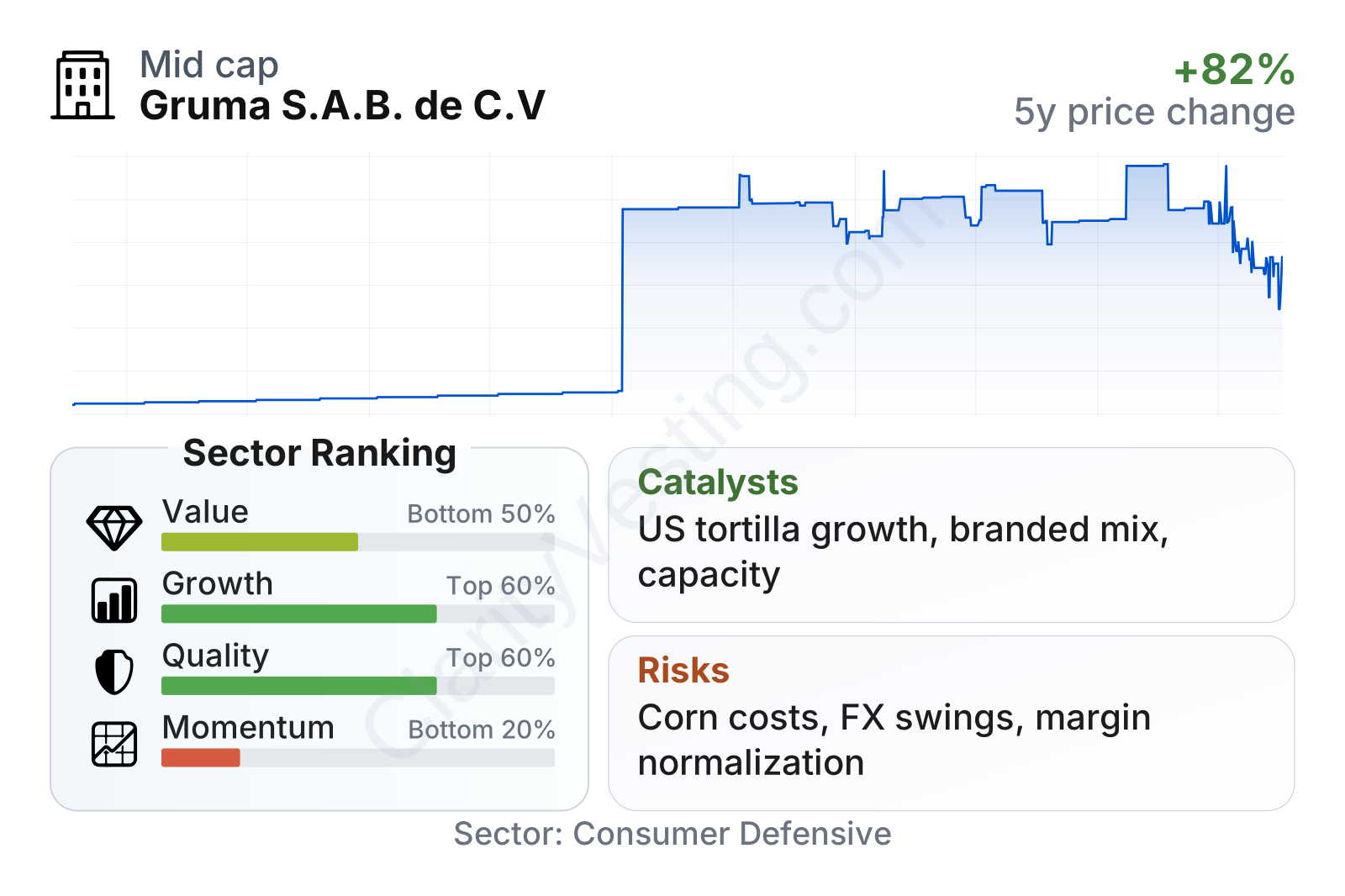
Growth metrics are mixed. Long-term revenue per share growth and free cash flow growth are clearly strong, but recent year-over-year sales growth has been more modest, around 3%. At the same time, margin trends over five years have softened from their best levels, and earnings-per-share growth over that period has been uneven. Market performance has also weakened recently: the stock had a strong multiyear run, but the last 6 to 12 months have been notably weaker than the sector.
Growth
Gruma operates in a resilient part of the food industry. Tortillas, wraps, flatbreads, and corn flour are everyday products with repeat purchasing patterns, and they also benefit from long-term convenience trends. In the United States, tortillas have steadily gained relevance as a bread alternative for sandwiches, snacks, and portable meals. That does not make the sector high-growth in the way a technology market might be, but it does support durable demand and room for gradual expansion through distribution, product innovation, and premium offerings.
The company’s strategy is coherent. It has built scale in the United States with Mission, where brand recognition, shelf space, and manufacturing reach matter. In Mexico, Maseca remains deeply embedded in a staple category. This two-part model reduces dependence on a single product format or a single country. International operations are still comparatively small, but they create optionality if tortilla and flatbread consumption continues spreading outside North America.
A meaningful catalyst is Gruma’s ability to keep shifting its mix toward branded and value-added products rather than relying only on commodity-like flour sales. Branded products generally carry better margins and stronger customer loyalty. Capacity expansion, wider retail penetration, and new product launches in wraps, healthier formulations, and convenience-oriented foods could support that shift further.
Another positive factor is operational consistency. The company has shown that it can turn revenue into cash and maintain above-sector profitability while keeping leverage under control. That matters in food manufacturing, where raw material swings can otherwise erase gains quickly. If inflation in inputs remains manageable, Gruma has room to protect margins better than less efficient competitors.
Recent corporate updates have also pointed to continued investment in production capacity and product availability across key markets. For a company selling staples, these projects are less about dramatic transformation and more about supporting steady volume growth, service levels, and market share retention in categories where scale matters.
Risks
This article is for informational purposes only and does not constitute financial advice. Some content is AI-generated. See Disclaimer


