Stock Analysis · Globus Medical (GMED)
Overview
Globus Medical is a medical device company focused on musculoskeletal care. In simple terms, it sells products and systems used by surgeons to treat spine conditions, orthopedic injuries, and certain brain-related conditions that require precise navigation or monitoring in the operating room. Its business combines implants, instruments, enabling technologies, and procedural support tools used mainly in hospitals and surgery centers.
The company became meaningfully larger and broader after its combination with NuVasive, which expanded its scale in spine surgery and added more international reach. Today, Globus Medical is best understood as a spine-focused device maker that is also building a wider platform in orthopedic trauma, robotics, navigation, and imaging.
Based on recent company reporting, revenue is mainly generated from procedural products and enabling technologies, with spine remaining the core contributor. A simplified breakdown is:
- Spine products and procedures: approximately 75% to 80% of revenue. This includes spinal implants, fixation systems, biologics, interbody devices, and instruments used in spinal fusion and related procedures.
- Enabling technologies: approximately 10% to 15% of revenue. This includes imaging, navigation, robotics, and other technology platforms that help surgeons plan and perform procedures with more precision.
- Trauma, orthopedic, and other musculoskeletal solutions: approximately 10% to 15% of revenue. This includes fracture management and adjacent orthopedic offerings outside the company’s core spine franchise.
- Geographically, the United States remains the dominant market, with international revenue representing a smaller but growing share following the NuVasive integration.
The overall financial profile shows a business that has become much larger in the last few years, while preserving strong gross profitability and improving operating earnings as integration work advances. Selling and administrative costs are still substantial, which is typical in medical devices because surgeon training, direct sales coverage, and hospital relationships are critical to winning procedures.
The long-term trend is clear: revenue has expanded sharply since the NuVasive combination, gross profit has scaled with it, and operating income improved strongly in the most recent full year shown. That suggests the enlarged platform is starting to convert scale into better earnings rather than just higher sales.
Key Figures
| Metric | Value | Sector ⓘ |
|---|---|---|
| Date | Oct 24, 2026 | |
| Context | ||
| Sector | Healthcare | |
| Industry | Medical Devices | |
| Market Cap ⓘ | $10.56B | |
| Beta ⓘ | 0.96 | |
Value (Cheapness) | ||
| P/E Ratio ⓘ | 20.17 | 25.42 |
| P/B Ratio ⓘ | 2.37 | 3.08 |
| FCF Yield ⓘ | 7.11% | 3.12% |
| Dividend Yield ⓘ | N/A | 1.85% |
| EBIT / EV ⓘ | 7.04% | 0.56% |
| PEG ⓘ | 1.73 | |
Growth (Business expansion) | ||
| Revenue Growth ⓘ | 5.90% | 7.50% |
| RPS Growth (5Y CAGR) ⓘ | 23.37% | 8.60% |
| EPS Growth (5Y CAGR) ⓘ | 4.71% | -17.73% |
| BVPS Growth (5Y CAGR) ⓘ | 18.67% | 3.72% |
| Margin Growth (5Y Trend) ⓘ | 0.41% | -0.57% |
| FCF Growth (5Y CAGR) ⓘ | 27.99% | 0.96% |
| DPS Growth (5Y CAGR) ⓘ | N/A | 6.69% |
Quality (Business durability) | ||
| ROIC (Latest) ⓘ | 11.59% | 3.17% |
| ROA (Latest) ⓘ | 10.12% | 2.98% |
| ROIC (5Y Median) ⓘ | 9.92% | 4.56% |
| ROA (5Y Median) ⓘ | 8.20% | 1.87% |
| Net Debt / EBIT (Latest) ⓘ | -0.60 | 1.34 |
| Net Debt / EBIT (5Y Median) ⓘ | -0.67 | 1.86 |
| Net Debt / EBITDA (Latest) ⓘ | -0.42 | 1.00 |
| Net Debt / Assets ⓘ | -7.23% | 5.06% |
| EBITDA / Interest ⓘ | N/A | 9.55 |
| Operating Margin (Latest) ⓘ | 21.14% | 9.25% |
| Operating Margin (5Y Median) ⓘ | 20.34% | 7.33% |
| Debt to Equity (Latest) ⓘ | 2.33% | 26.68% |
| Profit Margin (Latest) ⓘ | 17.03% | 3.34% |
| Free Cash Flow (Latest) ⓘ | $750.59M | |
Momentum (Price trend) | ||
| 3Y Return ⓘ | +61.96% | +51.61% |
| 12M Return (excl. last month) ⓘ | +32.35% | +19.90% |
| 6M Return ⓘ | -14.04% | +10.10% |
| Price vs. 200-Day MA ⓘ | -2.59% | +6.44% |
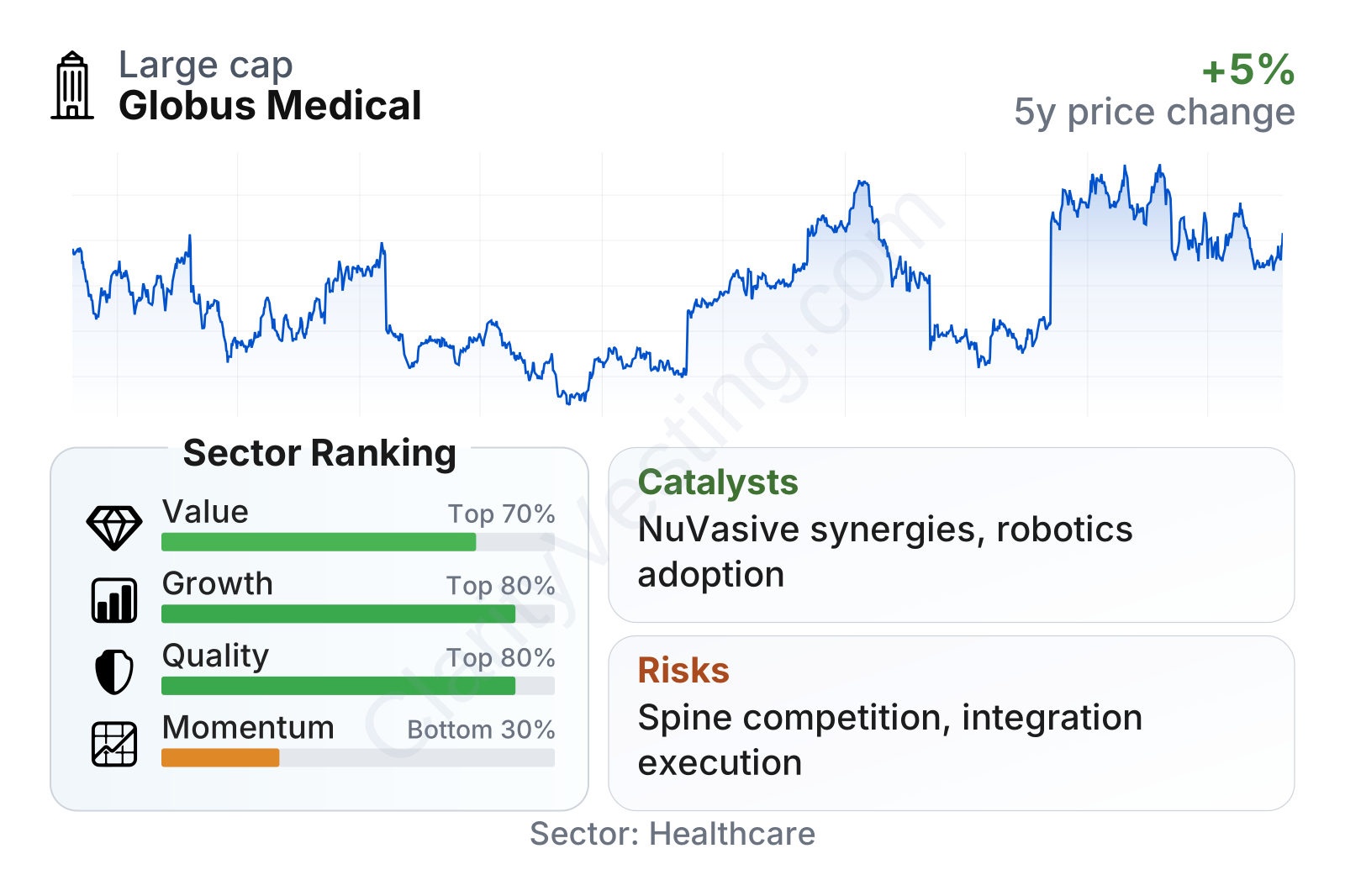
Globus Medical stands out as a mid-to-large medical device company with a relatively calm trading profile, as its beta sits close to the broader market. On valuation, profitability, and balance sheet strength, the company compares well with much of the healthcare equipment group. The most notable strengths are cash generation, returns on capital, and very low leverage. The weaker area is recent market momentum, as the stock has pulled back from earlier highs even though the underlying business metrics remain solid.
Growth
Globus Medical operates in a healthcare segment with durable long-term demand drivers. Spine and orthopedic procedures benefit from aging populations, degenerative conditions, obesity-related musculoskeletal issues, and the continued need for surgical treatment when conservative care is not enough. This is not a fast-changing consumer market; it is a procedure-driven market where innovation, surgeon relationships, and hospital economics matter over many years.
The company’s strategy appears coherent for future growth because it is not relying on a single product. It is building a broader ecosystem around procedures: implants, biologics, instruments, navigation, imaging, and robotics. That matters because hospitals and surgeons increasingly value integrated solutions that can improve workflow, reduce operating room complexity, and support more standardized outcomes. A company that can provide both the implant and the operating-room technology can deepen customer ties and potentially gain more revenue per procedure.
Revenue growth has been volatile over the last few years, but that needs context. The very large growth spikes were heavily influenced by the NuVasive transaction, which changed the company’s size overnight. More recently, growth has normalized into a much more moderate range. That makes the current phase easier to analyze: the key question is no longer whether the merger increased scale, but whether the combined company can keep winning procedures and gain efficiency. So far, the answer looks reasonably constructive, with recent annual comparisons still positive even after the acquisition effect faded.
Cash generation is one of the more compelling parts of the picture. Free cash flow has increased sharply from earlier levels, which suggests the larger platform is translating into real financial flexibility. That flexibility can support research and development, bolt-on acquisitions, product launches, manufacturing investment, and balance sheet resilience without heavy dependence on external financing.
A major catalyst is the integration of Globus Medical and NuVasive. If management continues to consolidate operations, improve commercial execution, and cross-sell products through a larger sales network, earnings growth can outpace revenue growth. Another catalyst is adoption of enabling technologies such as imaging, navigation, and robotic assistance, where hospitals may increasingly favor companies that combine hardware, software, and implants into one offering.
Recent company communications have also emphasized product innovation and procedural expansion, including efforts in advanced spine technologies and adjacent musculoskeletal categories. For a long-term business case, that matters because spine is a large market, but adjacency can reduce reliance on a narrower procedure set over time.
Risks
This article is for informational purposes only and does not constitute financial advice. Some content is AI-generated. See Disclaimer


