Stock Analysis · Grupo México S.A.B. de C.V (GMBXF)
Overview
Grupo México is a large Latin American industrial group with three main businesses: mining, transportation, and infrastructure. It is best known for copper production through Southern Copper, but it also operates railroads in Mexico and runs infrastructure projects such as roads, energy, and related concessions. For readers looking at the business in simple terms, this is mainly a copper-centered company supported by rail assets and a smaller infrastructure arm.
The company’s largest economic engine is mining. Public company materials show that copper dominates results, with additional exposure to molybdenum, silver, zinc, and sulfuric acid. Transportation, mainly through freight rail concessions, adds a second important cash-generating business, while infrastructure remains the smallest segment.
Based on recent annual reporting, the revenue mix is approximately:
- Mining: about 75% to 80% of revenue. This includes copper as the main product, plus by-products such as molybdenum, silver, zinc, and sulfuric acid.
- Transportation: about 15% to 20% of revenue. This primarily includes freight rail services in Mexico, moving industrial goods, containers, agricultural products, minerals, and automotive cargo.
- Infrastructure: about 3% to 7% of revenue. This includes engineering, construction, roads, energy-related assets, and concession-based projects.
This structure matters because it gives Grupo México more diversification than a pure mining company, but the investment case still depends heavily on copper prices, mining output, and the operating performance of Southern Copper.
Over the last several years, revenue has generally expanded while operating costs have remained relatively controlled, helping preserve very strong operating income. Net income has been more uneven than operating profit, which suggests taxes and other non-operating items can materially affect bottom-line results even when the underlying business remains solid.
Key Figures
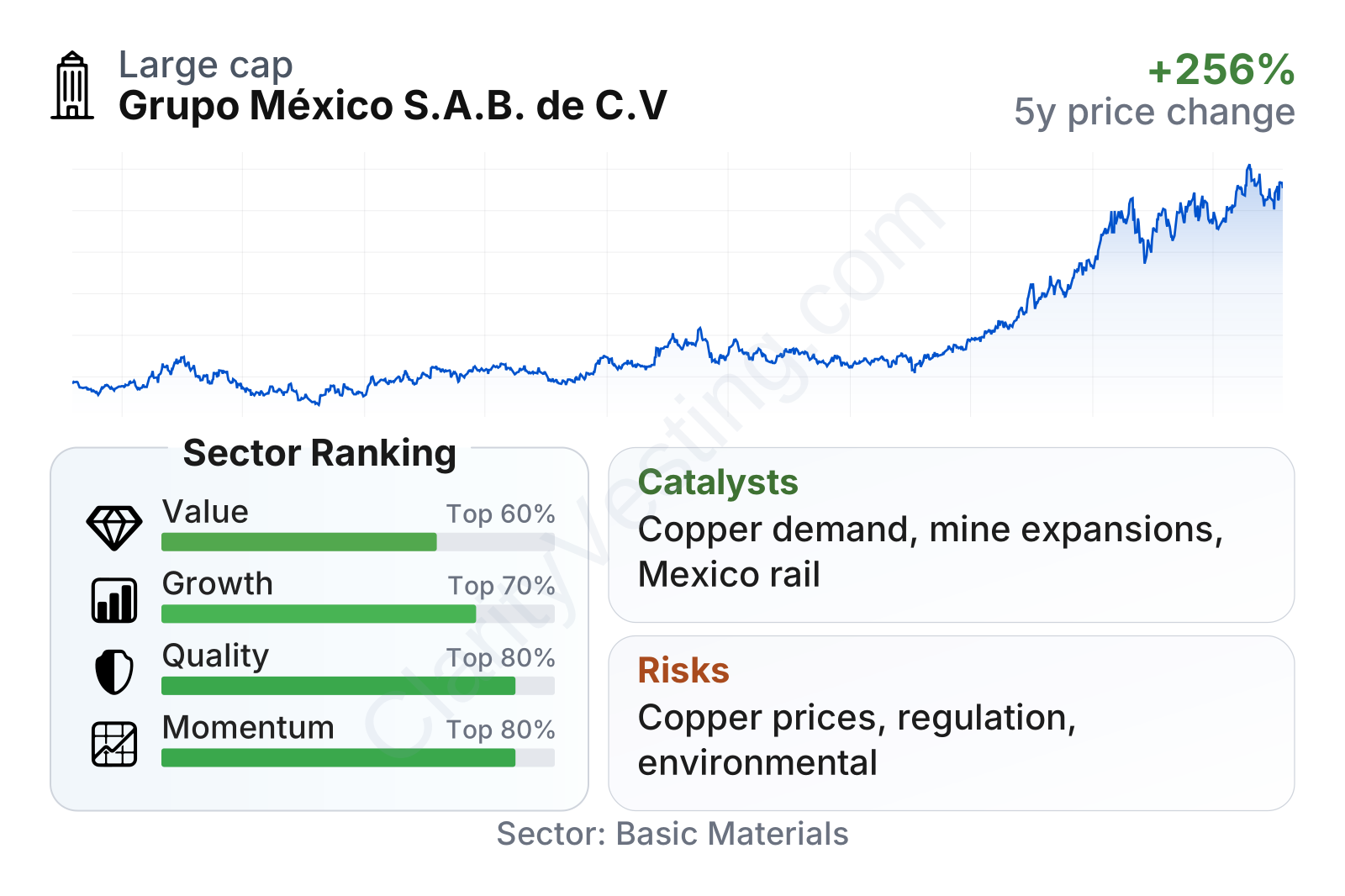
The share price has risen sharply over the last few years, especially from 2025 into 2026. That signals a major re-rating by the market and raises the importance of checking whether operating performance has improved enough to support that move.
| Metric | Value | Sector ⓘ |
|---|---|---|
| Date | Oct 17, 2026 | |
| Context | ||
| Sector | Basic Materials | |
| Industry | Other Industrial Metals & Mining | |
| Market Cap ⓘ | $104.23B | |
| Beta ⓘ | 1.05 | |
Value (Cheapness) | ||
| P/E Ratio ⓘ | 15.67 | 16.90 |
| P/B Ratio ⓘ | 4.68 | 1.65 |
| FCF Yield ⓘ | 5.59% | 5.76% |
| Dividend Yield ⓘ | 2.77% | 2.13% |
| EBIT / EV ⓘ | 11.93% | 6.30% |
| PEG ⓘ | 8.19 | |
Growth (Business expansion) | ||
| Revenue Growth ⓘ | 35.00% | 11.10% |
| RPS Growth (5Y CAGR) ⓘ | 7.32% | 4.49% |
| EPS Growth (5Y CAGR) ⓘ | 5.23% | -13.47% |
| BVPS Growth (5Y CAGR) ⓘ | 6.48% | 5.51% |
| Margin Growth (5Y Trend) ⓘ | -0.51% | -1.54% |
| FCF Growth (5Y CAGR) ⓘ | -10.89% | 0.37% |
| DPS Growth (5Y CAGR) ⓘ | -5.98% | 6.08% |
Quality (Business durability) | ||
| ROIC (Latest) ⓘ | N/A | 9.26% |
| ROA (Latest) ⓘ | 15.44% | 4.91% |
| ROIC (5Y Median) ⓘ | 20.17% | 7.70% |
| ROA (5Y Median) ⓘ | 12.57% | 3.86% |
| Net Debt / EBIT (Latest) ⓘ | 0.15 | 1.40 |
| Net Debt / EBIT (5Y Median) ⓘ | 0.42 | 1.70 |
| Net Debt / EBITDA (Latest) ⓘ | 0.14 | 0.95 |
| Net Debt / Assets ⓘ | 3.92% | 13.69% |
| EBITDA / Interest ⓘ | 19.78 | 12.34 |
| Operating Margin (Latest) ⓘ | 55.72% | 13.20% |
| Operating Margin (5Y Median) ⓘ | 45.06% | 11.80% |
| Debt to Equity (Latest) ⓘ | 47.64% | 40.56% |
| Profit Margin (Latest) ⓘ | 30.99% | 6.43% |
| Free Cash Flow (Latest) ⓘ | $5.83B | |
Momentum (Price trend) | ||
| 3Y Return ⓘ | +246.55% | +68.89% |
| 12M Return (excl. last month) ⓘ | +77.52% | +30.21% |
| 6M Return ⓘ | +11.29% | -4.16% |
| Price vs. 200-Day MA ⓘ | +10.63% | -1.27% |
Grupo México stands out for quality and profitability. Returns on assets and long-term returns on invested capital are far above sector norms, while leverage measured against earnings remains very low. Growth has also been better than much of the sector, especially in recent revenue trends. The more mixed area is cash generation consistency: free cash flow has been positive and sizable, but its five-year trend has been less steady than revenue and accounting earnings. Valuation is not stretched on earnings or enterprise value versus EBIT relative to peers, although the price-to-book ratio is clearly richer than the sector median.
Growth
Grupo México operates in a sector with long-term support from electrification, grid investment, renewable power buildout, electric vehicles, and general industrial demand. Copper is one of the central materials behind these trends, so the company is positioned in a market that has structural growth characteristics even if yearly pricing remains cyclical.
The company’s strategy also makes industrial sense. Its mining business benefits from large-scale, long-life assets, and management has continued investing in expansions and production capacity. The transportation division adds a more stable service business, which can soften part of the volatility that comes from commodity prices. Infrastructure is smaller, but it can still add optionality over time through concessions and project development.
Recent top-line momentum has been strong. Revenue growth turned clearly higher through late 2025 and remained elevated in early 2026, well above the sector median. That suggests the business is currently benefiting from a favorable combination of pricing, volume, or both. It also helps explain why market performance has been strong recently.
Cash generation has stayed positive at a multibillion-dollar level, although it has not moved in a straight line. That is normal for capital-intensive companies, especially miners that must keep investing in equipment, mine development, and expansion projects. The key point is that Grupo México still converts a meaningful portion of its earnings into cash, giving it room to fund projects, service debt, and continue distributions.
A notable catalyst is copper itself. If global supply remains tight while energy transition demand continues rising, large low-cost producers are in a favorable position. Grupo México also has scale advantages through Southern Copper, which owns reserves and expansion opportunities in Peru and Mexico. On the transportation side, nearshoring in Mexico can support freight rail demand over time by increasing manufacturing and cross-border industrial activity.
Recent company communications have also pointed to ongoing project execution and production initiatives in mining and infrastructure. For a group of this size, even moderate operational improvements can have a large effect on earnings because margins are already high.
Risks
This article is for informational purposes only and does not constitute financial advice. Some content is AI-generated. See Disclaimer


