Stock Analysis · Monte Rosa Therapeutics Inc (GLUE)
Overview
Monte Rosa Therapeutics is a clinical-stage biotechnology company focused on a newer drug discovery approach called targeted protein degradation. In simple terms, instead of trying to block a harmful protein, the company aims to mark that protein for destruction inside the cell. Its research platform, often described by the company as a molecular glue degrader platform, is being used to develop medicines mainly for cancer and autoimmune or inflammatory diseases.
Because Monte Rosa is still in the development stage, it does not generate recurring product sales from approved drugs. Its revenue comes primarily from collaboration and license agreements with larger pharmaceutical companies, along with related research support and milestone payments when programs advance.
The revenue mix appears concentrated in partnership-related sources rather than diversified commercial sales. Based on recent annual results, the main sources are approximately:
- Collaboration and license revenue: about 100% of total revenue. This includes upfront payments recognized over time, research funding from partners, and milestone-related revenue tied to development progress.
- Product revenue: 0%. The company does not currently have an approved product on the market.
- Other revenue: minimal to none disclosed as a separate meaningful category.
This business model is common in biotech: the company spends heavily on research for years, while revenue can move sharply from one period to another depending on accounting recognition and the timing of partnership milestones. A notable recent shift is that revenue was essentially absent in earlier years, then became meaningful in 2024 and 2025 as collaborations started to contribute at a much larger scale.
The cost structure is also typical for an early biotech company. Research and development is the largest expense by far, well ahead of general and administrative costs, showing that most spending is directed toward building the drug pipeline rather than supporting a large commercial organization.
The business has clearly moved from a pre-revenue profile to a partnership-funded development model, but it remains dependent on external deals and pipeline progress rather than steady end-market demand.
Key Figures
| Metric | Value | Sector ⓘ |
|---|---|---|
| Date | Oct 17, 2026 | |
| Context | ||
| Sector | Healthcare | |
| Industry | Biotechnology | |
| Market Cap ⓘ | $1.02B | |
| Beta ⓘ | 1.50 | |
Value (Cheapness) | ||
| P/E Ratio ⓘ | N/A | 24.79 |
| P/B Ratio ⓘ | 1.97 | 3.08 |
| FCF Yield ⓘ | -7.01% | 3.15% |
| Dividend Yield ⓘ | N/A | 1.94% |
| EBIT / EV ⓘ | -38.10% | 0.57% |
| PEG ⓘ | N/A | |
Growth (Business expansion) | ||
| Revenue Growth ⓘ | -61.30% | 7.45% |
| RPS Growth (5Y CAGR) ⓘ | N/A | 8.61% |
| EPS Growth (5Y CAGR) ⓘ | -22.52% | -17.81% |
| BVPS Growth (5Y CAGR) ⓘ | -16.93% | 3.72% |
| Margin Growth (5Y Trend) ⓘ | N/A | -0.62% |
| FCF Growth (5Y CAGR) ⓘ | -20.57% | 1.04% |
| DPS Growth (5Y CAGR) ⓘ | N/A | 6.77% |
Quality (Business durability) | ||
| ROIC (Latest) ⓘ | -34.38% | 3.24% |
| ROA (Latest) ⓘ | -27.88% | 3.01% |
| ROIC (5Y Median) ⓘ | -27.20% | 4.60% |
| ROA (5Y Median) ⓘ | -30.62% | 1.89% |
| Net Debt / EBIT (Latest) ⓘ | N/A | 1.34 |
| Net Debt / EBIT (5Y Median) ⓘ | N/A | 1.84 |
| Net Debt / EBITDA (Latest) ⓘ | N/A | 1.00 |
| Net Debt / Assets ⓘ | -7.49% | 5.45% |
| EBITDA / Interest ⓘ | N/A | 9.64 |
| Operating Margin (Latest) ⓘ | -570.80% | 9.27% |
| Operating Margin (5Y Median) ⓘ | N/A | 7.38% |
| Debt to Equity (Latest) ⓘ | 7.80% | 28.58% |
| Profit Margin (Latest) ⓘ | N/A | 3.59% |
| Free Cash Flow (Latest) ⓘ | -$71.31M | |
Momentum (Price trend) | ||
| 3Y Return ⓘ | +149.12% | +42.80% |
| 12M Return (excl. last month) ⓘ | +198.13% | +18.50% |
| 6M Return ⓘ | -34.42% | +7.57% |
| Price vs. 200-Day MA ⓘ | -38.21% | +5.12% |
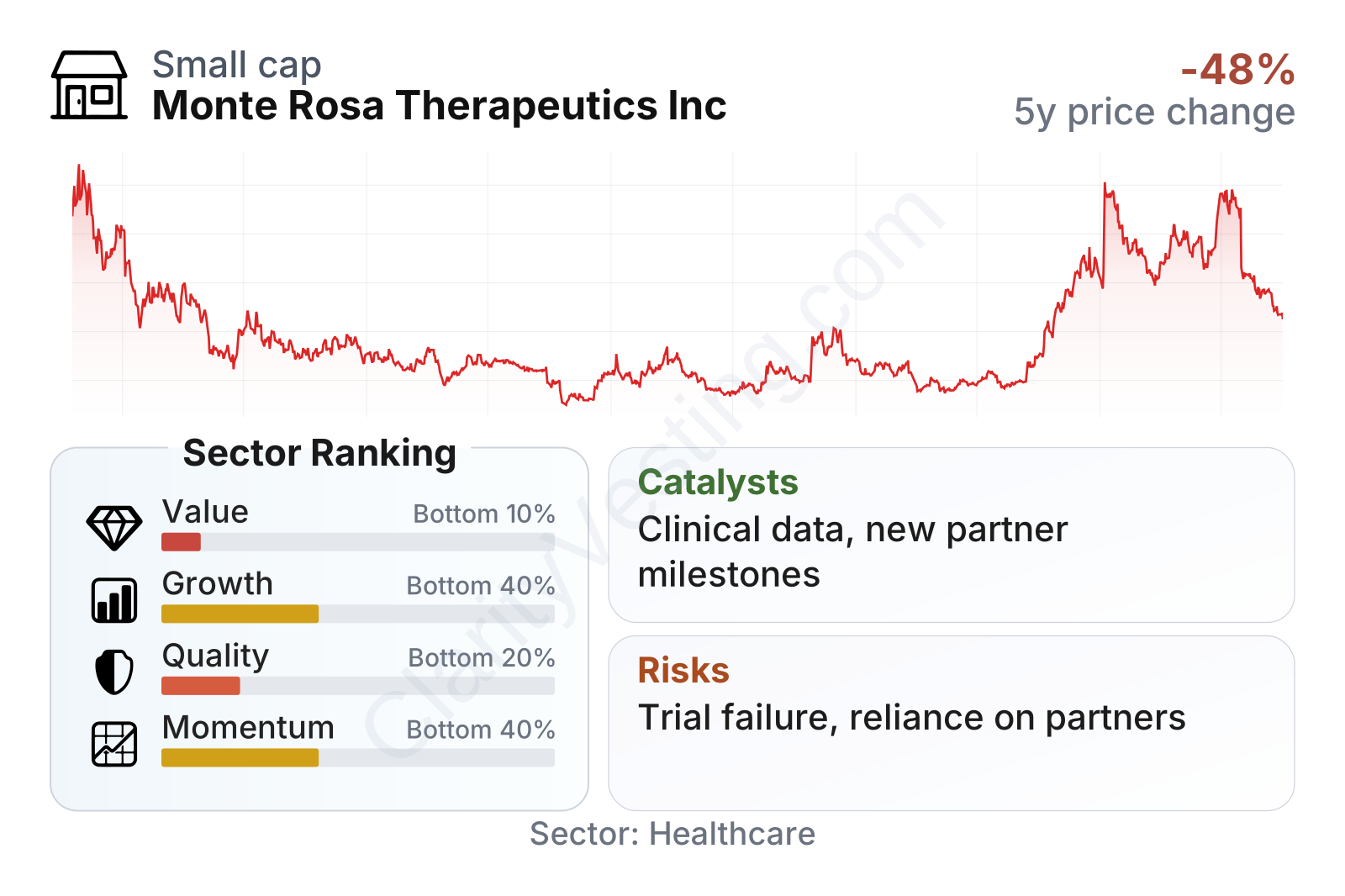
Monte Rosa remains a small biotechnology company by market value, with share-price behavior that has been volatile even by sector standards. The stock has produced strong gains over a multi-year view, but shorter-term trading has been uneven, which is common for companies whose valuation depends heavily on clinical updates and partnership news.
The overall factor profile is weak on traditional fundamentals. Value, quality, and growth rank in the lower part of the healthcare universe, largely because the company is still loss-making and cash flow is negative. One relative bright spot is the balance sheet: leverage is low, and book value is not stretched versus much of the biotech sector. That does not make the company financially strong in the conventional sense, but it does mean the capital structure is less burdened by debt than many peers.
Growth
Monte Rosa operates in a part of biotechnology that still attracts significant industry interest. Targeted protein degradation is considered one of the more promising drug discovery areas because it may reach disease-driving proteins that are hard to treat with conventional medicines. If this field continues to mature, companies with differentiated chemistry and validated biological targets could benefit from both licensing demand and pipeline expansion.
The company’s strategy is logical for that backdrop. Rather than trying to build a broad commercial operation too early, it is using partnerships to help fund expensive research while advancing a focused internal pipeline. That can be an efficient approach for a clinical-stage biotech, especially when platform technology is still being validated.
Revenue growth, however, needs to be interpreted carefully. The company showed a very large jump when collaboration revenue first scaled up, followed by a steep decline more recently. That does not necessarily mean demand is collapsing; it more likely reflects the irregular timing of milestone recognition and collaboration accounting. For long-term analysis, the more important point is that revenue is not yet stable enough to serve as a dependable indicator of operating momentum.
Cash generation tells a similar story. Free cash flow briefly turned positive before moving back into negative territory, which is typical when a biotech receives a partnership payment and then continues investing heavily in trials and research. The underlying pattern still points to a company consuming cash as it develops its programs.
The most important growth catalysts are tied to pipeline execution. Positive clinical data, advancement into later-stage studies, and new or expanded partnerships could all materially change how the market values the company. Monte Rosa has also positioned itself in immunology and oncology, two therapeutic areas where large pharmaceutical companies remain active in licensing external innovation. That creates a real opportunity if any of its programs show strong proof of concept.
Recent corporate developments have reinforced that the market sees meaningful optionality in the pipeline. The sharp rise in the stock during late 2025 and early 2026 suggests that investors reacted strongly to program progress or partnership-related developments. For a company at this stage, that kind of reaction usually reflects growing confidence that at least one asset or the underlying platform may have broader commercial relevance.
Risks
This article is for informational purposes only and does not constitute financial advice. Some content is AI-generated. See Disclaimer


