Stock Analysis · Gaming & Leisure Properties (GLPI)
Overview
Gaming & Leisure Properties is a real estate investment trust, or REIT, focused mainly on casino properties. In simple terms, it owns the land and buildings used by gaming operators and collects rent from those operators under long-term leases. The company generally does not run casinos itself. Its business model is closer to that of a landlord than a gambling company, which makes its cash flow more dependent on lease contracts than on day-to-day gaming volumes.
GLPI’s portfolio includes regional gaming properties across the United States, along with a smaller set of non-gaming real estate assets. Its strategy has been to acquire properties and lease them back to experienced operators, often using triple-net leases. Under this structure, tenants usually pay property taxes, insurance, and maintenance, which helps keep GLPI’s own operating costs relatively low and supports high margins.
The company’s revenue is overwhelmingly rental income. Based on its recent annual filings, the mix is approximately:
- Cash rental revenue: about 95% to 97% — base rent and contractual rent escalators from casino and related real estate leased to operators.
- Sales-type lease revenue and financing-related lease income: about 2% to 4% — accounting income tied to certain lease structures and financing arrangements.
- Other income: about 1% to 2% — smaller items such as percentage rent, ground lease elements, and miscellaneous property-related income.
That concentration is important: GLPI is essentially a specialized real estate platform built around gaming properties, with rental income doing most of the work.
From 2021 through 2025, total revenue and net income moved higher overall, while interest expense also rose. The broad pattern still points to a business that has been able to add assets and rent streams faster than overhead. One irregularity appears in the 2025 cost structure, likely tied to accounting classification rather than a normal deterioration in the operating model, so the longer-term trend matters more than that single line item.
Key Figures
| Metric | Value | Sector ⓘ |
|---|---|---|
| Date | Oct 24, 2026 | |
| Context | ||
| Sector | Real Estate | |
| Industry | REIT - Specialty | |
| Market Cap ⓘ | $11.49B | |
| Beta ⓘ | 0.68 | |
Value (Cheapness) | ||
| P/E Ratio ⓘ | 11.21 | 17.85 |
| P/B Ratio ⓘ | 2.44 | 0.87 |
| FCF Yield ⓘ | 5.47% | 7.30% |
| Dividend Yield ⓘ | 8.07% | 4.83% |
| EBIT / EV ⓘ | 7.10% | 3.78% |
| PEG ⓘ | 8.08 | |
Growth (Business expansion) | ||
| Revenue Growth ⓘ | 9.00% | 5.35% |
| RPS Growth (5Y CAGR) ⓘ | 2.56% | 6.02% |
| EPS Growth (5Y CAGR) ⓘ | -9.81% | -10.65% |
| BVPS Growth (5Y CAGR) ⓘ | 4.71% | 0.43% |
| Margin Growth (5Y Trend) ⓘ | 7.40% | -0.69% |
| FCF Growth (5Y CAGR) ⓘ | 1.17% | 5.40% |
| DPS Growth (5Y CAGR) ⓘ | 3.80% | 5.07% |
Quality (Business durability) | ||
| ROIC (Latest) ⓘ | 11.18% | 5.69% |
| ROE (Latest) ⓘ | 22.06% | 7.37% |
| ROA (Latest) ⓘ | 7.19% | 2.85% |
| ROIC (5Y Median) ⓘ | 10.26% | 4.26% |
| ROE (5Y Median) ⓘ | 20.28% | 6.04% |
| ROA (5Y Median) ⓘ | 6.29% | 2.45% |
| Net Debt / EBIT (Latest) ⓘ | 5.83 | 7.55 |
| Net Debt / EBIT (5Y Median) ⓘ | 6.17 | 8.26 |
| Net Debt / EBITDA (Latest) ⓘ | 4.84 | 5.26 |
| Net Debt / Assets ⓘ | 56.95% | 37.45% |
| EBITDA / Interest ⓘ | 4.34 | 4.11 |
| Operating Margin (Latest) ⓘ | 83.60% | 33.86% |
| Operating Margin (5Y Median) ⓘ | 76.83% | 37.49% |
| Debt to Equity (Latest) ⓘ | 168.16% | 88.76% |
| Profit Margin (Latest) ⓘ | 58.53% | 18.94% |
| Free Cash Flow (Latest) ⓘ | $627.73M | |
Momentum (Price trend) | ||
| 3Y Return ⓘ | +8.93% | +36.33% |
| 12M Return (excl. last month) ⓘ | -6.26% | +4.32% |
| 6M Return ⓘ | -9.91% | -1.74% |
| Price vs. 200-Day MA ⓘ | -7.64% | -1.42% |
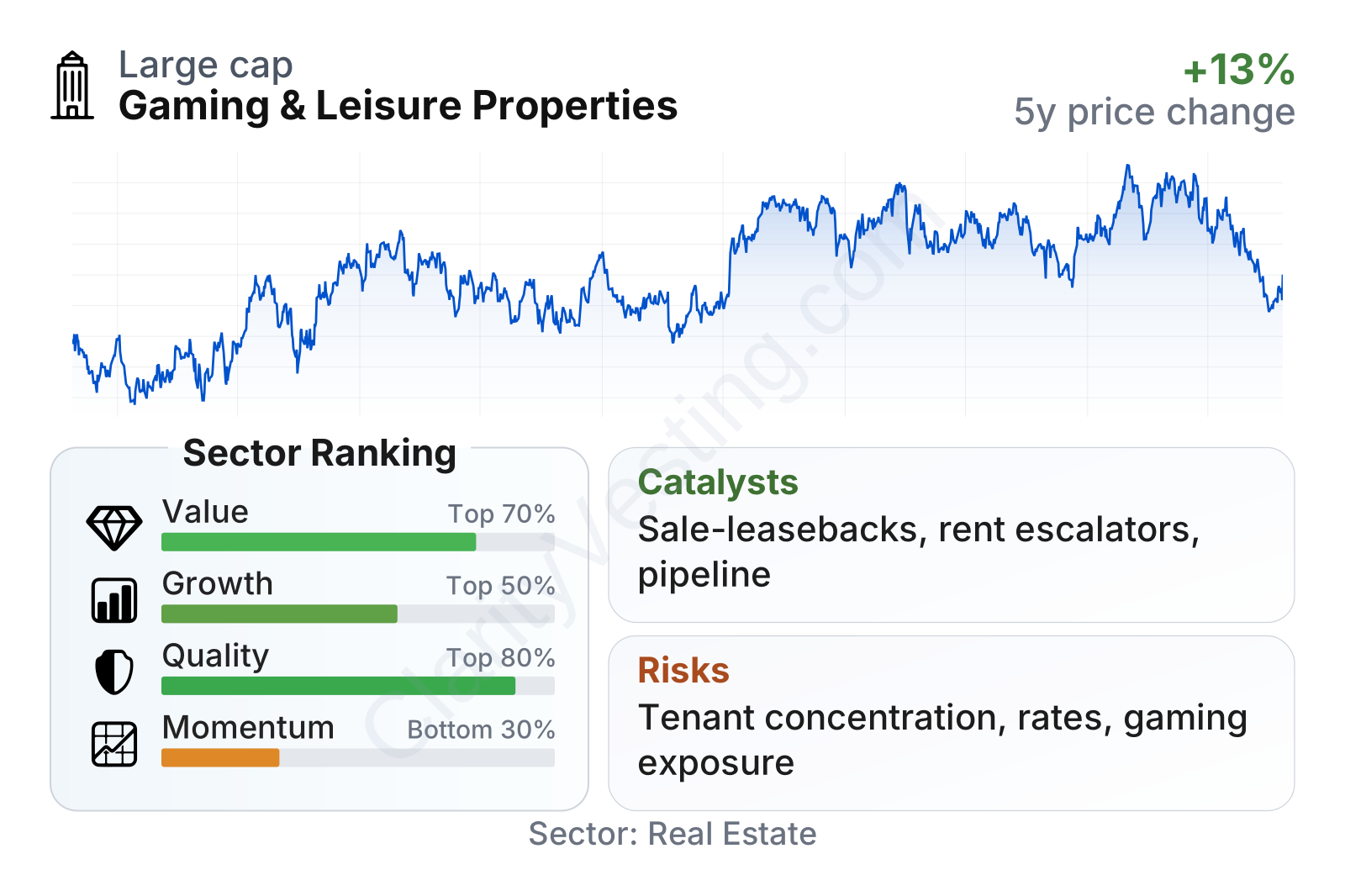
GLPI is a mid-to-large-cap REIT with a relatively low beta, meaning its shares have tended to fluctuate less than the broader market. On the factor view, quality stands out most clearly: profitability and returns on capital are well above many real estate peers, supported by an unusually high operating margin for the sector. Growth is more mixed, with recent year-over-year revenue progress looking decent but longer-term per-share expansion more moderate. Value signals are also mixed: the earnings multiple is below the sector median, but the price-to-book ratio sits well above it, which is common for established REITs with valuable specialized assets. Share-price momentum has been weak recently, suggesting the market has been cautious despite solid operating metrics.
Growth
The sector GLPI operates in is not a high-growth area in the way software or semiconductors might be, but it can still produce durable expansion. Regional gaming real estate benefits from long-lived assets, high replacement costs, and lease contracts that often run for decades. For GLPI, growth usually comes from acquiring more properties, funding operator transactions, adding development partnerships, and embedding rent escalators into leases. That makes the company’s opportunity set more dependent on deal flow and capital discipline than on rapid economic change.
Its strategy makes sense for long-term expansion because it focuses on assets where GLPI has deep sector knowledge. Casino operators often prefer to recycle capital into their core operations rather than keep large amounts tied up in owned real estate. That creates room for sale-leaseback transactions, one of GLPI’s core growth engines. The company has also broadened relationships beyond a single tenant base over time, which helps support future transaction volume.
Revenue per share has risen steadily over the past five years, but at a measured pace. That is an encouraging sign because it shows that portfolio growth has generally exceeded share dilution, even if the pace has not been especially fast compared with some other real estate names.
Dividend per share has also trended upward over the longer term, although not in a perfectly straight line. Combined with a trailing dividend yield above 8%, this points to a company whose total return profile relies heavily on recurring cash distributions rather than rapid internal growth alone.
A meaningful catalyst is the continuing use of real estate monetization by gaming operators. When operators want to unlock capital, GLPI can step in as a specialist buyer and landlord. Another catalyst is lease structuring: annual escalators, CPI-linked features in some arrangements, and potential tenant investment projects can all support gradual rent growth without requiring entirely new platforms. Recent company communications have also continued to emphasize pipeline opportunities in gaming real estate and selective expansion into adjacent experiential assets, which could widen the addressable market if executed carefully.
Risks
This article is for informational purposes only and does not constitute financial advice. Some content is AI-generated. See Disclaimer


